










Vibhor Steel Tubes Limited: Odisha unit lifts capacity to 377,000 MTPA
Key highlights
- VSTL’s Unit III added 156,000 MTPA and lifted total installed capacity to 377,000 MTPA in FY26.
- VSTL invested ₹119.83 crore in the 23.98-acre Odisha plant.
- VSTL began Odisha production in June 2025, including transmission towers, high-mast poles, octagonal poles and monopoles.
- VSTL reported capacity utilisation of 176,956 MTPA in FY26, versus 151,271 MTPA in FY25.
powered by IRIS
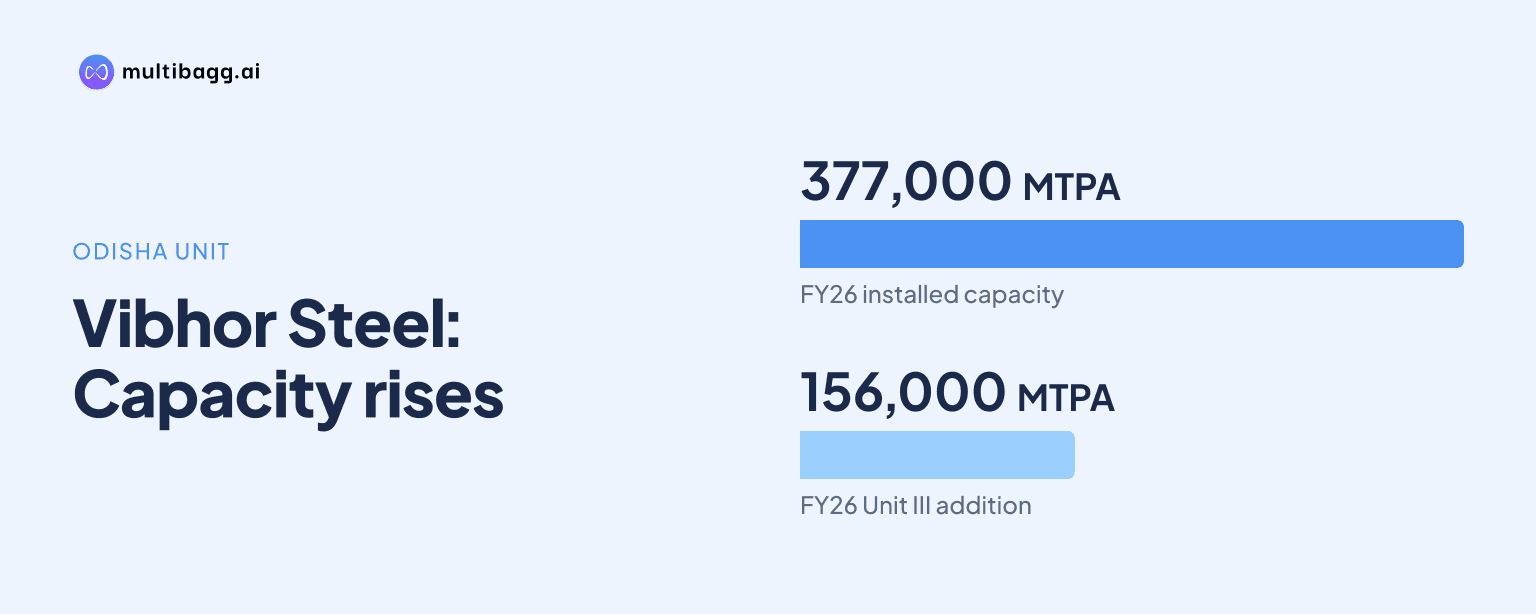
Vibhor Steel Tubes Limited’s Odisha Unit III added 156,000 metric tonnes per annum (MTPA) of capacity, lifting VSTL’s total installed capacity from 221,000 MTPA in FY25 to 377,000 MTPA in FY26. The ₹119.83 crore plant began production in June 2025 and introduced transmission towers, poles and related infrastructure products.
Know Vibhor Steel Tubes inside out
Results, valuation, peers and who's buying, in one view.
How much capacity did VSTL add through its Odisha unit?
VSTL added 156,000 MTPA through Unit III in Odisha, its largest disclosed manufacturing unit by capacity. This addition raised group installed capacity by 156,000 MTPA from 221,000 MTPA in FY24 and FY25 to 377,000 MTPA in FY26, where it remained in H1FY27.
The increase in installed capacity coincided with a rise in reported capacity utilisation to 176,956 MTPA in FY26 from 151,271 MTPA in FY25. H1FY27 utilisation was 91,033 MTPA, but it covers a partial year and cannot be directly compared with the full-year FY26 figure without annualising it.
Before Unit III, VSTL’s footprint consisted of a 125,000-MTPA Maharashtra unit and a Telangana unit whose manufacturing capacity was doubled to 96,000 MTPA through a galvanised iron, or GI, expansion in 2025. Together, these two units account for the 221,000-MTPA base shown for FY24 and FY25; Odisha added the balance to reach 377,000 MTPA.
What does VSTL manufacture at the Odisha plant?
VSTL began commercial production of transmission line towers at Unit III in Sundargarh, Odisha, in June 2025. The facility also began making transmission towers and poles, including high-mast poles, octagonal poles and monopoles, expanding the company beyond pipes, hollow sections and crash barriers.
The new tower capability is described as a dedicated power-transmission infrastructure facility. Its transmission towers serve the power-infrastructure category, while monopoles are intended for power transmission, telecom and urban infrastructure. Octagonal poles are listed for street lighting, power distribution, telecom and solar applications, and high-mast lighting poles for highways, airports, ports, stadiums and industrial areas.
These additions sit alongside VSTL’s established electronic resistance welded, or ERW, black pipes, hot-dipped galvanised pipes, hollow-section tubes and crash barriers. The product range matters because Unit II in Telangana produces ERW black pipes, hot-dipped galvanised pipes and crash barriers, whereas Unit III is specifically identified as the production location for transmission line towers from June 2025.
VSTL’s pipe portfolio continues to cover water transport, oil and gas and non-toxic-fluid applications through ERW products. Its hot-dipped galvanised pipes are used in agriculture, infrastructure, building materials, mechanical engineering, public transport and telecom, while its square and rectangular hollow sections serve offices, factories and hotels. Unit III therefore broadens the offered infrastructure formats rather than replacing these existing product categories.
Got a follow-up? Ask IRIS
Why is VSTL’s Odisha location important for distribution?
VSTL says its 23.98-acre Odisha site is located near India’s largest iron market, a position intended to support cost-efficient sourcing and supply reliability. Management also identifies the plant as a route to serve North-East and Visakhapatnam-South markets more efficiently, adding an eastern manufacturing base to Maharashtra and Telangana.
The geographic roles of the three factories are distinct in the presentation. The Maharashtra plant supplies Maharashtra, Gujarat and Madhya Pradesh, and all export revenue is derived from that plant because of its location. The Telangana plant is about 70 kilometres from Hyderabad in Mahabubnagar district, near the Jadcherla Industrial Area, while Odisha is positioned for the North-East and Visakhapatnam-South regions.
VSTL also operates a warehouse in Hisar, Haryana, with storage capacity of about 300 metric tonnes and an area of about 1,944 square yards. The warehouse supports storage and distribution across North India and complements the three manufacturing units, creating a separate logistics point from the new Odisha production site.
Input sourcing is central to the stated Odisha rationale. VSTL says proximity to the iron market can improve input-cost efficiency, while automated production is intended to support productivity, quality and consistency. Those are management-stated operating mechanisms, not quantified savings or margin outcomes in the presentation.
What did the Odisha project cost and what should investors watch?
VSTL built Unit III at an investment of ₹119.83 crore. The project is material to the manufacturing footprint because its 156,000-MTPA capacity exceeds Maharashtra’s 125,000 MTPA and Telangana’s 96,000 MTPA capacities individually, and it started production in June 2025.
The immediate operating evidence is that group capacity utilisation rose by 25,685 MTPA in FY26 from FY25, even as installed capacity increased by 156,000 MTPA. The presentation does not separately disclose Odisha production, tower sales, plant utilisation, customer contracts, order book, revenue or profitability for Unit III, so the direct financial contribution of the new plant cannot be determined from the supplied material.
VSTL does disclose a long-term manufacturing and supply relationship with Jindal Pipes Limited for the Jindal Star brand, including minimum assured annual order flow. The presentation says this arrangement supports capacity utilisation and revenue visibility, but it does not state whether the order flow is allocated to Odisha, transmission towers or any particular product line.
For the wider market context, management points to roads, railways, transmission lines and housing demand, and cites more than 191,000 circuit kilometres of transmission-line additions in India by FY32. That sector figure provides the demand backdrop cited by management, but the presentation does not quantify VSTL’s potential share of those projects or expected tower volumes.
Conclusion
VSTL’s Odisha Unit III changed the company’s manufacturing scale from 221,000 MTPA in FY25 to 377,000 MTPA in FY26 and added products such as transmission towers, monopoles, octagonal poles and high-mast poles. The ₹119.83 crore investment also places production in Odisha for the North-East and Visakhapatnam-South markets, alongside existing Maharashtra and Telangana operations.
The next disclosed benchmark is VSTL’s FY28 vision: management expects execution of its strategic priorities to create about 50% upside in overall revenue while focusing on improving earnings before interest, tax, depreciation and amortisation (EBITDA) and profit-after-tax margins. Investors can watch future disclosures for Unit III utilisation, tower and pole sales, and whether the 377,000-MTPA footprint converts into reported revenue and margin progress.