










Mahamaya H1 FY27 revenue rises 29.5% and margin reaches 10.95%
Key highlights
- Mahamaya reported H1 FY27 revenue from operations of Rs 211.63 crore, up 29.52% year on year.
- H1 FY27 EBITDA rose 41.54% year on year to Rs 23.16 crore and EBITDA margin reached 10.95%.
- H1 FY27 profit after tax increased 38.00% year on year to Rs 11.55 crore, with a 5.46% PAT margin.
- Short-term borrowings were Rs 111.69 crore at September 2026, compared with Rs 87.17 crore at March 2026.
powered by IRIS
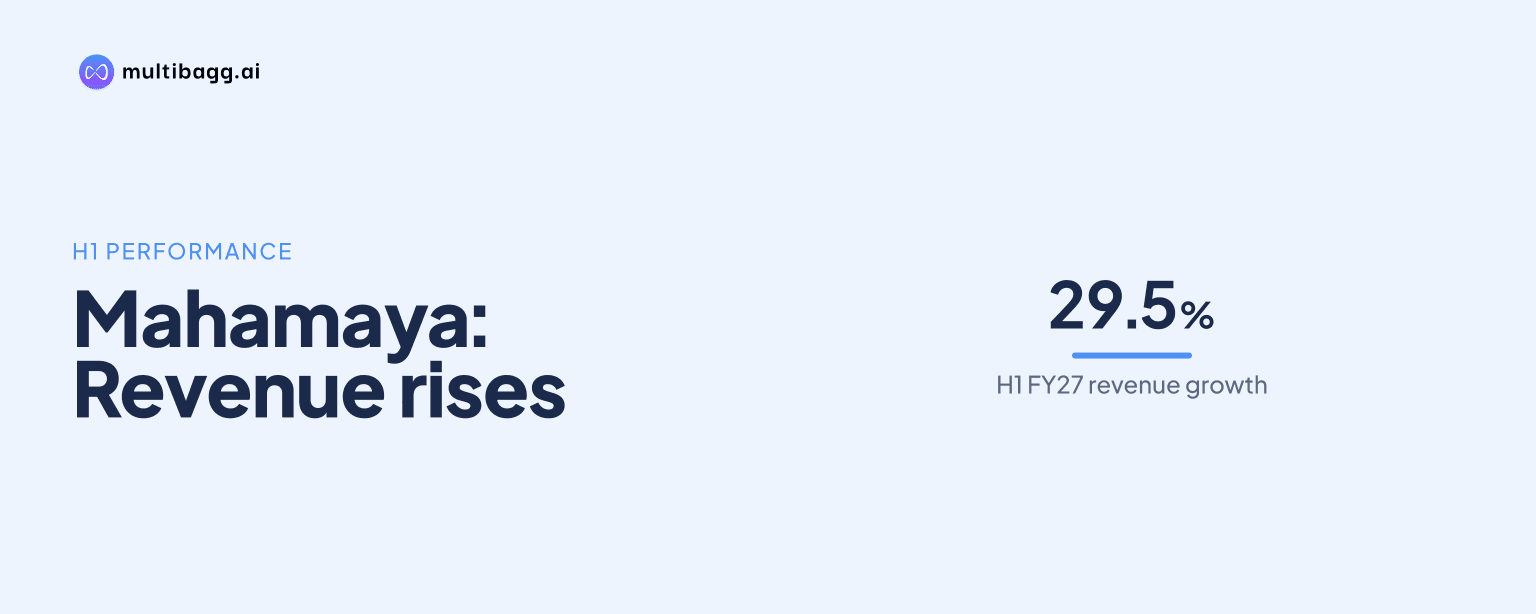
Mahamaya Lifesciences Limited reported consolidated H1 FY27 revenue from operations of Rs 211.63 crore, 29.52% above H1 FY26, as EBITDA margin rose 93 basis points to 10.95%; EBITDA increased 41.54% to Rs 23.16 crore and profit after tax rose 38.00% to Rs 11.55 crore.
Know Mahamaya Lifesciences inside out
Results, valuation, peers and who's buying, in one view.
What drove Mahamaya's H1 FY27 revenue growth?
Mahamaya's revenue from operations, including other operating income, reached Rs 211.63 crore in H1 FY27, compared with Rs 163.39 crore in H1 FY26 and Rs 165.90 crore in H2 FY26. This represented 29.52% year-on-year growth and 27.57% half-on-half growth, making H1 FY27 the highest of the three half-year periods presented.
The management commentary cites revenue growth of 29.78% to Rs 211.63 crore, while the highlights table and consolidated profit and loss statement show 29.52%. The underlying revenue figure is the same in both disclosures, and the difference is limited to the stated percentage growth rate.
Mahamaya operates across agrochemical and plant-nutrition products, including herbicides, insecticides, fungicides, plant growth regulators, biopesticides and bio-fertilisers. The presentation lists more than 500 product registrations, more than 50 branded products, a network of more than 400 dealers and distributors, and operations in 10 states.
How did Mahamaya's profitability change in H1 FY27?
Mahamaya's EBITDA, or earnings before interest, tax, depreciation and amortisation, rose 41.54% year on year to Rs 23.16 crore in H1 FY27 from Rs 16.36 crore. Its EBITDA margin increased to 10.95% from 10.02% in H1 FY26, a 93-basis-point improvement, where one basis point is one-hundredth of a percentage point.
The H1 FY27 EBITDA margin was also above the 10.79% reported in H2 FY26 and the 10.41% reported for FY26. Revenue increased 29.52% year on year while EBITDA increased 41.54%, although the presentation does not provide a product-level breakdown of profitability by technical, formulation, branded or export sales.
Profit after tax, or PAT, rose 38.00% year on year to Rs 11.55 crore from Rs 8.37 crore in H1 FY26. PAT was 41.62% above Rs 8.15 crore in H2 FY26, while PAT margin reached 5.46%, compared with 5.13% in H1 FY26 and 4.92% in H2 FY26.
What did Mahamaya's costs show in H1 FY27?
Mahamaya reported total income of Rs 212.43 crore in H1 FY27, up 29.27% from Rs 163.70 crore in H1 FY26, while total expenditure rose 28.46% to Rs 189.26 crore. The lower growth in expenditure than total income coincided with EBITDA increasing to Rs 23.16 crore from Rs 16.36 crore.
Cost of materials consumed increased 27.67% year on year to Rs 177.95 crore, while employee benefit expense rose 33.93% to Rs 5.19 crore. Other expenses increased 50.33% year on year to Rs 6.13 crore, but declined 28.46% from Rs 8.56 crore in H2 FY26.
Below EBITDA, depreciation and amortisation increased 30.34% year on year to Rs 1.43 crore and finance cost rose 60.79% to Rs 6.19 crore. Profit before tax was Rs 15.54 crore, up 36.18% from Rs 11.41 crore, while tax expense increased 31.20% to Rs 3.99 crore.
Got a follow-up? Ask IRIS
What is Mahamaya changing in its sales mix and manufacturing?
Mahamaya said formulation and branded products are making an increasing contribution to sales, while technical sales continue to provide its revenue base. Management said this mix is intended to add value and diversify the portfolio, but the presentation does not disclose H1 FY27 revenue or margins for formulation, branded, technical or export segments.
The company has four stated channels: bulk formulation supply to domestic and multinational agrochemical companies, technical sales of pesticide active ingredients, domestic branded crop-protection sales and exports through distribution partners. Its listed export markets are the Dominican Republic, Turkey, Egypt and the UAE, with UAE operations conducted through a subsidiary.
Management said it plans to expand solid and liquid formulation capacity and pursue backward integration into technical manufacturing at Dahej. The presentation lists annual solid formulation capacity of 1,040 metric tonnes and annual liquid formulation capacity of 13 lakh litres, alongside planned backward-integration investment of about Rs 30 crore without a stated timetable or capacity target.
How did Mahamaya's balance sheet change by September 2026?
Mahamaya's total balance sheet increased to Rs 375.84 crore at September 2026 from Rs 310.28 crore at March 2026. Shareholders' funds rose to Rs 133.47 crore from Rs 121.93 crore, as reserves and surplus increased to Rs 110.07 crore from Rs 98.52 crore while share capital remained Rs 23.41 crore.
Current assets rose to Rs 325.18 crore from Rs 266.45 crore, including inventory of Rs 154.46 crore, trade receivables of Rs 90.92 crore and cash and bank balances of Rs 63.33 crore. At March 2026, the respective figures were Rs 141.05 crore, Rs 70.76 crore and Rs 39.40 crore.
Current liabilities increased to Rs 233.81 crore at September 2026 from Rs 183.13 crore at March 2026. Short-term borrowings rose to Rs 111.69 crore from Rs 87.17 crore, while trade payables increased to Rs 95.87 crore from Rs 64.44 crore; long-term borrowings rose to Rs 6.57 crore from Rs 3.57 crore.
Conclusion
Mahamaya's H1 FY27 results combined 29.52% revenue growth with faster EBITDA growth of 41.54% and PAT growth of 38.00%. The company reported an EBITDA margin of 10.95% and PAT margin of 5.46%, both above H1 FY26 and H2 FY26, while finance cost increased 60.79% year on year to Rs 6.19 crore.
The next disclosed developments to watch are management's planned expansion of solid and liquid formulation capacity and its approximately Rs 30 crore backward-integration investment at Dahej. Management also identifies new product registrations, biological crop-care solutions, in-house research and development, and domestic and international expansion as priorities, but has not disclosed execution dates or quantitative targets.