










Faze Three FY27 capex to free 40-50% operating cash flow
Key highlights
- Faze Three expects Rs 1,950 crore-plus of installed revenue capacity after FY27 capex concludes by March 2027.
- Faze Three says 40% to 50% of cash flow from operations could be available for alternative uses after the major FY27 capex cycle ends.
- Faze Three deployed Rs 481.3 crore in capex and fixed assets from FY20 through H1 FY27.
- Faze Three reported Q2 FY27 total income of Rs 267.82 crore, up 29.14% year on year.
powered by IRIS
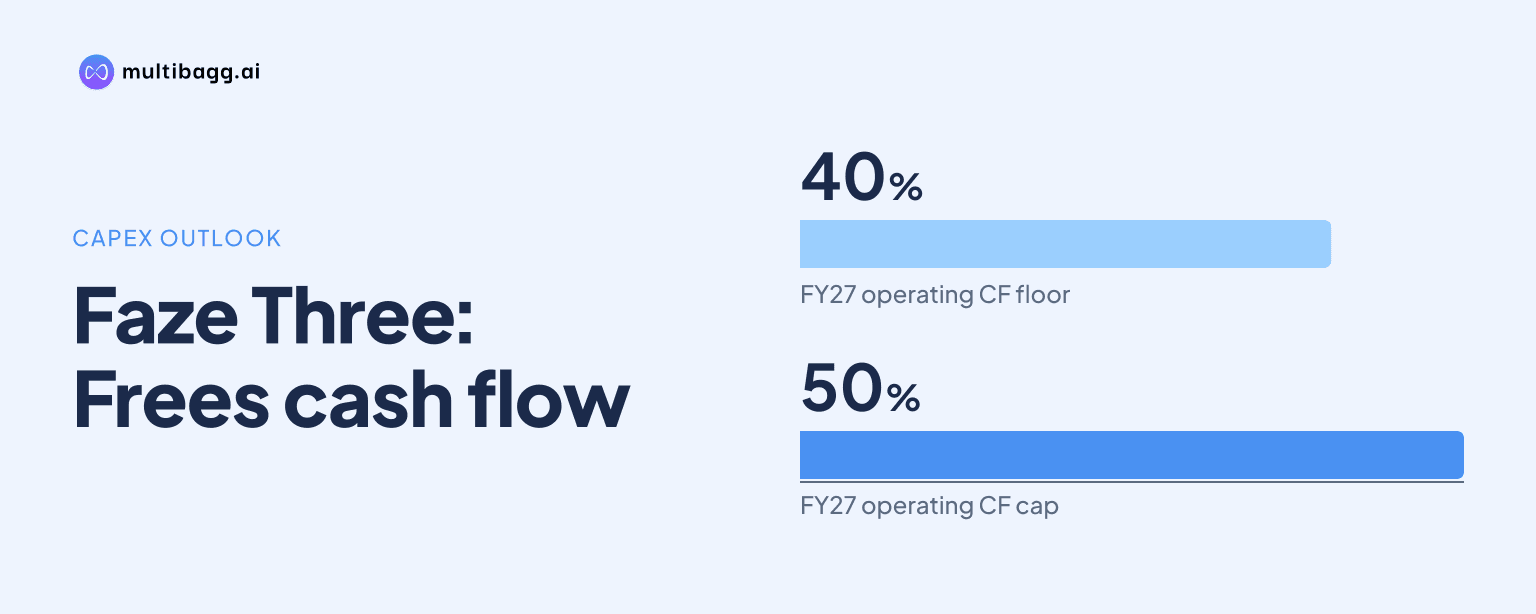
Faze Three Limited says completion of its FY27 capital-expenditure cycle by March 2027 is expected to create more than Rs 1,950 crore of installed annual revenue capacity and make 40% to 50% of cash flow from operations available for debt reduction, shareholder returns, working-capital optimisation or further expansion.
Know Faze Three inside out
Results, valuation, peers and who's buying, in one view.
How much capacity will Faze Three have after FY27 capex?
Faze Three expects installed revenue capacity across all units to exceed Rs 1,950 crore when its current capex programme concludes by March 2027. The company has invested more than Rs 480 crore since FY20, mostly from internal accruals, to expand technical and home-textile manufacturing across eight factory locations.
The capacity base is materially above current sales. Trailing-12-month revenue to September 2026 was Rs 1,012.6 crore, compared with about Rs 300 crore in FY21, while average utilisation across the Rs 1,950 crore-plus installed base was 52% to 55%. Management therefore says revenue can nearly double without significant incremental capex, subject to customer demand and execution.
Man-made fibre, or MMF, includes the Silvassa floor-covering, performance-rug, technical-textile and outdoor-product operations. Faze Three says the FY27 programme will add new product capabilities by the first quarter of FY28, while new product categories are scheduled to go live in FY28.
Why does capex completion change Faze Three's cash allocation?
Faze Three says the conclusion of the major FY27 capex cycle would make 40% to 50% of cash flow from operations, or CFO, available for alternative uses. Management identifies debt reduction, working-capital optimisation, shareholder returns and opportunity-based expansion as possible uses, without specifying an allocation among them.
The cash-flow record shows the scale of the investment cycle. From FY20 through H1 FY27, Faze Three generated cumulative CFO of Rs 324.6 crore but deployed Rs 481.3 crore in investing and fixed assets. In H1 FY27, CFO was Rs 81.7 crore, including a Rs 39.7 crore working-capital release, while investing cash flow and fixed-asset spending were Rs 117.6 crore.
H1 FY27 investment spending was funded by operating cash flow, realisation of non-current assets and Rs 17.1 crore of incremental borrowings. Net fixed assets rose to Rs 467.5 crore at September 30, 2026 from Rs 366.8 crore at March 31, 2026, showing that the programme continued to require capital as capacity was being added.
Got a follow-up? Ask IRIS
Is Faze Three already showing operating leverage?
Faze Three reported higher operating leverage in Q2 FY27, when consolidated total income reached Rs 267.82 crore, up 29.14% from Rs 207.39 crore in Q2 FY26. Earnings before interest, depreciation, tax and amortisation, or EBITDA, were Rs 35.59 crore, and the EBITDA margin was 13.29%, compared with 11.52% in Q1 FY27.
The year-on-year comparison includes an unusually low base. Faze Three says Q2 FY26 EBITDA margin of 2.66% was affected by a one-time mark-to-market impact on United States dollar-rupee forward contracts and then-prevailing 50% United States tariffs on India. Q2 FY27 profit after tax was Rs 15.46 crore, against a Rs 5.22 crore loss a year earlier, while cash profit rose to Rs 24.31 crore from Rs 2.43 crore.
For H1 FY27, revenue was Rs 502.9 crore, up 18.9% year on year, and management said the H2 FY27 order book was strong. On a trailing-12-month basis, revenue increased to Rs 1,012.6 crore from Rs 932.8 crore in FY26, while EBITDA margin improved to 11.93% from 9.89%, which management attributes to higher revenue, customer repricing and better United States dollar-rupee realisation.
What could affect Faze Three's cash-flow inflection?
Faze Three's stated cash-flow shift depends on the planned FY27 capex completion, input costs and customer repricing. Management said cotton, polyester, chemicals, fuel, packaging and logistics costs remained elevated versus pre-crisis levels in H2 FY27, although repricing and upcharge requests were under way and United States dollar-rupee realisation provided a partial offset.
The September 2026 balance sheet gives context for management's stated debt-reduction option. Net short-term borrowings were Rs 192.4 crore at September 30, 2026, up from Rs 175.3 crore at March 31, 2026, while net debt to EBITDA declined to 1.92 times from 2.33 times in FY26. The cash conversion cycle improved to 77 days from 99 days, as debtor days fell to 42 from 45, although inventory days rose to 86 from 78.
Management expects FY27 revenue growth of around 20% or more and expects FY28 revenue momentum to be stronger as new categories and opportunities with existing customers emerge. The company received Production Linked Incentive approval on July 1, 2026 and expects benefits to accrue from FY28, but the presentation does not quantify the financial benefit.
Conclusion
Faze Three's stated inflection rests on moving from an investment cycle to using the resulting capacity. Capex and fixed-asset investment totalled Rs 481.3 crore from FY20 through H1 FY27, creating Rs 1,950 crore-plus of potential revenue capacity, while trailing-12-month revenue was Rs 1,012.6 crore and average utilisation was 52% to 55%.
The next disclosed milestones are the expected completion of FY27 capex by March 2027 and the launch of new product capabilities in Q1 FY28. Management's outlook also leaves input costs, customer repricing, working-capital movements and the eventual allocation of 40% to 50% of CFO among debt reduction, shareholder returns or expansion as matters to watch.