










Filatex Ecosis starts with 7,000-8,000 tonne commitments
Key highlights
- Filatex disclosed Ecosis commitments of about 7,000-8,000 tonnes against 27,000 tonnes of annual capacity.
- Ecosis started depolymerisation and purification on 15 November 2026, with polymerisation expected by the first week of December 2026.
- Filatex expects Ecosis utilisation of 40%-50% in Q4 FY27 and full production by the middle of FY28.
- Management expects Decathlon and A&E order placements to begin by the end of December 2026 at the latest.
powered by IRIS
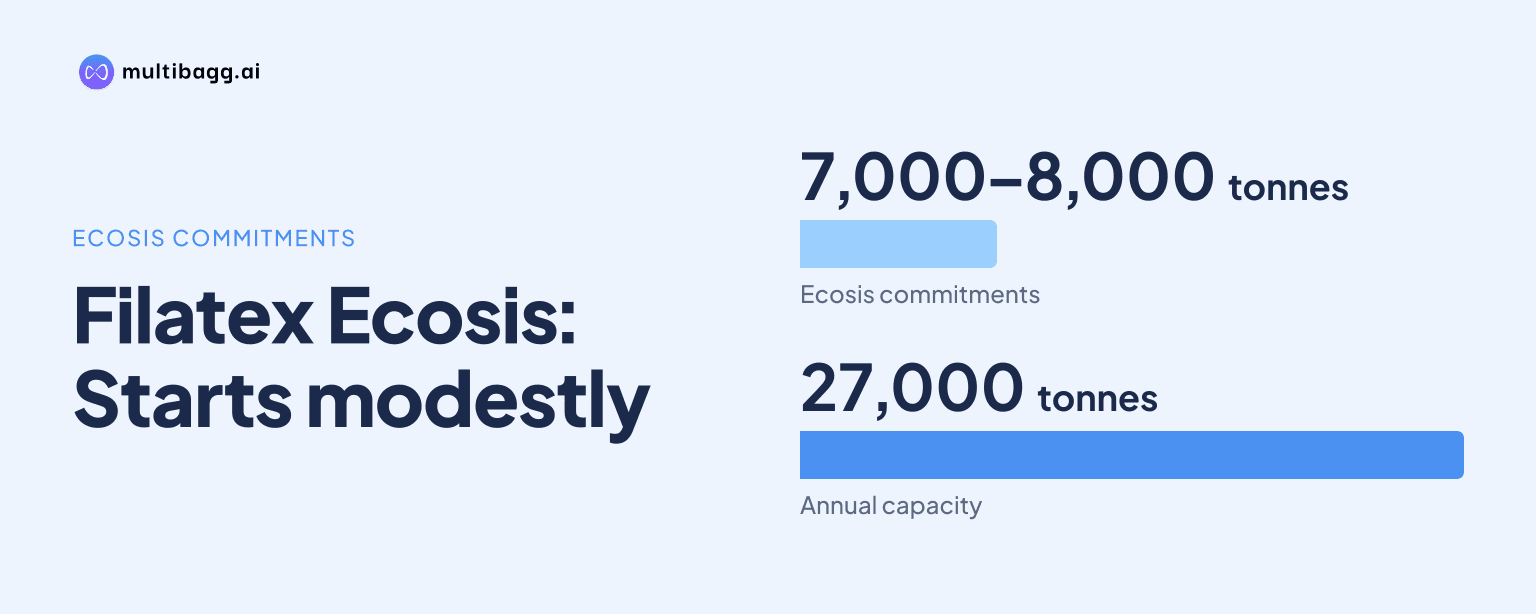
Filatex India Limited said its Ecosis textile-to-textile recycling plant has initial customer volume commitments of about 7,000-8,000 tonnes against annual capacity of about 27,000 tonnes. Filatex expects 40%-50% capacity utilisation in Q4 FY27 and a gradual ramp to full production by the middle of FY28.
Know Filatex India inside out
Results, valuation, peers and who's buying, in one view.
How much Ecosis capacity is covered by customer commitments?
Ecosis has commitments for about 7,000-8,000 tonnes, equal to roughly 26%-30% of its stated 27,000-tonne annual capacity. Filatex said the commitments include Decathlon, A&E, H&M and some IKEA buyers, while discussions with three other large European brands were continuing during its Q2 and H1 FY27 earnings call.
Filatex described the initial commitments as minimum volumes rather than the project’s prospective sales ceiling. Ecosis Chief Executive Officer Kapil Kumra said brands provide forecasts across seasonal buying cycles and volumes could rise after the first six months if product performance, testing outcomes and market conditions meet their requirements. He added that each named large customer could potentially absorb a significant share of the 27,000-tonne output.
When will Ecosis begin commercial orders and production?
Ecosis started depolymerisation and purification activities on 15 November 2026, while polymerisation was expected to start by the first week of December 2026. Filatex said product quality had not yet been established at the time of the call because depolymerisation had only just begun, although samples submitted for customer testing had met stipulated specifications.
Filatex expects orders from Decathlon and A&E to start by the end of December 2026 at the latest, subject to remaining review steps. Decathlon was due to visit the factory in the following weeks to verify the facility, including social-compliance requirements and final product quality. A&E had completed its audits and expected final test results for further products from China by mid-December 2026.
H&M had approved Ecosis as a global supplier in the week before the call, and Filatex said it had received H&M projections for the next six months. IKEA had approved certain products, according to management, with activation also expected by the end of December 2026. These approvals and projections do not mean the entire 27,000-tonne plant is contracted, because Filatex separately put confirmed initial volume commitments at 7,000-8,000 tonnes.
Why will Ecosis operate below full capacity in FY27?
Filatex said Ecosis will operate at around 40%-50% capacity utilisation in Q4 FY27 rather than reaching full production immediately after commissioning. At annual capacity of 27,000 tonnes, that range equates to an annualised output rate of about 10,800-13,500 tonnes, although actual quarterly production will depend on the timing and pace of the ramp.
Management said customers need to inspect the commercial facility, validate production and conduct product trials before making larger commitments. Filatex said a customer audit typically takes two to three weeks, followed by testing, and commercial orders could begin within about one month of a visit. The process can extend to two or three months when brands test not only recycled chips and yarn but also fabric, garments or footwear made from the material.
The project is a first-of-its-kind installation for Filatex, combining imported and Indian-fabricated equipment. Filatex said the arrival of much of the machinery after March, less predictable shipping schedules amid disruption in West Asia, turbine-delivery issues and shortages of skilled installation labour had moved timelines by a few weeks. Management said these delays did not relate to technology, product approval or the project’s underlying fundamentals.
Got a follow-up? Ask IRIS
What customer approvals and market demand does Ecosis have?
Ecosis signed memorandums of understanding, or MOUs, with Decathlon and A&E while the project was under construction. Filatex said the commercial focus has shifted from framework MOUs to customer audits, volume commitments and direct purchase orders because production is approaching. A&E sought an exclusive co-branded relationship, according to management, under which it would use Ecosis as its sole supplier for that arrangement.
Management said Ecosis was actively talking to 23 brands, while Decathlon, H&M, IKEA and A&E were already familiar with textile-to-textile, or T2T, recycled polyester through sourcing from China. Ecosis management cited an estimated 120,000-130,000 tonnes of T2T polyester already consumed in the market, primarily from China. The customer discussions therefore concern an alternative supply source outside China rather than introducing an unfamiliar material to those brands.
Filatex said brand demand is being supported by internal sustainability objectives and anticipated European requirements. Management referred to an extended producer responsibility framework adopted in August, with targets for T2T polyester content in apparel sold in Europe expected to be set over the next 12 months. Those regulatory targets were not specified on the call, leaving their eventual effect on Ecosis demand unquantified.
What does Filatex expect from Ecosis after commissioning?
Filatex expects Ecosis to become earnings before interest, tax, depreciation and amortisation, or EBITDA, positive in Q4 FY27, which management described as its first quarter of decent operation at 40%-50% utilisation. This is a management expectation rather than reported profitability, as Filatex had only started depolymerisation and purification on 15 November 2026.
Management expects utilisation to rise gradually after Q4 FY27 and reach full production by the middle of FY28. The stated timing means the gap between initial commitments of 7,000-8,000 tonnes and 27,000 tonnes of capacity will need to be addressed through additional customer approvals, repeat buying and higher commitments from existing brands during the ramp period.
Ecosis is part of Filatex’s wider capital-expenditure programme of about Rs 690 crore. The recycling project involves Rs 300 crore, while the Dahej expansion involves Rs 235 crore and adds about 55,000 tonnes of annual partially oriented yarn, fully drawn yarn and draw textured yarn capacity. Filatex said 67% of the Dahej expansion had been commissioned, with the remaining fully drawn yarn lines due by 23 November 2026.
Conclusion
Filatex has established an initial commercial base for Ecosis, but the disclosed 7,000-8,000 tonnes of commitments do not yet fill its 27,000-tonne annual recycling capacity. The disclosed operating sequence is therefore a staged ramp, with customer validation and trials preceding potentially larger orders from Decathlon, A&E, H&M, IKEA and other brands under discussion.
The next milestones are polymerisation by the first week of December 2026, A&E’s expected test results by mid-December and anticipated order placements by the end of December 2026. Filatex’s subsequent operating targets are 40%-50% Ecosis utilisation and EBITDA positivity in Q4 FY27, followed by full production by the middle of FY28.