










FILATEX targets FY28 core EBITDA of ₹10-₹12 per kg
Key highlights
- FILATEX said FY28 core-business EBITDA could reach ₹10-₹12 per kg.
- Management said overall FY28 EBITDA margin could be 11%-12%, compared with 14%-15% in FY22.
- GAIL and Indian Oil PTA plants would add 2.45 million tonnes of capacity against India’s roughly 2.2 million tonnes of imports.
- FILATEX aims for around ₹85 crore-₹90 crore of Ecosis EBITDA in FY28.
powered by IRIS
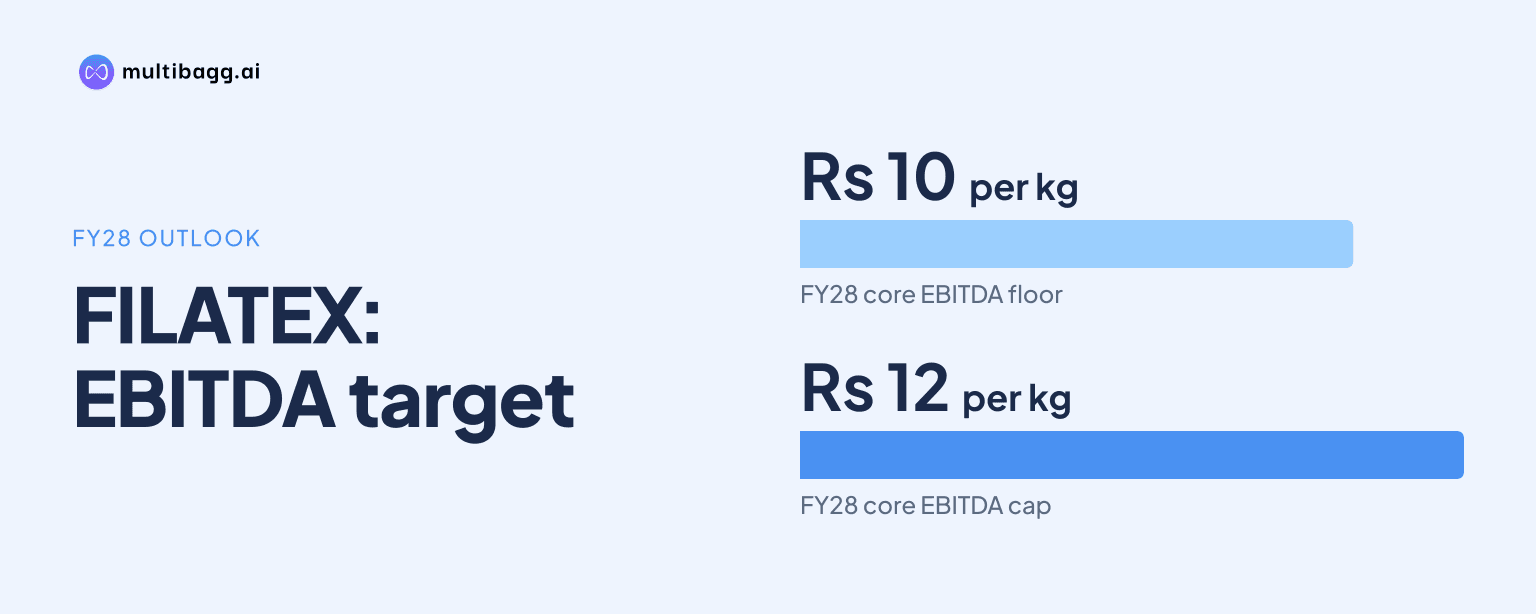
FILATEX said its core business could generate EBITDA of ₹10-₹12 per kg in FY28, while overall EBITDA margin could be 11%-12% rather than FY22’s 14%-15%. Management said domestic purified terephthalic acid supply, prospective trade benefits, higher volumes, Ecosis and the steam project could lift absolute EBITDA beyond the FY22 level.
Know Filatex India inside out
Results, valuation, peers and who's buying, in one view.
What profitability is FILATEX targeting for FY28?
FILATEX is targeting core-business earnings before interest, tax, depreciation and amortisation, or EBITDA, of ₹10-₹12 per kg in FY28, while management said overall EBITDA margin might reach 11%-12%. Management clarified that its comparison with FY22 was about absolute EBITDA, not a return to the 14%-15% margin reported in that earlier period.
Management said it does not focus on margin percentage because revenue, or top line, can be distorted by crude-price movements. Its FY28 case is that increased volumes, Ecosis and the steam project could enable FILATEX to exceed FY22 absolute EBITDA even if the margin remains below the FY22 percentage.
The ₹10-₹12 per kg indication applies to the core business, with management saying that the additional projects it has discussed would add to that outcome. FILATEX did not provide a separate FY28 core-volume forecast, so the eventual absolute EBITDA would depend on both output volumes and the per-kg result.
Why does FILATEX expect core EBITDA per kg to improve?
FILATEX expects new domestic purified terephthalic acid, or PTA, supply and a European Union free-trade agreement, or FTA, to improve core-business economics. Management said GAIL’s 1.25 million-tonne PTA plant had started commercial production and was expected to reach the market by the end of that month, while Indian Oil was likely to begin production from April 2027.
Management said the GAIL and Indian Oil facilities would provide 2.45 million tonnes of PTA capacity, against India’s roughly 2.2 million tonnes of imports. FILATEX expects that additional availability to virtually remove the domestic shortage, improve raw-material pricing and reduce the cost and effort of importing PTA. Management gave no PTA-price forecast.
Management also identified an EU FTA as a demand-side trigger. It said the European Union is the world’s biggest textile market and that Indian exporters have faced a disadvantage versus Vietnam, Cambodia and Bangladesh. If India reaches parity with those exporters, management expects textile exports to rise; it also said the current 4%-5% duty on yarn exports could fall to zero.
Got a follow-up? Ask IRIS
How could Ecosis and the steam project add to EBITDA?
FILATEX expects Ecosis and the steam project to contribute in addition to core-business EBITDA, rather than determine the ₹10-₹12 per kg target by themselves. An analyst referred to about ₹200 crore of EBITDA from new projects, but management did not confirm that as a formal combined forecast. It said the additional projects should add to the core-business contribution.
For Ecosis, management said it aimed to deliver around ₹85 crore-₹90 crore of EBITDA in FY28 and that the outcome could be better. It did not provide an FY28 revenue projection because it could not state the top line. Management nevertheless said Ecosis should be EBITDA-positive in the fourth quarter, its first quarter of decent operations, at expected utilisation of 40%-50%.
Ecosis converts waste fabric into chips, after which the downstream process is the same as for virgin chips; FILATEX can also arrange job work to supply yarn. Management said it was looking for a ₹30-₹35 per kg margin on recycled chips. It expects both domestic and export sales, and said exports could be close to 50% of the mix, although the final split remains uncertain.
The steam project is another identified earnings source. Management said it had signed offtake agreements for roughly 42 tonnes, of which 22-24 tonnes were to start from the 20th and the balance by mid-December. It hoped to sell its full 65 tonnes per hour by the end of January and said the stated ₹60 crore-₹65 crore EBITDA gain from lower conversion cost should begin from the middle of the fourth quarter.
When could FILATEX reach its FY28 earnings profile?
FILATEX said the FY28 profile depends on a gradual ramp-up, not immediate full utilisation. Management expected the first commercial Ecosis product by December 10-15, while a customer’s plant audit, sampling and testing could take one to three months. It expected Decathlon, A&E, IKEA and H&M to begin orders or deliveries by the end of December, subject to their respective approvals.
Management said new recycling capacity takes 18-24 months to build. FILATEX has disclosed plans for two 150,000-tonne plants, one in India and one in Vietnam, with commissioning targeted for the first quarter of calendar year 2029. Those plants are outside the immediate FY28 objective and remain subject to execution of the stated plan.
In the existing polyester operations, FILATEX said 67% of its brownfield expansion had been commissioned and the remaining 33% of lines were expected to start by the following week. Management said utilisation has generally been close to 95%, with 4%-5% production cuts at lean times or during shutdowns. That indicates the FY28 plan relies principally on spreads, raw-material availability and new-project contributions rather than a substantial recovery in base-business utilisation.
Conclusion
FILATEX’s FY28 objective is not a forecast of a return to FY22’s 14%-15% EBITDA margin. Management instead set out core EBITDA of ₹10-₹12 per kg and an overall margin possibility of 11%-12%, while arguing that higher volumes and incremental income from Ecosis and steam could lift absolute EBITDA beyond FY22.
The next disclosures to watch are the market availability and pricing effect of GAIL’s 1.25 million-tonne PTA plant, Indian Oil’s planned April 2027 start, and the pace of Ecosis customer approvals after commercial output begins. Management’s stated FY28 Ecosis aim of around ₹85 crore-₹90 crore of EBITDA and its first-quarter calendar 2029 target for two 150,000-tonne recycling plants are the subsequent milestones.