










Filatex India maps Rs 690 crore plan targeting Rs 195–205 crore EBITDA
Key highlights
- Filatex’s FY26–27 five-project capital programme totals Rs 690 crore.
- The disclosed ECOSIS, PFY and steam targets total about Rs 195–205 crore of annual steady-state EBITDA.
- The renewable-energy project is intended to raise renewables’ share of captive power consumption from about 26% to about 55%.
- The PFY expansion adds about 55,000 TPA against Filatex’s FY26 installed PFY capacity of 417,240 TPA.
powered by IRIS
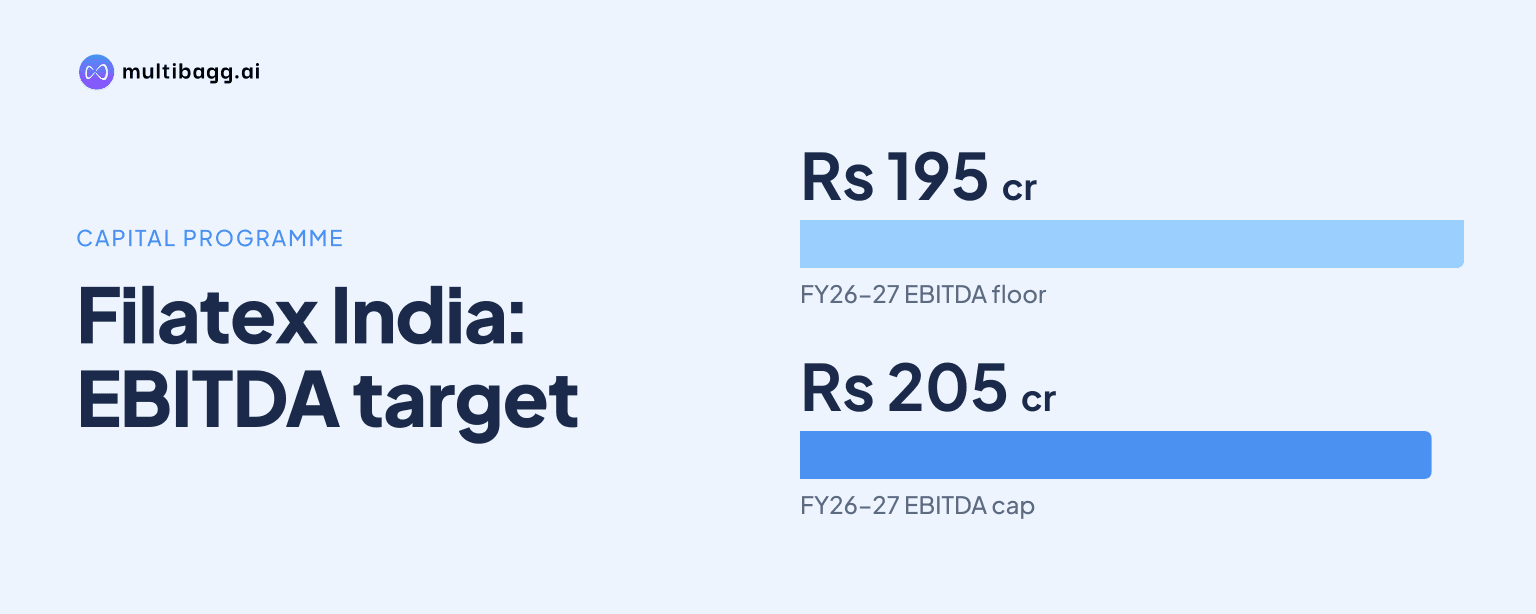
Filatex India has set out a Rs 690 crore FY26–27 programme whose three quantified earnings projects target a combined Rs 195–205 crore of annual steady-state EBITDA, while renewable power is expected to save Rs 18–20 crore annually. The five projects span textile recycling, polyester filament yarn expansion, steam sales, renewable energy and automation, with commissioning scheduled from November 2026 to January 2027.
Know Filatex India inside out
Results, valuation, peers and who's buying, in one view.
What does Filatex’s Rs 690 crore plan include?
Filatex’s plan comprises five projects: a Rs 300 crore ECOSIS textile-recycling facility, a Rs 235 crore polyester filament yarn, or PFY, brownfield expansion, Rs 30 crore for renewable power, an Rs 85 crore steam-distribution platform and Rs 40 crore for automated doffing and packing. The company presents the combined Rs 690 crore outlay as its FY26–27 growth transformation programme.
Three projects have disclosed annual earnings targets at steady state: ECOSIS at about Rs 75–80 crore of EBITDA, PFY expansion at about Rs 60 crore, and steam distribution at about Rs 60–65 crore. EBITDA means earnings before interest, tax, depreciation and amortisation. The renewable-energy project has an expected annual saving of Rs 18–20 crore, while Filatex has not disclosed a numerical savings or EBITDA target for automation.
Which Filatex projects have earnings targets?
Filatex’s largest capital allocation is the Rs 300 crore ECOSIS Ltd greenfield project, which is designed to convert end-of-life textiles into virgin-grade polymer and yarn. The 27,000 tonnes per annum, or TPA, facility has a disclosed steady-state EBITDA target of about Rs 75–80 crore a year and is expected to be commissioned by the end of December 2026.
ECOSIS has memorandums of understanding with Decathlon India and American & Efird Global, LLC for the use of high-quality recycled polyester. Filatex says its recycling development is supported by its Department of Scientific and Industrial Research-approved research and development centre, a granted patent and a pilot plant with capacity of 1 tonne per day, but it does not disclose contracted customer volumes, feedstock volumes or pricing.
The Rs 235 crore PFY brownfield expansion is expected to add about 55,000 TPA, predominantly in partially oriented yarn, fully drawn yarn and draw textured yarn. Filatex targets about Rs 60 crore of annual EBITDA at optimum capacity and says the project uses existing infrastructure to support faster ramp-up and a shift toward higher-value yarns.
The Rs 85 crore steam-distribution project has a stated steady-state EBITDA target of about Rs 60–65 crore annually. Filatex plans to sell excess steam, described as about 50% of output from its 30-megawatt captive power plant, to nearby industrial users; management also says the model would reduce the company’s power-generation cost.
Got a follow-up? Ask IRIS
When will Filatex commission its projects?
Filatex expects the balance of its partly commissioned PFY project, the steam-distribution platform and the automation project to be commissioned by the end of November 2026. ECOSIS is scheduled for commissioning by the end of December 2026, followed by the renewable-energy project by the end of January 2027.
The PFY expansion is the only one of the five projects that Filatex identifies as partly commissioned. The presentation does not state how much of the planned 55,000 TPA has already been commissioned, nor does it provide revenue, utilisation or EBITDA ramp-up milestones for the project.
The Rs 40 crore automation investment involves auto-doffing and packing lines with an Italian technology partner. Filatex says the November 2026 project should improve finished-goods packing efficiency and reduce manual intervention, labour-shortage risk and labour costs, without providing a productivity, headcount or cost-saving figure.
How will Filatex change its PFY and energy mix?
Filatex’s planned 55,000 TPA PFY addition compares with its FY26 installed PFY capacity of 417,240 TPA. The company says it has sustained utilisation above 90% across business cycles, while the expansion is intended to increase output of fully drawn yarn, draw textured yarn and partially oriented yarn.
The Rs 30 crore renewable-energy investment is intended to raise renewables’ share of captive power consumption from about 26% to about 55%. Filatex plans to source captive power from a hybrid wind-solar project in Gujarat and expects annual savings of about Rs 18–20 crore after the targeted end-January 2027 commissioning.
ECOSIS would add a 27,000 TPA circular-material stream alongside Filatex’s virgin PFY business. Filatex says recycled polymer chips can support higher conversion into fully drawn yarn and draw textured yarn, while the project’s stated output is virgin-grade polymer and yarn made from end-of-life textiles.
What execution and funding points matter for Filatex?
Filatex says the Rs 690 crore programme will be funded through internal accruals and structured debt, with management stating that leverage will remain contained. The presentation does not provide a project-level funding split, borrowing cost, repayment schedule or numerical leverage measure.
Filatex reported standalone Q2FY27 revenue of Rs 1,304.19 crore, up 21% year on year, EBITDA of Rs 91.03 crore, up 2%, and profit after tax of Rs 53.48 crore, up 12%. Its EBITDA margin was 6.98%, down 129 basis points year on year, meaning EBITDA growth trailed revenue growth in the quarter.
The projects have different commercial requirements. ECOSIS depends on recycling output and customer arrangements, the PFY project on ramping 55,000 TPA of new capacity, and steam distribution on sales to nearby industrial users; Filatex does not disclose contracted steam volumes, recycling feedstock volumes or renewable-power generation volumes.
Conclusion
Filatex’s Rs 690 crore programme combines PFY capacity, circular-material production, utility monetisation, captive renewable energy and factory automation rather than relying on conventional yarn expansion alone. The disclosed annual targets total about Rs 195–205 crore of steady-state EBITDA from ECOSIS, PFY and steam distribution, alongside Rs 18–20 crore of expected renewable-energy savings.
The next items to watch are the planned end-November 2026 commissioning of the PFY balance, steam and automation projects, ECOSIS commissioning by the end of December 2026, and renewable-energy commissioning by the end of January 2027. Filatex has yet to disclose project financing detail, contracted customer and feedstock volumes, steam-sale volumes, or the pace at which the projects could reach their stated steady-state targets.