










Filatex targets December 2026 commissioning for 27,000-TPA ECOSIS
Key highlights
- Filatex targets commissioning its 27,000-TPA ECOSIS plant from the end of December 2026.
- India generates 7,073 KTPA of textile waste, including 4,100 KTPA of post-consumer material.
- About 55% of India’s stated post-consumer textile-waste stream is currently recovered, according to Filatex.
- Filatex reported FY26 production of 389,027 tonnes and sales of 388,113 tonnes.
powered by IRIS
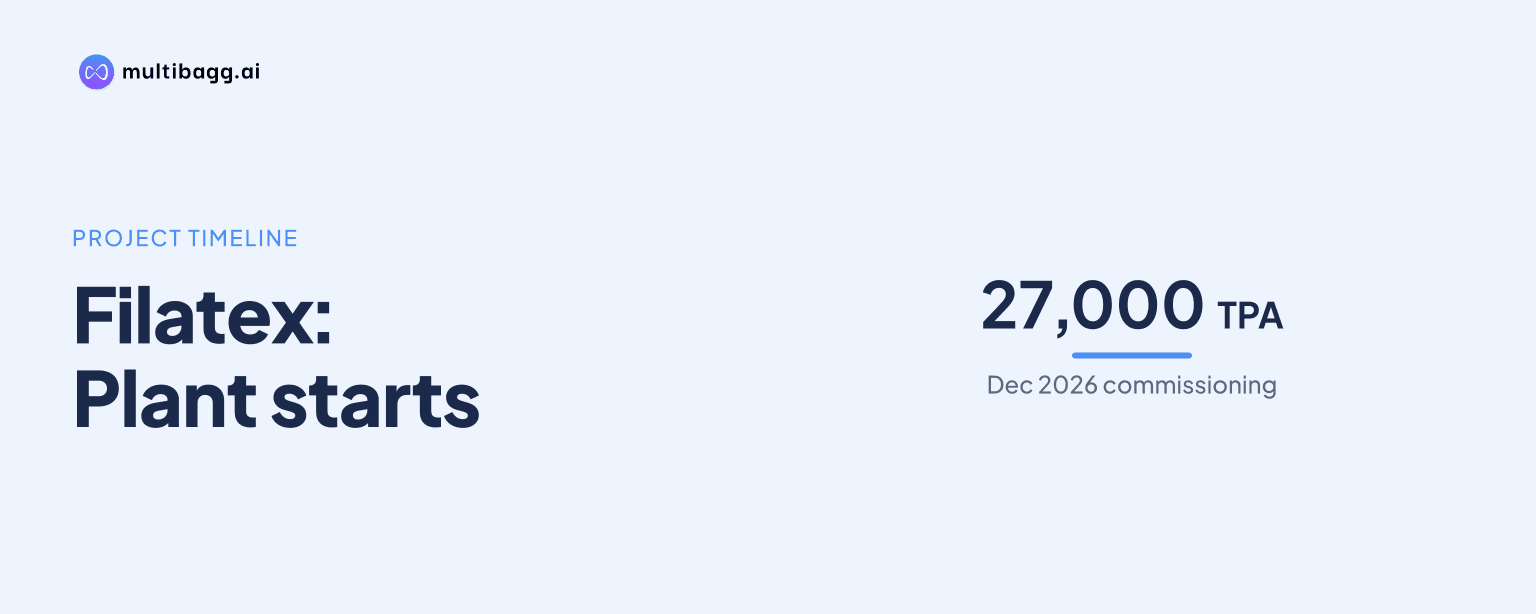
Filatex targets commissioning from the end of December 2026 for ECOSIS, a 27,000-tonnes-per-annum chemical textile-to-textile recycling plant designed to convert discarded polyester textiles into virgin-quality polyester. The plan addresses India’s reported 7,073 thousand-tonnes-per-annum textile-waste stream, including 4,100 thousand tonnes per annum of post-consumer waste, of which about 55% is recovered.
Know Filatex India inside out
Results, valuation, peers and who's buying, in one view.
What is Filatex’s ECOSIS project?
ECOSIS is Filatex’s planned 27,000-tonnes-per-annum chemical textile-to-textile recycling platform, with commissioning targeted from the end of December 2026. Tonnes per annum, or TPA, measures annual rated capacity, while textile-to-textile recycling means using discarded textiles as the feedstock for new textile material.
Filatex describes ECOSIS as India’s first commercial circular textile-to-textile platform and as one of the first commercial-scale projects globally, while characterising many overseas peers as being at research, development or pilot stage. These are company characterisations, not evidence of current operations, because the disclosed commissioning milestone remains end-December 2026. The proposed process has six stages: collection, depolymerisation, purification, molecular regeneration, yarn production and textile manufacturing.
How does Filatex chemically recycle textile waste?
Filatex says ECOSIS will chemically depolymerise polyester textile waste into monomers, purify those monomers and re-polymerise them into virgin-quality polyester. The stated feedstock includes coloured, dyed and blended polyester textile waste, unlike conventional recycling based on clear polyethylene terephthalate, or PET, bottle scrap.
The presentation contrasts chemical recycling with mechanical recycling, where it says quality parameters can deteriorate over repeated cycles and dyes, pigments, finishes and mixed fibres can contaminate the output. Filatex says mechanical recycling of pre-consumer waste is commonly used for products such as blankets and rags, whereas ECOSIS is intended to create base monomers for new fibre. Its stated objective is a closed textile-to-textile loop in which end-of-life polyester textiles become new textiles.
How large is India’s textile-waste recycling gap?
India generates 7,073 KTPA of textile waste, according to Filatex, of which 58% is post-consumer and 42% is pre-consumer. KTPA means thousand tonnes per annum. The presentation separately identifies 2,615 KTPA of pre-consumer waste, excluding spinning waste, and 4,100 KTPA of post-consumer waste, so those segment figures should be read as presented rather than combined into a revised total.
The recovery gap is concentrated in post-consumer material: Filatex says only about 55% of the 4,100 KTPA stream is recovered. By comparison, it says 95% of the identified 2,615 KTPA pre-consumer stream is recycled, although mainly through mechanical downcycling rather than textile-to-textile processing. Globally, Filatex puts discarded textiles at about 92 million tonnes annually, says polyester represents about 59% of global fibre, and estimates that less than 1% of global fibre comes from textile waste.
Got a follow-up? Ask IRIS
What demand and regulation support Filatex’s ECOSIS plan?
Filatex identifies brand recycled-content targets and tighter waste rules as the demand context for its 27,000-TPA ECOSIS plan. It says global fashion leaders target 25% to 50% textile-to-textile recycled polyester by 2030, while global sports brands are signing multi-year textile-to-textile resin offtakes before plants are commissioned. These are market observations cited by Filatex, not disclosed ECOSIS supply contracts.
The presentation says the European Union required separate textile-waste collection from January 2025 and will ban destruction of unsold apparel by large firms from July 2026. It also says textile extended producer responsibility, under which producers pay for recycling, is expected by 2028. Filatex says India is planning man-made-fibre and textile-recycling frameworks, but does not disclose an implementation date, final rules or financial effect for those frameworks.
What feedstock and commercial progress has Filatex disclosed?
Filatex has identified three ECOSIS feedstock streams: post-industrial material marked as secured, pre-consumer material marked as in progress, and post-consumer material to be obtained through aggregators. The 27,000-TPA plant’s eventual throughput will therefore depend on both its chemical process and the development of the two supply channels not labelled secured.
For commercial validation, Filatex has disclosed memorandums of understanding with Decathlon India and American & Efird Global, LLC for trials of high-quality textile-to-textile recycled polyester. The presentation does not state trial volumes, product pricing, duration, binding purchase quantities or plant revenue. It also does not specify how much feedstock each of the three post-industrial, pre-consumer and post-consumer streams is expected to provide.
How does ECOSIS compare with Filatex’s current production scale?
ECOSIS’s proposed 27,000-TPA capacity equals about 7% of Filatex’s FY26 production of 389,027 tonnes, based on a simple capacity-to-production comparison. That comparison indicates relative scale only: it is not a forecast of ECOSIS output, utilisation, sales or contribution to Filatex’s existing yarn business.
Filatex’s production declined by 16,576 tonnes between FY24 and FY25, then by a further 2,275 tonnes in FY26; sales declined by 10,841 tonnes and 2,098 tonnes over the same two intervals. In FY 2025-26, drawn textured yarn accounted for 40.39% of product mix, partially oriented yarn for 27.92% and fully drawn yarn for 30.63%, placing the proposed recycled-polyester route alongside Filatex’s polyester-yarn portfolio.
Conclusion
ECOSIS would give Filatex a planned 27,000-TPA entry into chemical textile-to-textile recycling, focused on material that it says is difficult to process mechanically because it may be coloured, dyed, finished or blended. The opportunity identified in the presentation is centred on India’s 7,073 KTPA textile-waste stream and the approximately 45% of the stated 4,100 KTPA post-consumer segment that is not currently recovered.
The next disclosed milestone is commissioning from the end of December 2026. Before that point, the issues to watch are progress in obtaining pre-consumer and aggregator-led post-consumer feedstock, plus the results of the trials under the memorandums of understanding with Decathlon India and American & Efird Global, LLC.