










Filatex India targets Q3 recycling and PFY commissioning
Key highlights
- Filatex India expects Q3FY27 commissioning of its Rs 300 crore, 26,750-TPA Ecosis recycling project.
- The remaining capacity of Filatex India's Rs 235 crore, 55,000-TPA PFY expansion is due by end-November 2026.
- Filatex India expects renewable-power sourcing to rise from about 26% to about 55% by January 2027.
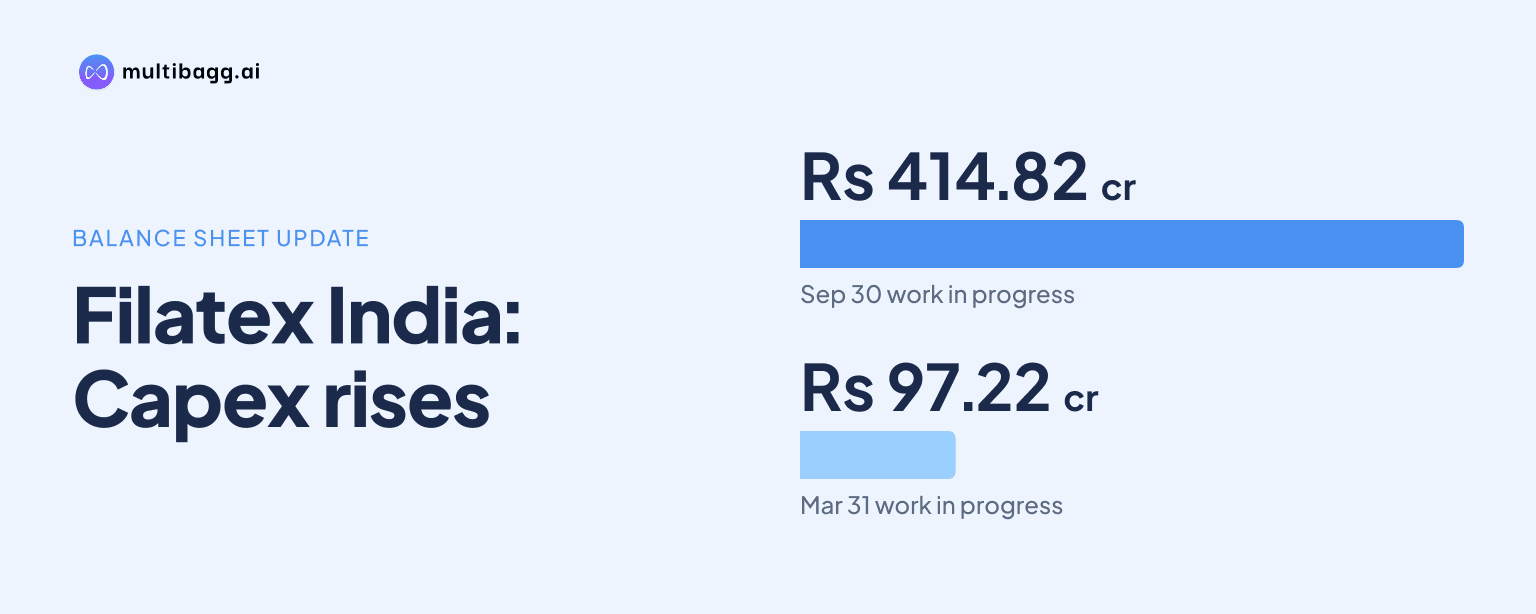
- Capital work in progress rose to Rs 414.82 crore at September 30, 2026 from Rs 97.22 crore at March 31, 2026.
powered by IRIS
Filatex India Limited expects to commission its Rs 300 crore, 26,750-tonnes-per-annum textile-to-textile recycling project in Q3FY27, while the remaining capacity from its Rs 235 crore, 55,000-TPA polyester filament yarn expansion is due by end-November 2026. It also expects renewable-power sourcing projects to lift its renewable share from about 26% to about 55% by January 2027.
Know Filatex India inside out
Results, valuation, peers and who's buying, in one view.
When will Filatex India commission the Ecosis recycling project?
Filatex India expects the Ecosis recycling project to be commissioned in Q3FY27. The Rs 300 crore project is being developed by wholly owned subsidiary Ecosis Limited and is designed for 26,750 tonnes per annum, or TPA, of textile-to-textile recycling capacity. Filatex India said the project was in the final stage of execution in its earnings release dated November 13, 2026, and that its fundamentals remained unchanged.
Filatex India invested a further Rs 20 crore in Ecosis through a rights issue in September 2026. The investment was disclosed alongside the final-execution status of the 26,750-TPA unit, rather than as a revised project-cost estimate. The company did not disclose a commercial production date within Q3FY27, expected utilisation, or projected revenue from the recycling facility.
Trials of recycled polyester yarn continued in Q2FY27 under memoranda of understanding with American & Efird Global, LLC and Decathlon. Filatex India said the trials covered thread manufacturing and other applications, while approvals from several other global brands were at an advanced stage. The release did not identify those brands or quantify trial volumes, purchase commitments or potential sales.
When will Filatex India complete its PFY expansion?
Filatex India expects the balance of its polyester filament yarn, or PFY, expansion to be commissioned by the end of November 2026. The Rs 235 crore brownfield project will add about 55,000 TPA, primarily in partially oriented yarn, fully drawn yarn and drawn textured yarn, known respectively as POY, FDY and DTY. The company said part of this capacity had already been commissioned by the Q2FY27 update.
The end-November target is more specific than the Q3FY27 timetable for the Ecosis project, although both dates fall in the October-to-December quarter. Filatex India said the added PFY capacity would support product-mix improvement. It did not disclose the commissioned portion of the 55,000-TPA capacity, the cost incurred to date, or expected revenue, margin and utilisation effects.
Management grouped the recycling and PFY projects together in its results commentary as initiatives expected to be commissioned in Q3FY27. That statement aligns the November deadline for the remaining PFY capacity with the broader quarterly target for Ecosis. Both milestones remain forward-looking management expectations, subject to the risks and uncertainties set out in the company's safe-harbour statement.
How has Filatex India funded its expansion programme?
Filatex India's capital work in progress rose to Rs 414.82 crore at September 30, 2026, from Rs 97.22 crore at March 31, 2026. The Rs 317.60 crore increase occurred during the period in which the company reported work on the recycling, PFY and renewable-energy programmes. Total non-current assets increased to Rs 1,865.84 crore from Rs 1,490.58 crore over the same six-month comparison.
Non-current borrowings increased to Rs 306.07 crore at September 30, 2026, from Rs 58.99 crore at March 31, 2026. In the half year ended September 30, 2026, Filatex India received Rs 277.29 crore in proceeds from long-term bank borrowings and repaid Rs 23.58 crore. These reported movements coincide with higher capital work in progress, but the release does not assign bank borrowings to individual projects.
Cash-flow data recorded Rs 409.44 crore of purchases of property, plant and equipment, including capital advances and capital work in progress, in H1FY27. That was higher than Rs 88 crore in H1FY26. Net cash used in investing activities rose to Rs 486.96 crore from Rs 206.11 crore, while net cash from financing activities was Rs 240.06 crore compared with a Rs 37.50 crore outflow a year earlier.
Got a follow-up? Ask IRIS
What renewable-power shift does Filatex India expect?
Filatex India expects hybrid wind-solar and solar sourcing projects to be commissioned by January 2027. Management said this would increase the renewable share of the company's power sourcing from about 26% to about 55%, representing an expected increase of roughly 29 percentage points. The company described the projects as being under implementation at the time of the Q2FY27 release.
The renewable-energy timetable follows the end-November 2026 deadline for the balance of the PFY expansion and could also follow the Q3FY27 recycling target. Filatex India did not disclose capital expenditure, generation capacity, sourcing counterparties or expected savings associated with the hybrid wind-solar and solar projects. The January 2027 date and the 55% renewable-share outcome are management expectations rather than completed results.
The stated renewable target forms part of an expansion agenda that includes Rs 414.82 crore of capital work in progress at September 30, 2026. However, Filatex India operates in one segment, manufacture of polyester goods, under Indian Accounting Standard 108 on operating segments. Its financial statements therefore do not provide separate segment financial information for recycling, PFY expansion or renewable-power sourcing.
How do these projects compare with Filatex India's Q2FY27 performance?
Filatex India reported standalone revenue from operations of Rs 1,304.19 crore in Q2FY27, up 13.87% from Rs 1,145.30 crore in Q1FY27 and 21.22% from Rs 1,075.93 crore in Q2FY26. Earnings before interest, tax, depreciation and amortisation, or EBITDA, reached Rs 91.03 crore, compared with Rs 77.92 crore sequentially and Rs 88.93 crore a year earlier. Profit after tax was Rs 53.48 crore, against Rs 49.14 crore in Q1FY27 and Rs 47.58 crore in Q2FY26.
Revenue rose even as year-on-year physical volumes declined. Production was 94,763 metric tonnes in Q2FY27, down 5.21% from 99,974 metric tonnes in Q2FY26, while sales volume fell 8.28% from 1,01,391 metric tonnes to 92,998 metric tonnes. Sequentially, sales volume increased 3.36% from 89,972 metric tonnes in Q1FY27.
EBITDA margin was 6.98% in Q2FY27, compared with 6.80% in Q1FY27 and 8.27% in Q2FY26. Management cited elevated raw-material prices, while saying downstream demand began recovering as cautious, need-based buying eased during the quarter. For H1FY27, revenue was Rs 2,449.49 crore and profit after tax was Rs 102.62 crore, compared with Rs 2,125.33 crore and Rs 88.32 crore respectively in H1FY26.
Conclusion
Filatex India's disclosed plan combines three linked execution milestones: the remaining 55,000-TPA PFY capacity by end-November 2026, the 26,750-TPA Ecosis recycling project in Q3FY27, and renewable sourcing projects by January 2027. These projects are being pursued alongside a rise in capital work in progress to Rs 414.82 crore and H1FY27 property, plant and equipment purchases of Rs 409.44 crore.
The next events to watch are the stated commissioning of the balance PFY capacity and the Ecosis unit, followed by the January 2027 renewable-energy deadline. Filatex India also disclosed ongoing recycled-yarn trials with American & Efird Global, LLC and Decathlon, as well as advanced approvals from other global brands, but gave no volumes or commercial commitments for those initiatives.