










Flomic’s Bhiwandi expansion is already customer-occupied
Key highlights
- Flomic increased Bhiwandi’s effective leasable area from 5,000 to 20,000 square feet without leasing new space.
- Bhiwandi’s total capacity reached approximately 8,000 pallets after more than 2,000 pallet positions were added.
- A quick-commerce customer occupied the multi-tier storage from September 2026, while an FMCG customer used added pallet positions from October 2026.
- Warehousing contributed about 14% of Flomic’s H1 FY27 revenue, against management’s eventual target of around 20%.
powered by IRIS
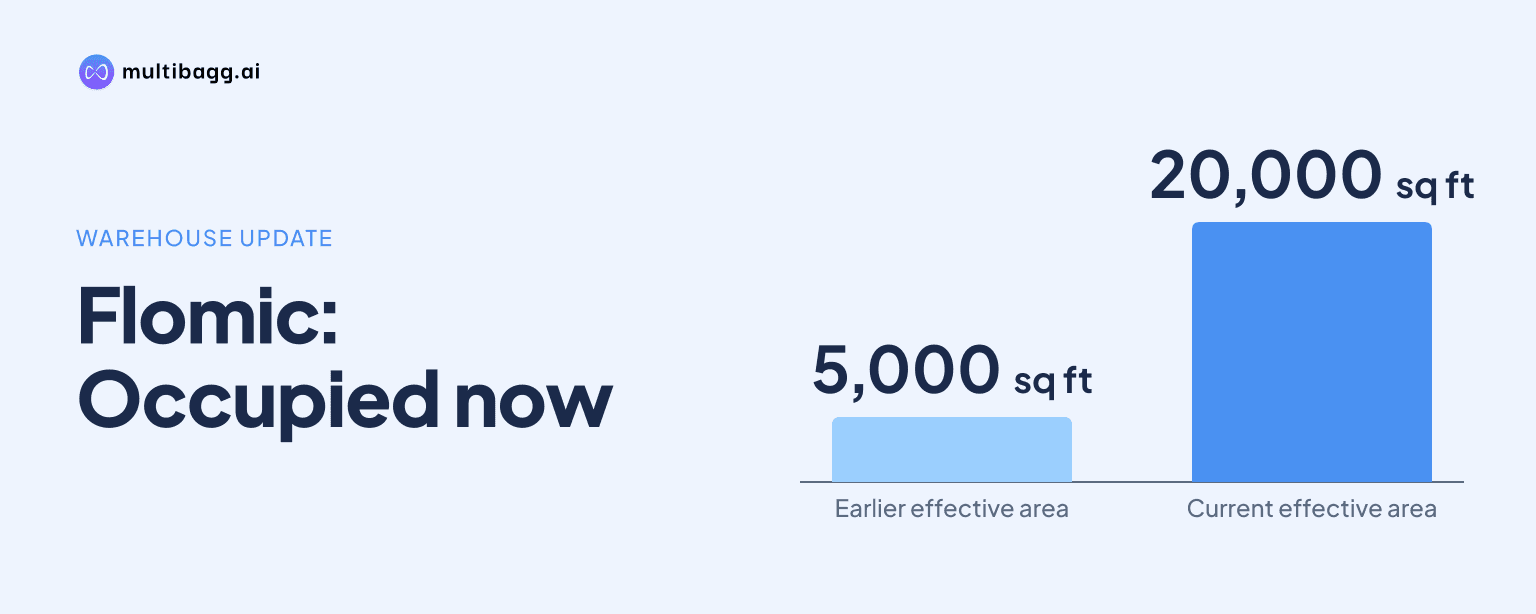
Flomic Global Logistics Limited expanded its Bhiwandi facility’s effective leasable area from 5,000 square feet to 20,000 square feet and lifted total capacity to about 8,000 pallets by October 2026 without leasing new space. Flomic said a quick-commerce customer occupied the new multi-tier storage from September and an FMCG customer used the added pallet positions from October.
Know Flomic Global Logistics inside out
Results, valuation, peers and who's buying, in one view.
How did Flomic expand Bhiwandi without leasing new space?
Flomic expanded Bhiwandi vertically through a multi-tier storage structure and pallet racking within its existing facility, rather than by adding leased warehouse space. Management announced the development on October 27, 2026, and said the additions followed its policy of increasing capacity only where there is clear customer visibility and appropriate margin potential.
The first project was a ground-plus-three-tier storage structure commissioned in July and completed in September 2026. It added 15,000 square feet of storage through three tiers of 5,000 square feet each, increasing the effective leasable area of the same 5,000-square-foot footprint to 20,000 square feet.
Flomic said this was its second multi-tier installation in Bhiwandi but its first one procured outright. Its earlier Bhiwandi multi-tier installation was under a long-term lease, while the 2026 project used an existing 5,000-square-foot footprint and changed the storage configuration rather than the site’s leased area.
A quick-commerce customer has occupied the multi-tier storage space since September 2026, according to management. That occupancy before the October 27 announcement supports management’s stated approach of customer-backed warehousing expansion rather than building capacity on assumptions.
What pallet capacity did Flomic add at Bhiwandi?
Flomic added more than 2,000 pallet positions at Bhiwandi, taking total warehouse capacity to approximately 8,000 pallets. The additional positions came from ground-plus-five-level long-span pallet racking installed during September and October 2026.
An FMCG, or fast-moving consumer goods, customer has occupied the additional pallet positions since October 2026. The timing means both elements of the Bhiwandi work had customers in place by October: the quick-commerce customer for the 15,000-square-foot multi-tier addition and the FMCG customer for the racking capacity.
The racking project measures capacity in pallet positions, while the multi-tier installation measures effective leasable area in square feet. Together, the projects increased usable storage density within the facility, whose underlying footprint for the multi-tier structure remained 5,000 square feet.
Management said overall warehouse-space utilisation across Flomic’s network was almost 97.5%. It added that shelving, racking and vertical structures may be installed at existing locations where an investment can be recovered in two to three years, but it did not disclose the Bhiwandi investment amount, project-specific payback, annual revenue or profitability contribution.
Got a follow-up? Ask IRIS
How important is warehousing in Flomic’s revenue mix?
Warehousing contributed about 13% of Flomic’s revenue in Q2 FY27 and about 14% in H1 FY27, while freight forwarding represented approximately 86% of revenue. In Q2 FY27, sea export accounted for 38% of revenue, air and sea import for 30%, air export for 14%, warehousing for 13%, and air and sea import clearance for 5%.
The H1 FY27 mix showed a modest change from Q2 FY27. Sea export contributed 33%, down 5 percentage points from Q2, while air and sea import contributed 31%, air export 16%, warehousing 14% and air and sea import clearance 6%; warehousing’s share was therefore 1 percentage point higher than in Q2.
Management said it aims to raise warehousing’s contribution gradually to 17% to 18% over coming quarters and eventually to around 20% of total turnover. It described this as a customer-backed objective, not a commitment to lease or build warehouse capacity before obtaining demand from anchor customers.
Flomic operates more than 30 warehouses and 25 branches across India. Management said every location is reviewed for performance and cautioned that warehousing gross margin can appear high because Indian Accounting Standard 116, or Ind AS 116, records rent on leased premises in interest and depreciation rather than operating cost.
What does the Bhiwandi project mean for Flomic’s operating plan?
The Bhiwandi project supports Flomic’s plan to scale warehousing alongside customer demand and cross-sell transportation, customs and freight-forwarding services. Management said a storage customer can also use these services, and it presented this integrated offering as a way to deepen customer relationships across its network of more than 30 warehouses.
In FY26, repeat customers accounted for 51% of Flomic’s business, while its top 15 customers contributed more than 20% of turnover. Management said it is seeking a larger share of business from existing customers and a stronger presence among mid-sized customers, where it sees suitable margins and payment discipline.
The expansion comes while Flomic’s revenue remains primarily linked to freight forwarding and international freight-rate movements. H1 FY27 revenue from operations rose 28.15% year on year to Rs 275.65 crore, while earnings before interest, tax, depreciation and amortisation, or EBITDA, increased 80.48% to Rs 28.14 crore; EBITDA margin rose to 10.21% from 7.24% in H1 FY26.
In Q2 FY27, revenue from operations reached Rs 156 crore, compared with Rs 113.72 crore in Q2 FY26, while EBITDA increased to Rs 16.94 crore from Rs 8.91 crore. Management attributed much of the revenue increase to elevated freight rates on several international routes alongside shipment activity, and said it remained focused on revenue quality and operating margins amid rate volatility.
Conclusion
Flomic used vertical storage and racking to expand Bhiwandi’s effective storage area by 15,000 square feet and add more than 2,000 pallet positions without a new lease. The additions were already occupied by quick-commerce and FMCG customers by October 2026, aligning the project with management’s stated preference for customer-backed warehousing capacity.
The next measure to watch is warehousing’s revenue share, which was 13% in Q2 FY27 and 14% in H1 FY27, against management’s 17% to 18% objective over coming quarters and eventual target of around 20%. Management also said its H2 FY27 priorities include scaling warehousing with customer demand, strengthening project cargo and specialised logistics, and using technology to improve operating efficiency.