










Flomic targets 20% warehousing revenue at 97.5% utilisation
Key highlights
- Flomic's warehousing revenue share was 14% in H1 FY27, compared with 13% in Q2 FY27.
- Management aims to lift warehousing to about 20% of total turnover within three to five years.
- Flomic reported nearly 97.5% overall warehouse space utilisation.
- The Bhiwandi additions could generate about Rs 1 crore of annual revenue at 100% capacity, according to management.
powered by IRIS
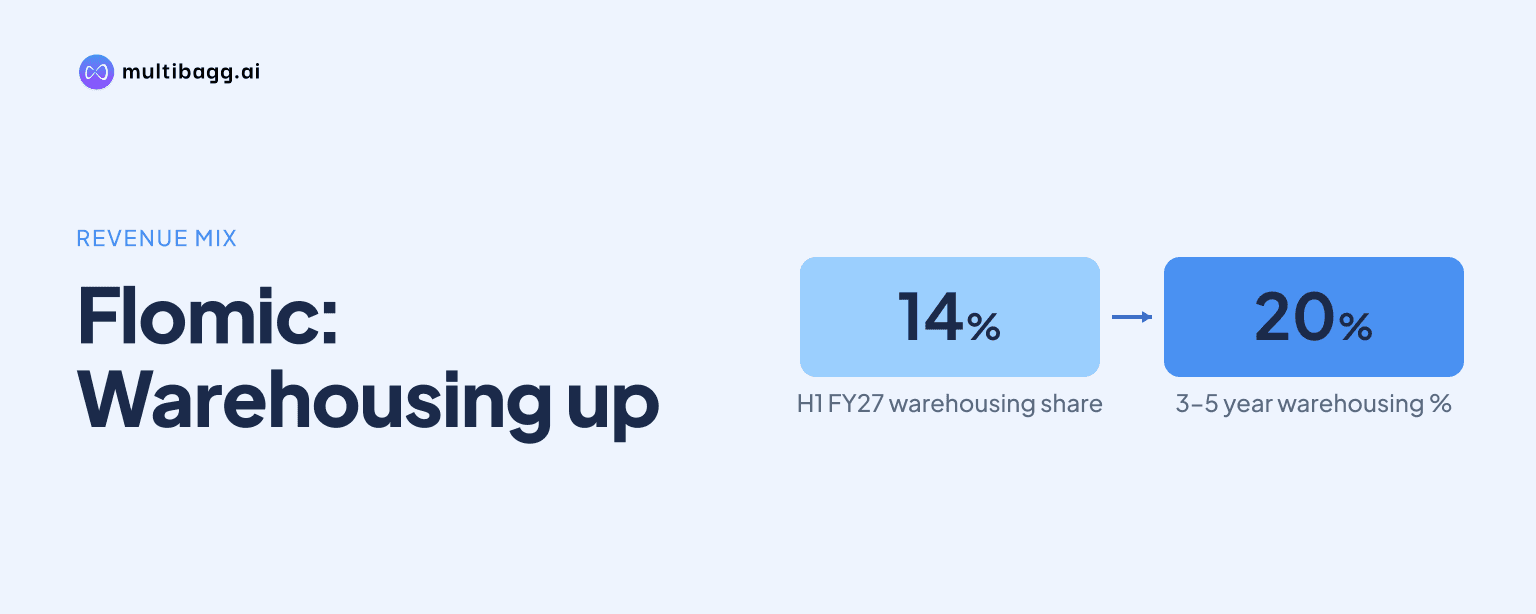
Flomic Global Logistics Limited said warehousing contributed 14% of H1 FY27 revenue and is targeted to reach about 20% of turnover within three to five years, while overall warehouse space utilisation stood at nearly 97.5%. Management said expansion will remain customer-backed, rather than based on adding leased space ahead of demand.
Know Flomic Global Logistics inside out
Results, valuation, peers and who's buying, in one view.
How large is Flomic's warehousing business today?
Flomic's warehousing business accounted for 13% of revenue in Q2 FY27 and 14% in H1 FY27, while freight forwarding remained approximately 86% of revenue. In Q2 FY27, sea export generated 38% of revenue, air and sea import 30%, air export 14%, warehousing 13%, and air and sea import clearance 5%.
The H1 FY27 mix put sea export at 33%, air and sea import at 31%, air export at 16%, warehousing at 14%, and air and sea import clearance at 6%. Warehousing therefore gained 1 percentage point between the Q2 and H1 reporting views, while sea export was 5 percentage points lower and air export was 2 percentage points higher in H1.
Management described warehousing as a comparatively steady revenue stream relative to freight forwarding, which it said is influenced by global conditions and freight-rate movements. The objective is not to replace forwarding, which still represented about 86% of revenue, but to increase the warehousing component of Flomic's integrated logistics offering.
What is Flomic's warehousing revenue target?
Flomic aims to increase warehousing's revenue contribution from the present 13% to 14% range to 17% to 18% over coming quarters and eventually to around 20% of total turnover. In response to an investor question, management said the 20% level could be reached over the next three to five years.
Management said the target depends on profitable locations, visible customer demand and anchor tenants rather than a fixed warehouse rollout schedule. Flomic said it does not create capacity on assumptions and will invest only when customers are in hand and a facility has appropriate margin potential.
The strategy also draws on Flomic's existing customer base. In FY26, repeat customers accounted for 51% of business and the top 15 customers generated more than 20% of turnover. Management said storage customers can also use transportation, customs and freight-forwarding services, creating opportunities to increase the number of services supplied to the same customer.
How is Flomic expanding capacity in Bhiwandi?
Flomic expanded its Bhiwandi facility through a multi-tier storage structure and pallet racking, adding 15,000 square feet of storage and more than 2,000 pallet positions without leasing additional space. The projects were backed by a quick-commerce customer and a fast-moving consumer goods, or FMCG, customer.
The multi-tier project was commissioned in July and completed in September 2026. Its ground-plus-three-tier design increased effective leasable area on a 5,000-square-foot footprint to 20,000 square feet, with the quick-commerce customer occupying the added space from September.
The second project installed ground-plus-five-level long-span pallet racking during September and October 2026. It added more than 2,000 pallet positions, lifted the warehouse's total capacity to about 8,000 pallets, and had an FMCG customer occupying the additional positions from October.
Management estimated the additional 15,000 square feet could generate about Rs 50 lakh of revenue annually. It said the extra pallet positions could generate Rs 5 lakh to Rs 5.5 lakh per month, although e-commerce customers can enter and exit without fixed contracts; at 100% capacity, management estimated the two additions could produce about Rs 1 crore of annual revenue.
Got a follow-up? Ask IRIS
Why does 97.5% utilisation matter for Flomic?
Flomic reported overall warehouse space utilisation of nearly 97.5%, leaving limited unused capacity across its network of more than 30 warehouses. Management said this supports investments in shelving, racking and vertical storage where such measures can create additional pallet positions within an existing facility.
Management said the Bhiwandi storage investment could be recovered in two to three years, although it did not disclose its cost. The company is open to expansion, but said a new warehouse would have to be profitable and supported by customer demand, rather than opened simply to increase the number of locations.
Flomic also cautioned that reported warehouse gross margin can appear high under Indian Accounting Standard 116, or Ind AS 116. Rent on leased premises is recorded through interest and depreciation rather than operating cost, management said, meaning warehouse gross margin should be read alongside those charges.
How does warehousing fit Flomic's FY27 results?
Flomic reported H1 FY27 revenue from operations of Rs 275.65 crore, up 28.15% from Rs 215.10 crore in H1 FY26. Earnings before interest, tax, depreciation and amortisation, or EBITDA, rose about 80% to Rs 28.14 crore from Rs 15.60 crore, while EBITDA margin increased to 10.21% from 7.24%.
In Q2 FY27, revenue from operations rose nearly 37% year on year to Rs 156 crore from Rs 113.72 crore. EBITDA increased about 90% to Rs 16.94 crore from Rs 8.91 crore, and the margin rose to 10.88% from 7.84%.
Management said higher freight rates were the main driver of FY27 revenue growth, with rates for a 40-foot container from India to the US rising from about $2,800 at February or March levels to about $9,600 in August or September. It said its second-half FY27 priorities include scaling warehousing in line with customer demand, building project cargo and specialised logistics capabilities, and expanding integrated services for existing customers.
Conclusion
Flomic is seeking to move warehousing from 14% of H1 FY27 revenue towards about 20%, reducing the relative weight of a business mix in which freight forwarding still accounts for approximately 86% of revenue. The Bhiwandi projects show the chosen approach: increase capacity within existing space, place customers into the added capacity, and use warehousing to support sales of transport, customs and forwarding services.
The next measures to watch are progress towards the 17% to 18% warehousing mix objective, utilisation of the Bhiwandi additions and the customer-backed capacity decisions management makes in H2 FY27. Management estimates the Bhiwandi projects could add about Rs 1 crore of annual revenue at full capacity, but has said pallet occupancy may vary where e-commerce customers do not have fixed contracts.