










Flomic Q2 profit turnaround coincided with higher freight rates
Key highlights
- Flomic’s Q2 FY27 revenue rose almost 37% year on year to Rs 156 crore.
- Q2 FY27 EBITDA increased almost 90% to Rs 16.94 crore and EBITDA margin reached 10.88%.
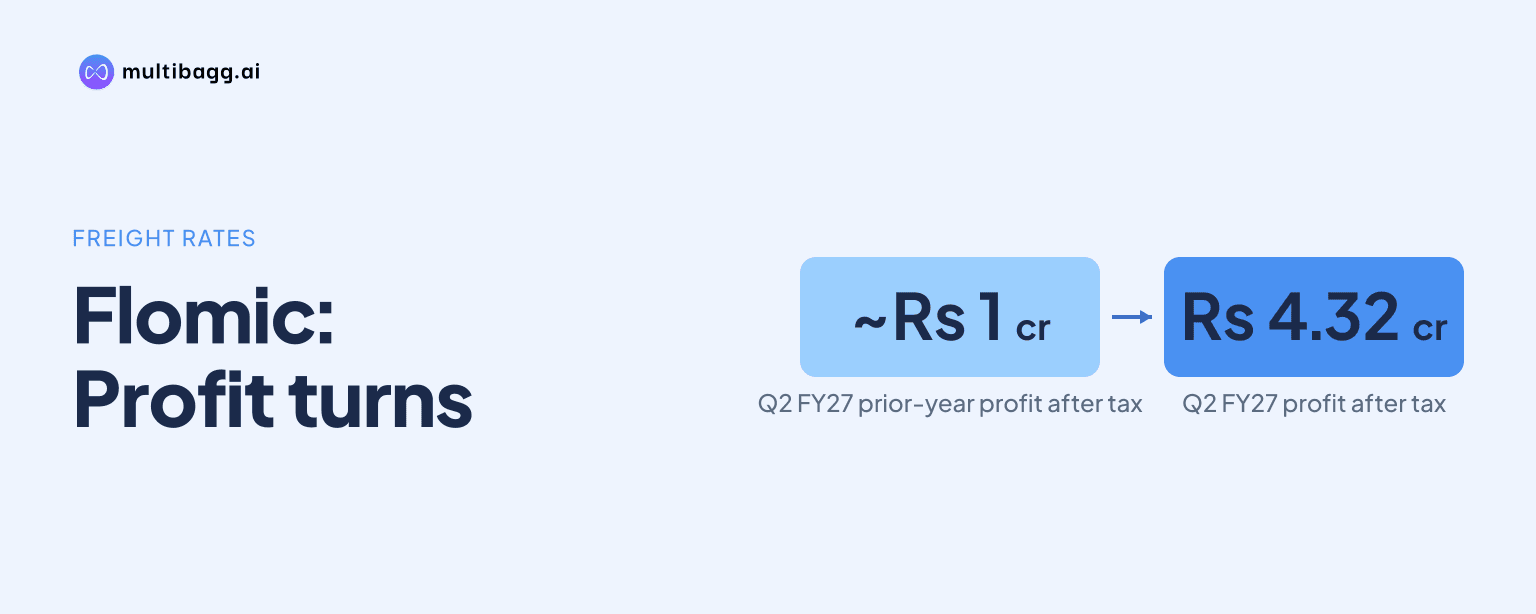
- Flomic reported Q2 FY27 profit after tax of Rs 4.32 crore versus an approximately Rs 1 crore loss a year earlier.
- Freight forwarding represented approximately 86% of Q2 FY27 revenue, while warehousing contributed 13%.
powered by IRIS
For the second quarter of financial year 2027 (Q2 FY27), Flomic Global Logistics Limited reported revenue of Rs 156 crore, up almost 37%, and EBITDA of Rs 16.94 crore, up almost 90%, as management said elevated freight rates on several international routes supported growth alongside shipment activity without quantifying their respective effects.
Know Flomic Global Logistics inside out
Results, valuation, peers and who's buying, in one view.
What drove Flomic’s Q2 FY27 revenue growth?
Elevated freight rates were an identified driver of Flomic’s Q2 FY27 revenue growth alongside shipment activity, but the company did not disclose a rate-versus-volume breakdown for its Rs 156 crore quarterly revenue. Revenue from operations increased from Rs 113.72 crore in Q2 FY26, growth that management described as almost 37% year on year.
Management said freight rates remained elevated across several international trade routes during Q2, following significant increases in July, August and September. It specifically cited container freight-rate increases to Manzanillo, Buenaventura and Callao compared with rates at the beginning of FY27, while noting that certain other destinations had relatively stable pricing. Management said these uneven movements affected revenue realisations across the freight-forwarding industry.
Flomic had previously said Q1 FY27 revenue was supported by both higher freight rates and shipment volumes, with volume growth of around 6% to 7%. For Q2, management again said elevated rates contributed alongside shipment activity, but did not provide a quarterly volume-growth figure. The disclosure identifies freight rates as a revenue driver but does not allocate the quarterly increase between rates and shipment volumes.
How did Flomic’s profitability change in Q2 FY27?
Flomic moved from losses in Q2 FY26 to profit after tax of Rs 4.32 crore in Q2 FY27 as EBITDA rose to Rs 16.94 crore from Rs 8.91 crore. Profit before tax was Rs 6.09 crore, compared with a Rs 0.78 crore loss a year earlier, and management said the company had maintained a positive profitability trajectory for nearly six quarters.
The EBITDA margin rose to 10.88% from 7.84%, an expansion of almost 300 basis points. Revenue increased by Rs 42.28 crore year on year, while EBITDA increased by Rs 8.03 crore. Management attributed the first-half improvement to operational efficiency, cost management and expanded integrated-logistics capabilities, in addition to revenue support from freight rates.
For the first half of financial year 2027 (H1 FY27), revenue rose 28.15% to Rs 275.65 crore from Rs 215.10 crore in H1 FY26. EBITDA increased around 80% to Rs 28.14 crore from Rs 15.6 crore, while the EBITDA margin improved to 10.21% from 7.24%. Profit after tax reached Rs 6.39 crore after a Rs 3.99 crore loss in the corresponding prior-year period.
Got a follow-up? Ask IRIS
Which Flomic segments were most exposed to freight-rate movements?
Freight forwarding was Flomic’s principal revenue exposure in Q2 FY27, accounting for approximately 86% of revenue, with sea export the largest individual stream at 38%. Air and sea import contributed 30%, air export 14%, warehousing 13%, and air and sea import clearance 5%, leaving the majority of revenue linked to forwarding activity.
Sea export’s 38% Q2 share was 5 percentage points above its 33% contribution in H1 FY27, while air and sea import was 1 percentage point below its 31% H1 share. The company did not report freight rates, shipment volumes or profitability by segment. As a result, the call shows the business mix during a period of elevated rates but not sea export’s specific contribution to EBITDA growth.
Management said it was focused on revenue quality, disciplined pricing and a balanced customer mix rather than depending solely on freight-rate movements. That approach is relevant because rate movements differed by destination and freight forwarding generated approximately 86% of Q2 revenue. Flomic’s other disclosed services include customs broking, warehousing and supply chain, project cargo, exhibition logistics and specialised logistics.
Can warehousing reduce Flomic’s reliance on freight forwarding?
Management aims to raise warehousing from 13% of Q2 FY27 revenue and 14% of H1 FY27 revenue to 17% to 18% over coming quarters, and eventually to around 20% of turnover in three to five years. Flomic said the expansion would be customer-backed rather than based simply on leasing additional space, so the target is a stated plan rather than an achieved change in business mix.
At Bhiwandi, a project commissioned in July and completed in September 2026 added 15,000 square feet of storage through a ground-plus-three-tier structure. The installation increased effective leasable area on the same footprint from 5,000 square feet to 20,000 square feet, and a quick-commerce customer had occupied the added space since September. Management said the expansion optimised existing infrastructure without additional leased space.
A second Bhiwandi initiative installed ground-plus-five-level racking in September and October 2026, adding more than 2,000 pallet positions and taking capacity to approximately 8,000 pallets. A fast-moving consumer goods customer had occupied the additional pallet positions since October. Flomic operates more than 30 warehouses and 25 branches across India.
Management said warehousing gross margin can appear high because Indian Accounting Standard (Ind AS) 116 records rent on leased premises in interest and depreciation rather than cost. It also said repeat customers accounted for 51% of FY26 business and the top 15 customers generated more than 20% of turnover. The company described storage, transportation, customs and freight forwarding as cross-selling opportunities within its integrated service offering.
Conclusion
Flomic’s Q2 FY27 results paired almost 37% revenue growth with almost 90% EBITDA growth and a return to Rs 4.32 crore of profit after tax. Management explicitly identified elevated freight rates as a contributor alongside shipment activity, while the EBITDA margin rose to 10.88% from 7.84%. The call does not quantify how much of the earnings change came from freight rates, volumes, pricing or operating efficiency.
The next disclosed milestone is management’s plan to raise warehousing from 13% of Q2 revenue toward 17% to 18% over coming quarters and around 20% in three to five years. Flomic also plans to scale warehousing with customer demand, strengthen project cargo and specialised logistics, and deepen relationships with existing customers. Freight-rate movements across international routes remain an unresolved factor because management said conditions varied by destination.