










Foods and Inns Q2 sales fall 12% as exports are delayed
Key highlights
- Foods and Inns reported Q2 FY27 sales of Rs 162 crore, down 12% from Rs 185 crore in Q2 FY26.
- About 3,300 MT of confirmed export orders worth Rs 32 crore could not be shipped.
- Export volume fell 25% to 6,418 MT, while domestic volume rose 25% to 15,176 MT in Q2 FY27.
- Foods and Inns reported Rs 10.62 crore of foreign-exchange loss charged during the year.
powered by IRIS
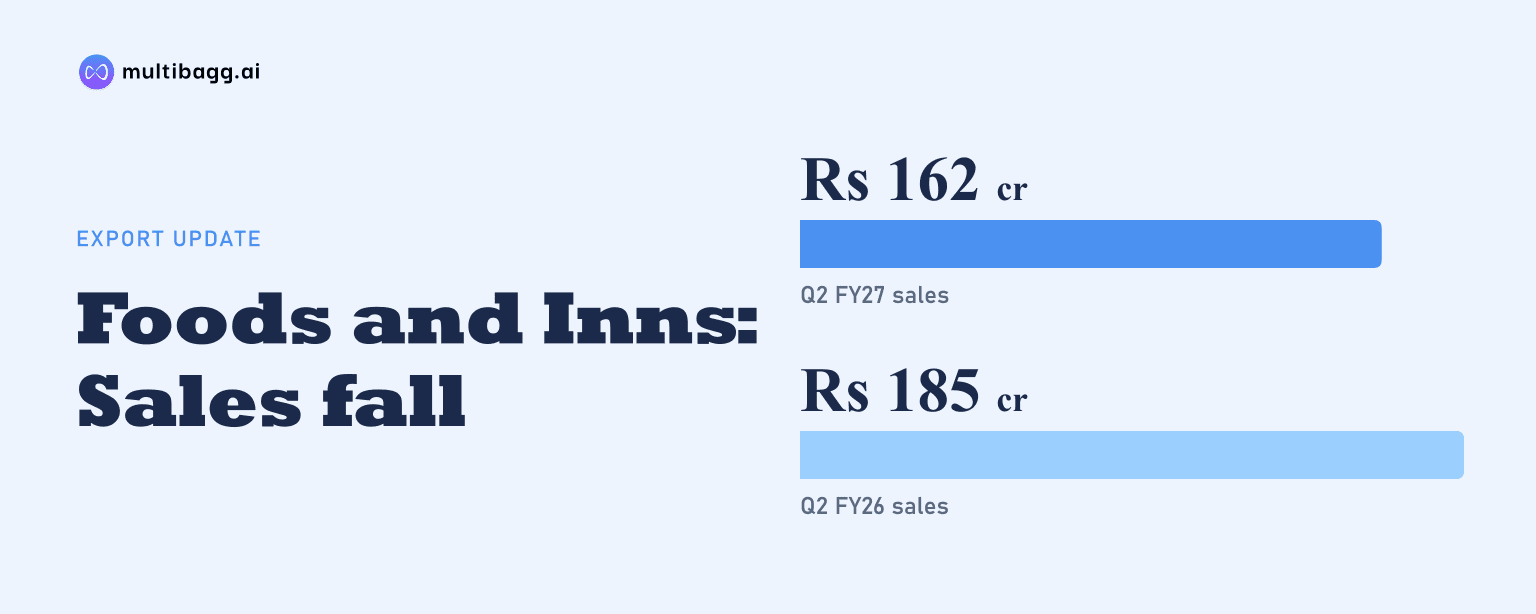
Foods and Inns Limited reported Q2 FY27 sales of Rs 162 crore, down 12% year on year, after about 3,300 metric tonnes (MT) of confirmed export orders worth Rs 32 crore could not be shipped. Management attributed the disruption to deferred customer call-offs, high export freight and container-availability issues amid the continuing war situation.
Know Foods & Inns inside out
Results, valuation, peers and who's buying, in one view.
Why did Foods and Inns sales fall in Q2 FY27?
Foods and Inns sales fell because export dispatches declined and average realisations were 12% lower year on year. Q2 FY27 sales were Rs 162 crore versus Rs 185 crore in Q2 FY26, even as total sales volume increased 4% to 21,594 MT from 20,737 MT.
The investor note does not disclose a quarterly profit-after-tax or net-loss figure. It says that approximately 3,300 MT of finished goods valued at Rs 32 crore could not be shipped against confirmed orders and had spilled into the current quarter, making delayed export dispatches the clearest disclosed reason for the sales decline.
How did export and domestic volumes compare?
Foods and Inns export volume fell 25% to 6,418 MT in Q2 FY27 from 8,551 MT in Q2 FY26, while domestic volume increased 25% to 15,176 MT from 12,186 MT. Management said export customers deferred call-offs because of high freight rates and container-availability problems connected with the continuing war situation.
Domestic volume added 2,990 MT, exceeding the 2,133-MT reduction in export volume and lifting total tonnage by 857 MT. However, the higher domestic volume did not offset the revenue effect of lower realisations and unshipped export orders worth Rs 32 crore.
Foods and Inns said processed tomato products saw a surge in domestic demand during the quarter. The company has started tomato sourcing for its Gujarat and Nashik plants, while management expects the overall tomato crop period to be shorter and plans to maximise production within that window.
What affected Foods and Inns profitability?
Foods and Inns said average realisations declined 12% year on year in Q2 FY27 because it sold inventory manufactured during the 2025 crop season at substantially lower raw-material costs. Management described pricing as a pass-through of raw-material movements, linking lower selling prices to the lower cost base of the inventory sold.
The company also said Rs 10.62 crore of foreign-exchange loss was debited to the statement of profit and loss during the year. Management said it had entered forward bookings in the previous financial year against current-year export sales and that rupee depreciation over the preceding nine months, attributed to the West Asia war, produced realised and unrealised losses.
Management characterised the foreign-exchange transaction loss as one-time in nature, noting that previous years had not seen such wide volatility. The note does not separate the part of the Rs 10.62 crore charge booked in Q2 FY27 or disclose a Q2 profit-after-tax figure.
Got a follow-up? Ask IRIS
Which Foods and Inns businesses grew in Q2 FY27?
Foods and Inns reported Q2 FY27 volume growth of 8% in spray-dried powders, about 11% in frozen food and 0.7% in Kusum Spices. Spray-dried powders grew less rapidly than in the half year, when volume growth was 14%, and management said the plant was running at full capacity.
Construction of expanded spray-dried powders capacity is under way, with management targeting commercial production in January 2027. It expects sales to increase over the next two quarters, but the note gives neither the planned capacity addition nor a sales-value target.
Frozen-food value increased about 27% year on year, outpacing its roughly 11% volume gain. Management attributed the difference to a higher contribution from value-added products and cited growing demand from the United States and Gulf Cooperation Council markets, although it did not disclose order value or volume.
Kusum Spices reported Q2 FY27 sales of Rs 5.51 crore, compared with Rs 5.47 crore in Q2 FY26. Its 0.7% quarterly growth was below the 7.3% growth reported for the half year, while management said a business restructuring is expected to improve overall margin without specifying the measures or timetable.
What are Foods and Inns plans for guava and Tetra Recart?
Foods and Inns expects significant demand for guava products because management believes the El Niño effect has reduced irrigation water and raw-material availability for processing. The company said its farmer-linked backward-integration activities have supported sustained production and that it expects guava prices to be higher.
In Tetra Recart, Foods and Inns said it is expanding its international presence and evaluating additional avenues to improve capacity utilisation. Management cited repeat business from existing customers as evidence of acceptance, but did not disclose Tetra Recart revenue, utilisation, customer numbers or timing for a capacity decision.
Foods and Inns was also identified as the implementing agency for the Nashik tomato cluster under the National Horticulture Board Cluster Development Programme, which was virtually launched on October 30, 2026. The programme’s stated aims include modern technology adoption, productivity, value addition, exports and improved farmer income.
Conclusion
Foods and Inns reported a mixed Q2 FY27 operating picture: total volume increased 4% and domestic volume rose 25%, but export volume declined 25% and sales fell 12% to Rs 162 crore. The disclosed pressures were Rs 32 crore of unshipped confirmed export orders, a 12% decline in average realisations and Rs 10.62 crore of foreign-exchange loss charged during the year; the supplied note does not establish a quarterly net loss.
The next markers are whether the delayed Rs 32 crore of export orders are dispatched, how tomato sourcing performs during the shorter expected crop period, and whether spray-dried powders capacity begins commercial production in January 2027. Management’s planned Kusum Spices restructuring and its evaluation of Tetra Recart capacity-utilisation options remain unresolved matters.