










Foods & Inns broadens beyond mango as pulping reaches Rs 695 crore
Key highlights
- Fruit and vegetable pulping generated Rs 695 crore in FY26, compared with Rs 92 crore from frozen foods.
- Foods & Inns commercialised a tomato processing line at Gonde, Nashik in 2024.
- The spray-drying business has 1,100 MTPA of capacity and is adding 120 MTPA.
- India imports 95% of its pectin requirement, according to the Foods & Inns presentation.
powered by IRIS
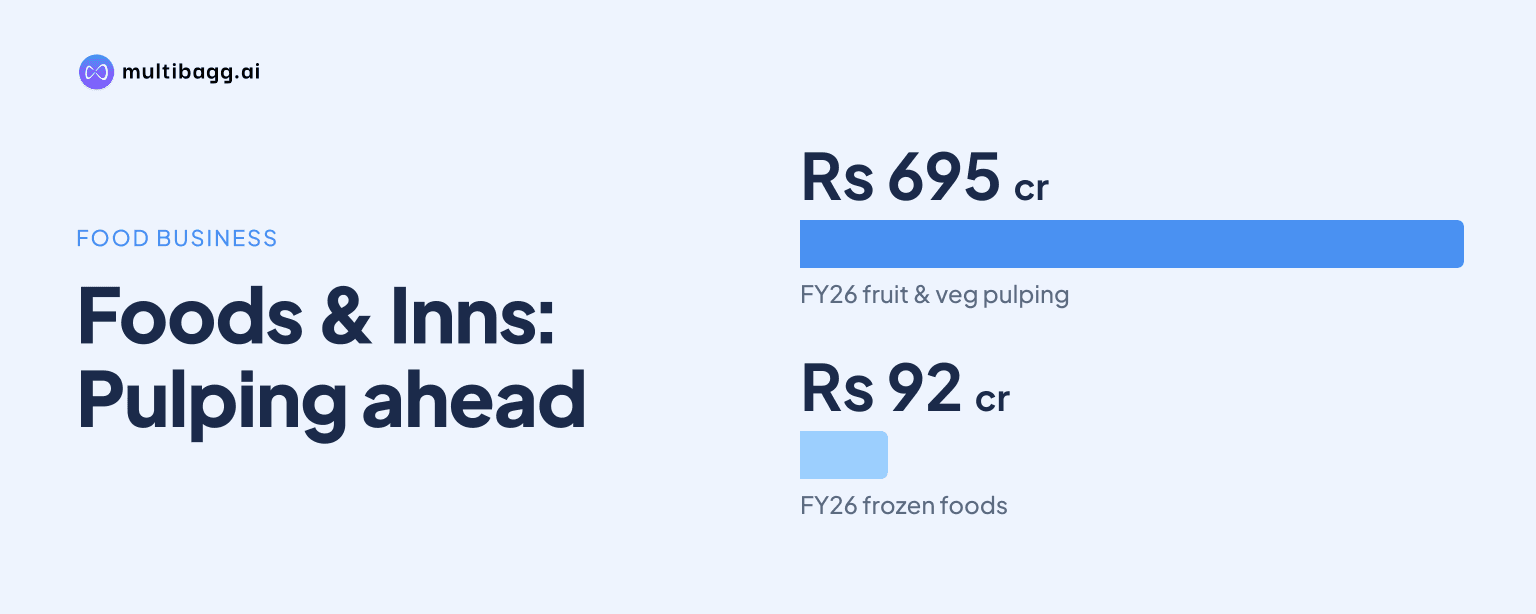
Foods and Inns Limited is broadening its operations beyond mango pulp through tomato processing, frozen foods, spices, pectin, spray drying and Tetra Recart, although fruit and vegetable pulping remained its largest FY26 vertical at Rs 695 crore. Frozen foods, the next-largest disclosed vertical, contributed Rs 92 crore.
Know Foods & Inns inside out
Results, valuation, peers and who's buying, in one view.
What is Foods & Inns’ diversification strategy?
Foods & Inns’ strategy is to retain mango pulp as its core while processing other fruits and vegetables outside the mango season. Its stated “Pulping Theorem” calls for using existing assets for other pulpy products, including tomato, guava, banana, chilli, papaya, tamarind, ginger and garlic, with minimal modifications to machinery.
Foods & Inns has also structured brands by product group: Madhu for pulp and paste, GreenTop for ready-to-eat, ready-to-cook and frozen foods, and Kusum for spices. Tetra Recart supports the branded portfolio through carton-packed products with shelf life of up to two years without preservatives, while the pectin project is intended to turn pulping waste into pectin, oils and butter.
How dependent is Foods & Inns on fruit and vegetable pulping?
Foods & Inns remained concentrated in fruit and vegetable pulping in FY26, when the vertical generated Rs 695 crore, compared with Rs 92 crore from frozen foods. Spray drying and spices each contributed Rs 19 crore, while Tetra Recart ready-to-eat and ready-to-cook products contributed Rs 3 crore.
Mango remains an established component of the pulping business, covering varieties including Alphonso, Kesar and Totapuri. Foods & Inns identifies Coca-Cola and PepsiCo as long-standing customers and says its farmer relationships support procurement of raw material for processing.
The FY26 comparison shows the scale gap between the core and adjacent operations: pulping revenue was Rs 603 crore higher than frozen-food revenue. Foods & Inns presents other pulps as a way to improve utilisation and absorb fixed overheads during the mango off-season, rather than as a replacement for mango pulp.
How is Foods & Inns using tomato beyond the mango season?
Foods & Inns is using tomato pulp to increase plant activity outside mango season and commercialised a tomato processing line at Gonde, Nashik in 2024. The company describes tomato pulp as a large untapped opportunity within its wider fruit and vegetable processing operation.
Foods & Inns was also selected as implementing agency for the Nashik Tomato Cluster under the National Horticulture Board’s Cluster Development Programme. The initiative was one of 12 horticulture clusters launched virtually on 30 October 2026, with stated objectives including modern cultivation, higher productivity, processing, value addition, market linkages and exports.
The company hosted the Nashik programme at its Gonde facility with National Horticulture Board officials, farmers, farmer producer organisations and other stakeholders. The presentation identifies opportunities for tomato, grape and pomegranate growers, but does not disclose tomato-processing capacity, revenue targets or expected financial contribution.
Got a follow-up? Ask IRIS
Which non-pulp businesses are Foods & Inns building?
Foods & Inns is building frozen foods as its largest disclosed non-pulp vertical, with FY26 revenue of Rs 92 crore. Its GreenTop range includes individually quick frozen, or IQF, fruits, vegetables, snacks and flatbreads, supplied to global brands and large-format modern retail through private-label arrangements.
The company says frozen products can be shelf stable for about 24 months and used by hotels, restaurants and catering businesses as well as households. Foods & Inns has installed new cold rooms at its Gonde, Nashik and Vankal plants, and its displayed frozen range includes samosas, vegetable rolls and falafel tikki.
Spray drying generated Rs 19 crore in FY26 and converts liquid fruit, vegetable, dairy and specialty inputs into low-moisture powders. Foods & Inns lists existing capacity of 1,100 metric tonnes per annum (MTPA) and an addition of 120 MTPA; it says the powders can have an approximately 24-month shelf life at room temperature and lists honey powder and cheese powder among added products.
The Kusum spices business also generated Rs 19 crore in FY26. Foods & Inns acquired Kusum Spices in FY19, and the brand has more than 70 products across ground, whole and blended spices; the presentation says it sells domestically and exports United States Food and Drug Administration-approved products to 12 countries, including the US, UK, Oman and UAE.
How do pectin and Tetra Recart extend Foods & Inns’ model?
Foods & Inns has set up a pectin manufacturing facility in Chittoor, Andhra Pradesh, to convert fruit-pulping waste into pectin and potentially oils and butter. The company says about 50% of a mango becomes skins and kernels after pulping, creating disposal requirements, and says laboratory results for its pectin have been approved by some large multinational and Indian companies.
The presentation says India imports 95% of its pectin from countries including Brazil, China and Mexico. Foods & Inns identifies pectin as a thickening and gelling ingredient for food and beverage, personal care and cosmetics applications, but does not disclose commercial pectin sales, capacity or customer contracts.
Tetra Recart adds a packaging route for Foods & Inns’ own brands and commercial customers. The company says the carton is an alternative to cans, offers up to two years of shelf life without preservatives and is about 25% more efficient for storage and transportation than cans; the FY26 ready-to-eat and ready-to-cook vertical generated Rs 3 crore.
Conclusion
Foods & Inns’ FY26 mix shows that its diversification is underway but its revenue base remains centred on fruit and vegetable pulping at Rs 695 crore. Frozen foods at Rs 92 crore are the largest adjacent vertical, while tomato, spray drying, Kusum spices, pectin and Tetra Recart extend the company across products, processing formats and customer channels.
The next disclosed execution points are the 120 MTPA spray-drying capacity addition, commercial development of the Chittoor pectin facility after laboratory approvals, and activity linked to the Nashik Tomato Cluster launched on 30 October 2026. Foods & Inns has not provided revenue or profit targets for tomato, pectin or Tetra Recart.