










Fortis targets 2,000 beds by FY30 with Rs 3,500 crore capex
Key highlights
- Fortis has committed Rs 3,500 crore for identified expansion projects over the next three to three-and-a-half years.
- Fortis expects around 600 additional beds in the current financial year, including the 110-bed Suguna Hospital acquisition.
- The roughly 2,000-bed pipeline excludes a separate 400-bed greenfield hospital planned at Ashok Vihar in New Delhi.
- Fortis hospital occupancy rose to 72% in Q2 FY27 from 71% in Q2 FY26.
powered by IRIS
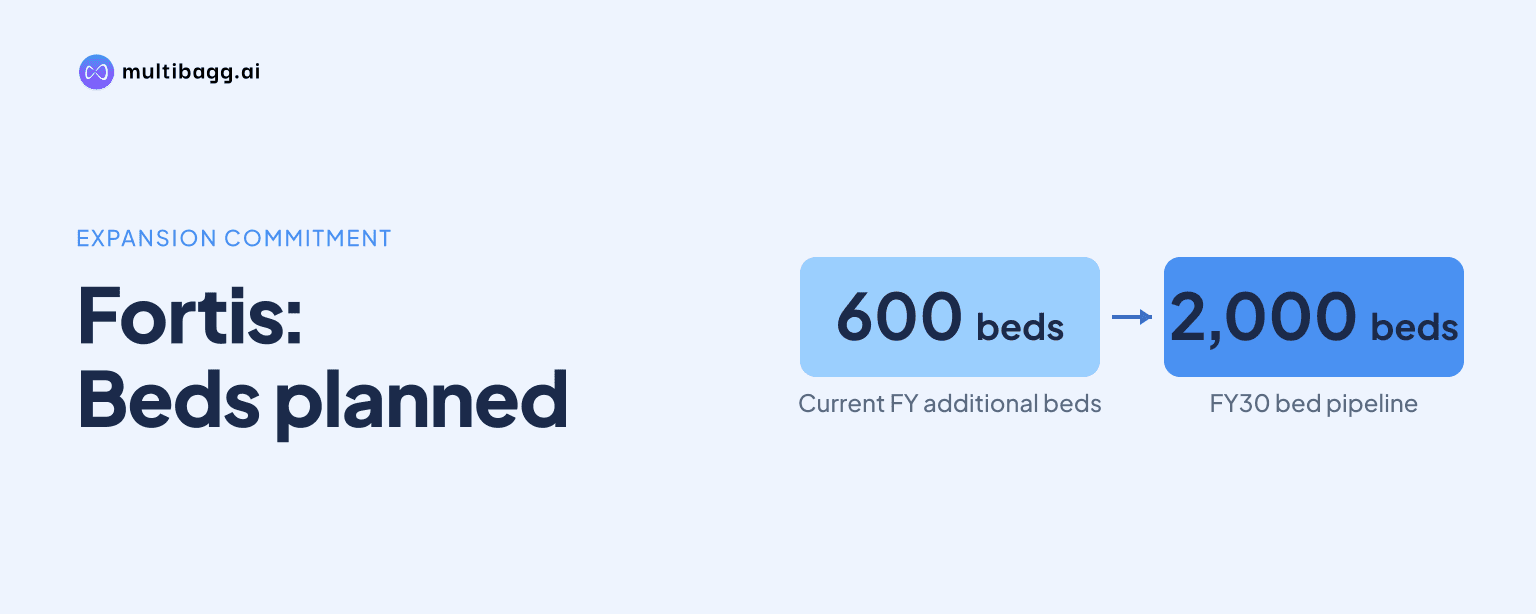
Fortis Healthcare Limited plans to operationalise roughly 2,000 additional beds by FY30, backed by Rs 3,500 crore of committed capital expenditure over the next three to three-and-a-half years. Management said the identified pipeline is led by completed acquisitions and brownfield expansion, while a separate 400-bed Delhi greenfield project is excluded from the total.
Know Fortis Healthcare inside out
Results, valuation, peers and who's buying, in one view.
How will Fortis add roughly 2,000 beds by FY30?
Fortis expects to add roughly 2,000 beds over the next three to four years through capacity already acquired or in its expansion pipeline. Management said it was targeting more than 500 additional beds in the current financial year, and that the addition would reach around 600 beds after including the Suguna Hospital acquisition in Bengaluru.
The current-year additions include the 110-bed Suguna Hospital and brownfield capacity at FMRI, Noida, Faridabad and Manesar. Fortis said Suguna has potential to expand to 150 beds, while the group’s Bengaluru capacity reached approximately 1,000 beds following the acquisition.
Fortis expects brownfield programmes to add around 200 beds in each of the following two years. Management said the largest capacity increase would follow completion of major brownfield projects at Mohali and Shalimar Bagh by FY30, with the balance of the roughly 2,000 beds expected thereafter.
The expansion follows an increase in hospital utilisation. Hospital occupancy rose to 72% in Q2 FY27 from 71% in Q2 FY26, while occupied beds increased 9% to 3,616 from 3,318. In Punjab, management said all units had occupancy above 70%, with some above 75%, and described capacity constraints in the cluster.
Is Fortis’s 2,000-bed pipeline mainly greenfield capacity?
No. Fortis said the roughly 2,000 beds comprise completed acquisitions and brownfield expansions already in the pipeline, rather than greenfield development. Management added that the company had not included Gleneagles beds or greenfield projects under evaluation in the stated 2,000-bed total.
A 400-bed greenfield super-specialty hospital at Ashok Vihar, New Delhi, is separate from the identified pipeline. Fortis has entered a long-term healthcare services agreement for the hospital, which will be developed by Seth Sunder Lal Jain Charitable Eye Hospital Society, and management said it should come up in about four years.
Management also said it was evaluating build-to-suit sale and build-to-suit lease models in a few locations. These opportunities include some Tier 2 cities as well as Kolkata, Hyderabad and Mumbai, but no bed count or capital commitment for these prospective projects was disclosed on the November 6, 2026 call.
Fortis said the 2,000-bed number could rise as it continues to pursue acquisitions. That is management’s assessment of its future opportunity set, rather than a revised committed target, because projects being evaluated were explicitly excluded from the capacity figure already identified.
How will Fortis fund its bed expansion plan?
Fortis has committed around Rs 3,500 crore of capital expenditure for projects identified to date, spread over the next three to three-and-a-half years. Management described this as committed expenditure, meaning it did not represent a fixed allocation for acquisitions or greenfield opportunities that may emerge later.
Fortis reported net debt of Rs 2,188 crore as of September 30, 2026, with net debt to earnings before interest, tax, depreciation and amortisation, or EBITDA, at 0.87 times. That compared with 0.96 times as of September 30, 2025, while consolidated revenue increased 17.4% year on year to Rs 5,280 crore in H1 FY27.
Management said internal accruals and some debt should fund the current expansion programme. It also said the parent, IHH, had expressed an intention to increase its Fortis stake above 50%, which management estimated could potentially provide around Rs 10,000 crore over time at the then-current market price, although Fortis said it did not currently require fresh parent capital for committed projects.
Got a follow-up? Ask IRIS
Which Fortis clusters will receive the new capacity?
Fortis is prioritising deeper clusters in Delhi NCR, Bengaluru, Mumbai, Kolkata, Punjab and Hyderabad. Management said Hyderabad was added as a possible focus cluster because Fortis manages two Gleneagles facilities there, while the company’s strategy remains to build scale across its existing city clusters.
Bengaluru illustrates the use of different hospital formats within one cluster. Fortis said it has about eight facilities in the city, including Suguna, People Tree at Yeshwanthpur, BG Road and a managed Gleneagles hospital. The next block at People Tree is under construction, while Suguna is planned to receive another 50 beds and BG Road is also expected to add capacity.
Management said Bengaluru occupancy was lower than other parts of the network because the Bannerghatta Road hospital was operating at around 58% occupancy and People Tree was still ramping up. It said a 92-bed Nagarbhavi hospital was operating above 80% occupancy, showing the role smaller community hospitals can play alongside larger facilities in the same cluster.
Fortis said small hospitals can share clinicians and administrative resources with larger hospitals, while transferring more complex cases within the network. Management cited the Nagarbhavi facility as having profitability of around 25% over time, and said smaller hospitals in established clusters can have margin profiles comparable with larger sites because their cost base is controlled.
What are the near-term capacity and operating milestones?
Fortis said the new FMRI block was awaiting final approvals after inspections, with commissioning expected soon after approvals were received. Management also said FMRI had not faced major clinician attrition and had recruited clinical talent in areas including head and neck surgery, rheumatology and neurology during the preceding months.
Manesar was generating positive low-double-digit EBITDA, according to management, and its radiation oncology facility was expected to be commissioned by February in the fourth quarter. Management said the comprehensive cancer centre should support a performance increase from the first quarter of the following financial year.
The operating backdrop includes a 6.8% increase in average revenue per patient, or ARPP, to Rs 2.1 lakh in Q2 FY27 from Rs 1.96 lakh in Q2 FY26. Management attributed about 1.5 percentage points of ARPP growth to price increases, with the remaining growth principally driven by case mix, including more complex cases and robotic surgeries.
Fortis maintained that hospital EBITDA margin for FY27 should be broadly flat at around 22% after employee stock-option plan expenses. Management did not provide guidance for later years because it was assessing the impact of a recent circular on oncology-drug pricing, noting that drugs account for around one-third of oncology revenue but that not all drugs are covered.
Conclusion
Fortis has set out an identified expansion programme of roughly 2,000 beds by FY30, supported by Rs 3,500 crore of committed expenditure. The plan is principally based on acquired hospitals and expansion of existing facilities, which distinguishes it from a broad greenfield build-out. Rising occupancy to 72% in Q2 FY27 and capacity constraints in Punjab provide the operational context for the additions.
The next milestones are final approvals and commissioning for FMRI’s new block, the expected February commissioning of Manesar’s radiation oncology facility, and annual brownfield additions of around 200 beds in each of the next two years. Investors should also watch progress at Mohali and Shalimar Bagh, expected by FY30, and whether Fortis converts its additional build-to-suit, acquisition and greenfield evaluations into committed projects.