










Fortis sees Bengaluru unit reaching 25% profitability over time
Key highlights
- Fortis acquired a 110-bed Bengaluru hospital for Rs 270 crore and plans another Rs 140 crore-odd for upgrades, stamp duty and 40 additional beds.
- Fortis expects the acquired Bengaluru hospital to deliver profitability of around 25% over time.
- Bengaluru cluster occupancy was about 63%, versus 72% across Fortis hospitals.
- Fortis said its 96-bed Nagarbhavi hospital had about 85% occupancy and profitability of about 25%, close to 30%.
powered by IRIS
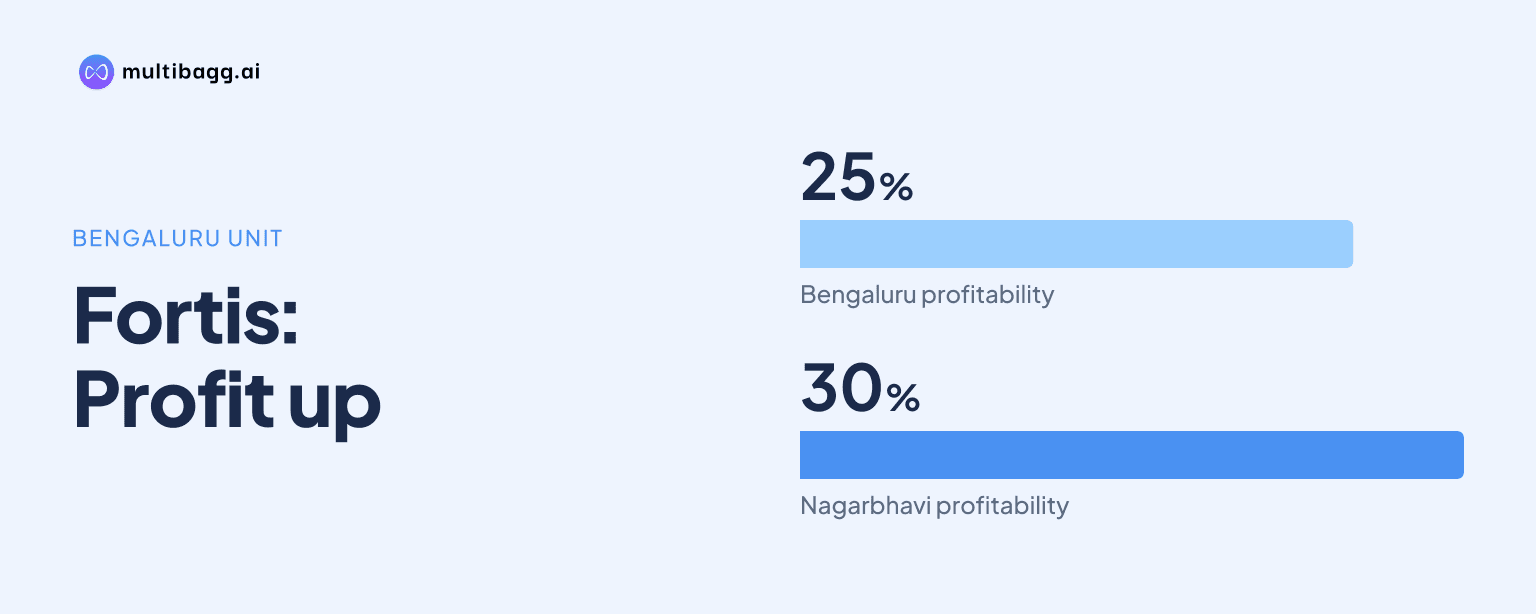
Fortis Healthcare Limited expects its newly acquired 110-bed Bengaluru hospital to deliver profitability of around 25% over time, using a community-hospital model connected to larger local facilities. Fortis said it paid Rs 270 crore for the property and plans another Rs 140 crore-odd for renovation, stamp duty and a 40-bed expansion.
Know Fortis Healthcare inside out
Results, valuation, peers and who's buying, in one view.
Why did Fortis buy a 110-bed Bengaluru hospital?
Fortis bought the hospital because it sees a role for smaller community facilities in densely populated Bengaluru micro-markets, despite cluster occupancy of about 63%. Management said the site will serve patients’ immediate needs locally, while cases requiring more complex treatment can move to larger hospitals within the city cluster.
The acquired site is part of a strategy that combines small secondary-care hospitals with larger hubs. Fortis cited its 60-bed Rajajinagar hospital, located about 6-7 kilometres from the acquired facility, as an existing small-format example. By comparison, People Tree is intended to become a larger hospital with about 350 beds and broader facilities.
Management said the transaction was negotiated directly with the owner rather than run through a competitive bidding process. Fortis said acquisition processes differ by opportunity, and that relationships in the healthcare market can create bilateral deal opportunities.
How will Fortis connect smaller hospitals with larger Bengaluru hubs?
Fortis expects the cluster to share clinicians, administration and its local brand presence across hospitals of different sizes. Management said established doctors and their teams can cover more than one facility, allowing patients to access care close to home while being referred within the network for complex procedures.
The company said a common administrative team can manage an additional 100-200 beds, creating a potential operating benefit from cluster scale. Management also said a wider network can help clinician recruitment because doctors have opportunities to practise across several locations rather than at a single hospital.
Fortis pointed to its Nagarbhavi hospital as an example of the model. The Bengaluru facility has 96 beds, occupancy of about 85% and profitability of about 25%, with management saying the figure was close to 30%. It receives clinical support from Fortis’s BG Road facility, according to management.
What is Fortis spending on the Bengaluru acquisition?
Fortis said the Rs 270 crore acquisition cost includes the land and building, while stamp duty, renovation and the planned 40-bed addition will require another Rs 140 crore-odd. The renovation is intended to bring the hospital to Fortis standards before it is expected to achieve its longer-term operating potential.
Management expects the acquired hospital’s occupancy and profitability eventually to resemble selected existing Bengaluru units, including profitability of around 25%. It said this outcome is not expected immediately, reflecting the time required for expansion, renovation and operating ramp-up.
Fortis said average revenue per occupied bed, or ARPOB, should be comparable with Nagarbhavi at around Rs 2 crore per bed. Management also said the new site’s revenue could be below the company average because it may not have high-cost services such as oncology.
Fortis uses Board-approved financial benchmarks for acquisitions, generally avoiding projects with an internal rate of return, or IRR, below 15% or a payback period beyond 8-10 years. Management said it can look beyond those financial screens where a project has a wider strategic purpose, as it does with cluster-building opportunities.
Got a follow-up? Ask IRIS
Why is Bengaluru occupancy below Fortis’s network average?
Fortis said the Bengaluru cluster’s about 63% occupancy was below the group’s 72% hospital occupancy because newer and ramping facilities are weighing on utilisation. The Bannerghatta Road hospital was operating at around 58% occupancy, although management said its occupancy had increased from earlier levels.
TMI in Yeshwanthpur, added in the prior year, was also still in its ramp-up phase and had low occupancy, management said. Fortis described both Bannerghatta Road and TMI as good hospitals in favourable micro-markets and expects their occupancy to move closer to that of other hospitals in the cluster.
Bannerghatta Road was already performing well on profitability despite occupancy of about 58%, according to management. People Tree was undergoing renovation and was not contributing much, so Fortis said including or excluding it did not materially change Bengaluru’s reported growth.
What does the wider margin outlook mean for the new site?
Fortis expects its current financial-year hospital EBITDA margin, or earnings before interest, tax, depreciation and amortisation margin, to remain broadly flat at around 22% after employee stock option plan, or ESOP, costs. Management said further occupancy gains at Bengaluru, Manesar and People Tree could support profitability as those facilities ramp up.
Management did not provide margin guidance for the subsequent financial year because it was assessing a recent circular affecting 137 oncology drugs. It said drugs account for around one-third of oncology revenue, but not all medicines are covered and packages also affect the eventual financial impact.
The 25% profitability expectation for the Bengaluru acquisition is therefore a site-level, long-term target rather than group-wide margin guidance. Management compared it with selected small Bengaluru hospitals already supported by the broader cluster, rather than with Fortis’s company-wide EBITDA margin of around 22%.
Conclusion
Fortis is using the Bengaluru acquisition to add a community access point within a wider hospital network, rather than relying only on large flagship assets. The 110-bed site is intended to share clinicians and administrative resources with larger hubs, while its Rs 270 crore acquisition cost and Rs 140 crore-odd upgrade plan underpin management’s expectation of about 25% profitability over time.
The next operating evidence will be occupancy progress at Bannerghatta Road, currently around 58%, and at ramping TMI and People Tree facilities, against Fortis’s 72% network occupancy. Management also needs to assess the impact of the November-effective oncology drug circular before it resumes guidance beyond the current year’s around-22% post-ESOP EBITDA margin expectation.