










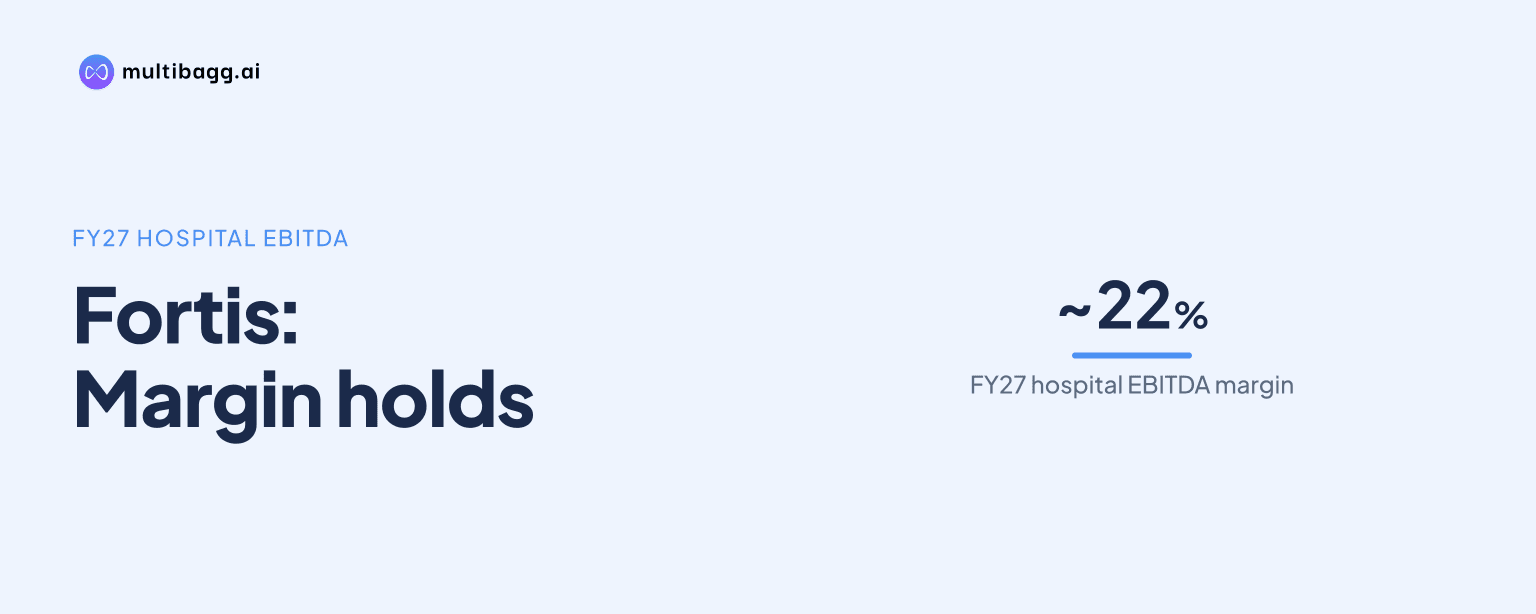
Fortis holds FY27 hospital margin near 22% amid drug caps
Key highlights
- Fortis expects FY27 hospital EBITDA margin of about 22% after ESOP costs, broadly flat versus the prior year.
- Fortis withheld guidance beyond FY27 while assessing November-effective price caps on 137 oncology drugs.
- Drugs contribute around one-third of Fortis oncology revenue, but management gave no quantified profitability impact.
- Fortis has 2,000 beds in acquired and brownfield projects, with roughly Rs 3,500 crore committed over 3 to 3.5 years.
powered by IRIS
Fortis Healthcare Limited expects its FY27 hospital earnings before interest, tax, depreciation and amortisation, or EBITDA, margin to stay near 22% after employee stock option plan, or ESOP, costs, matching the prior year, but it has withheld guidance beyond FY27 while assessing price caps covering 137 oncology drugs.
Know Fortis Healthcare inside out
Results, valuation, peers and who's buying, in one view.
What is Fortis's FY27 hospital margin outlook?
Fortis expects FY27 hospital EBITDA margin to be broadly flat at about 22% after ESOP costs. Vivek Goyal said this expectation is in line with the previous year's margin of around 22%, and confirmed in response to an analyst that the figure is post-ESOP.
The outlook allows for further improvement from the network's 72% occupancy. Management identified the Bannerghatta Road hospital in Bengaluru, where occupancy was around 58%, and the ramping Manesar and People Tree units as facilities with capacity to raise utilisation and contribute more to profitability.
Management also cited an improvement at its flagship FMRI hospital as a potential source of margin support. FMRI, Manesar and People Tree were specifically identified in the November 6, 2026 call, although management did not quantify how much each unit could add to the FY27 margin.
Why is Fortis withholding margin guidance beyond FY27?
Fortis is withholding guidance beyond FY27 because it cannot yet quantify the profitability effect of a recent circular capping prices for 137 oncology drugs. Management said the circular would be effective in November and referred to the possibility of further disruption around drug prices and other industry matters.
Fortis has not said that its FY29 25% margin objective has been withdrawn. Goyal said the company would meet that earlier target if there were no regulatory impact, but said management would not provide a margin outlook for future years until it could determine the extent of the effect and its ability to recover it.
The uncertainty matters because drugs account for around one-third of oncology revenue. Not all oncology drugs are covered by the price measure and some patient treatment is delivered through packages, leaving management unable to convert the 137-drug list into a specific EBITDA or revenue impact during the call.
How could oncology drug caps affect Fortis's hospital economics?
Fortis expects the oncology drug caps to have a negative effect on profitability, but it has not disclosed a numerical estimate. Management said hospitals evaluate profitability by specialty rather than product, making it difficult to isolate the effect of a price change across medical oncology, surgery and packaged treatments.
The company therefore needs to assess the capped products within the broader oncology specialty before estimating the result. With drugs contributing around one-third of oncology revenue, the other components of specialty revenue and the presence of packages mean that a direct application of the cap to total oncology revenue would not reflect Fortis's stated approach.
Ashutosh Raghuvanshi said the hospital industry has experienced price controls before and that business models may evolve over time. He described potential disruption as temporary, but management did not disclose a specific mitigation measure, recovery timetable or earnings impact from the November-effective circular.
Got a follow-up? Ask IRIS
What operating factors could support Fortis's FY27 margin?
Fortis sees occupancy gains, improvement at FMRI and continued ramp-up at Manesar and People Tree as the principal operational supports for its roughly 22% FY27 margin expectation. Management said Manesar and People Tree are on an upward trajectory, but their ramp-up currently places some stress on profitability.
Case mix is another factor cited by management. Inpatient volume grew around 13% from the corresponding quarter a year earlier, while price increases contributed only around 1.5 percentage points to average revenue per patient growth; management attributed most of the increase to complex cases and more robotic surgeries.
Bengaluru illustrates the difference between ramping and established assets. The Bannerghatta Road hospital was operating at around 58% occupancy, whereas a Nagarbhavi hospital had occupancy of about 85% and profitability of about 25%, close to 30%, according to Raghuvanshi.
Management said clusters can improve the economics of smaller hospitals by sharing clinicians and administration. In Bengaluru, Fortis cited a 96-bed Nagarbhavi facility receiving clinical support from its BG Road hospital, a mechanism management said can help local hospitals serve nearby patients while referring more complex cases within the cluster.
How does Fortis's expansion pipeline affect profitability and capital needs?
Fortis has 2,000 beds from completed acquisitions and brownfield expansion projects in its pipeline, supported by committed capital expenditure of roughly Rs 3,500 crore over the next 3 to 3.5 years. Management said these 2,000 beds exclude Gleneagles, prospective greenfield projects and a separate planned 400-bed greenfield hospital in the National Capital Region.
The pipeline combines capacity additions with the operational work needed to fill new facilities. Management said the visible greenfield additions outside the 2,000-bed figure would generally arrive over about three years, although one or two projects could add beds in around one year, while Manesar and People Tree show that new units can take time to build occupancy.
For acquisitions, Fortis generally uses an internal benchmark of at least 15% internal rate of return and a payback period not exceeding 8 to 10 years. Management said it may depart from those financial measures for a larger strategic objective, rather than treating them as absolute conditions for every project.
The recent Bengaluru community-hospital acquisition cost Rs 270 crore, including land and building, with a further roughly Rs 140 crore planned for stamp duty, renovation and 40 additional beds. Management expects the facility to approach the performance of other local cluster hospitals over time, rather than immediately after the upgrade and expansion.
Conclusion
Fortis has retained its near-term FY27 hospital EBITDA-margin expectation of about 22% after ESOP costs, supported by 72% occupancy, 13% year-on-year inpatient-volume growth and scope for improvement at specific ramping facilities. The same company has declined to reaffirm FY29 guidance because the effect of capped prices on 137 oncology drugs remains unquantified.
The next issue to watch is management's assessment in forthcoming quarters of the November-effective oncology-drug circular, including whether specialty-level economics can absorb part of the pressure. Investors can also monitor occupancy at the around-58%-occupied Bannerghatta Road hospital, the ramp-up at Manesar and People Tree, and progress on the Rs 3,500 crore expansion commitment over 3 to 3.5 years.