










Fortis Healthcare Q2 Revenue Rises 17.3% to INR 2,735 Crore
Key highlights
- Fortis reported Q2 FY27 consolidated revenue of INR 2,735 crore, up 17.3% year-on-year.
- Hospital revenue rose 18.6% to INR 2,340 crore, with occupancy improving to 72%.
- Operating EBITDA pre-ESOP grew 19.2% to INR 663 crore and margin reached 24.2%.
- Net debt to EBITDA improved to 0.87 times on September 30, 2026, from 0.96 times a year earlier.
powered by IRIS
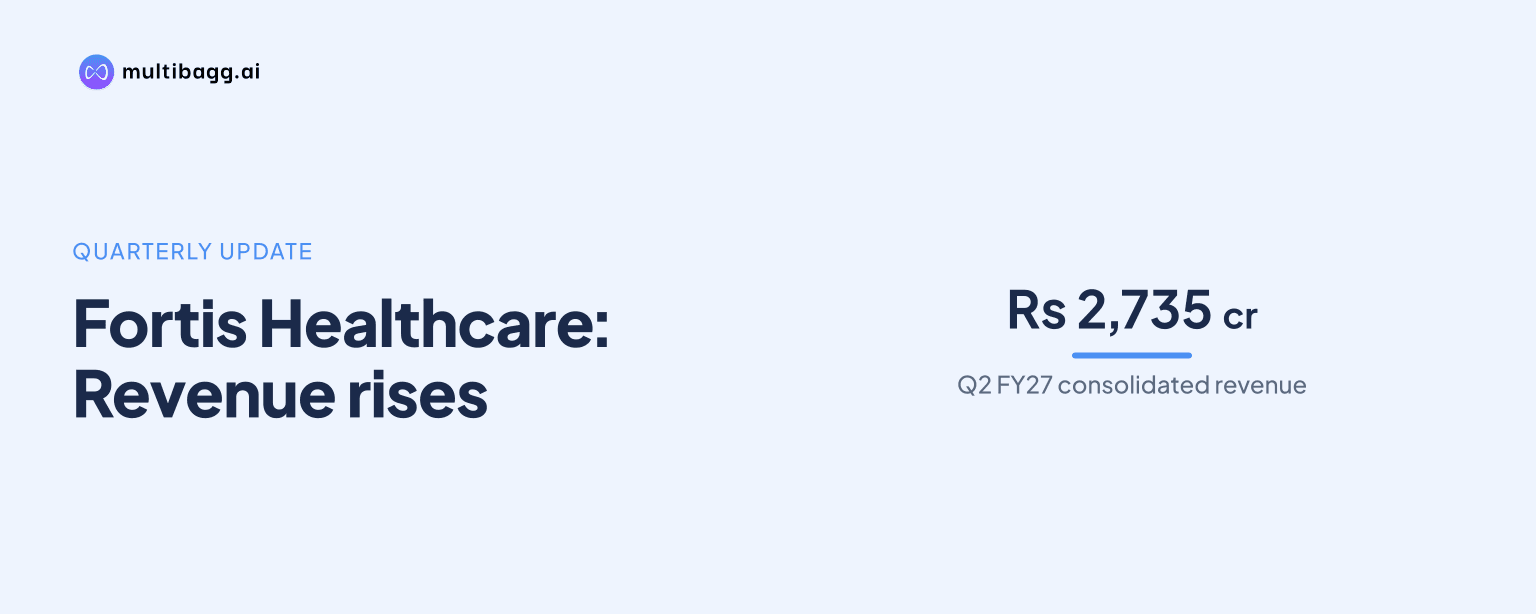
Fortis Healthcare Ltd reported consolidated revenue of INR 2,735 crore in Q2 FY27, a 17.3% year-on-year increase, supported by 18.6% growth in its hospital business, where occupancy improved to 72% and average revenue per occupied bed rose 6.8% to INR 2.1 lakh.
Know Fortis Healthcare inside out
Results, valuation, peers and who's buying, in one view.
How did Fortis perform in Q2 FY27?
Fortis delivered higher revenue and operating profit in the quarter ended September 30, 2026, with its hospital operations remaining the principal growth driver. Consolidated revenue rose to INR 2,735 crore, while hospital business revenue increased to INR 2,340 crore. The quarterly performance reflected higher patient throughput, a better case mix and continued growth in complex clinical procedures.
Operating EBITDA before ESOP costs increased 19.2% year-on-year to INR 663 crore. The pre-ESOP operating EBITDA margin improved to 24.2% from 23.9% in Q2 FY26. Consolidated profit after tax, excluding exceptional items, grew at a slower 4% year-on-year to INR 317 crore, indicating that the expansion in revenue and operating EBITDA did not translate into a similar rise in reported profit.
The company also reported consolidated revenue of INR 5,280 crore for H1 FY27 and PAT of INR 581 crore for the half year. These figures place the second-quarter result in the context of a first-half performance led by the hospitals segment.
What drove Fortis hospital revenue growth?
Fortis said hospital revenue growth was supported by higher occupancy and a rise in average revenue per occupied bed, or ARBP. Occupancy increased by one percentage point from 71% a year earlier to 72%, while ARBP rose 6.8% to INR 2.1 lakh. Management attributed this improvement to a stronger case mix and a higher share of complex surgeries.
Several specialty areas grew faster than the overall hospital business. Renal sciences recorded 27% year-on-year growth, neurosciences rose 28%, and orthopedics grew 30%. These specialties supported the revenue increase by contributing higher-complexity treatments and procedures.
Chief Financial Officer Vivek Goel said there remains scope to improve occupancy. He cited the Bangalore hospital and ramp-up facilities such as Manesar and People Tree as areas with further potential. This indicates that the company sees operational capacity utilisation, alongside new beds, as an important contributor to its hospital business growth.
What is Fortis planning for capacity expansion?
Fortis has outlined a capacity expansion programme that management said provides visibility over bed additions for the next three to four years. The company expects more than 500 beds to be added in FY27 through the Suna acquisition and brownfield expansion projects, according to the earnings call summary.
Management also indicated that roughly 200 beds a year could be added over the following two years through brownfield expenditure. Major brownfield projects in Mahali and Salimar Bab are expected after FY30. The cited capacity plan includes around 600 beds through the Suna acquisition in Bangalore, alongside brownfield expansion, though the disclosed timelines differentiate between current-year additions and later projects.
Capacity additions matter because hospital revenue depends both on available beds and on the ability to achieve sustainable occupancy. Fortis reported a 72% occupancy level in Q2 FY27, and management’s comments on ramp-up units suggest that existing and newly added facilities will need to scale patient volumes over time.
Got a follow-up? Ask IRIS
What are the key risks to Fortis margins and earnings?
Fortis expects its FY27 operating EBITDA margin after ESOP costs to remain broadly flat at about 22%, in line with the previous year. Management did not provide FY28 margin guidance, citing regulatory uncertainty, including the possibility of drug price caps. The company’s guidance signals that revenue growth alone may not lead to a higher reported margin in the current year.
The diagnostics business grew more slowly than the hospital segment. Diagnostic revenue rose 12.2% year-on-year, with volume growth of 5.8% and test growth of 7.2%. These measures were below the growth reported for hospital revenue and remain relevant to the consolidated growth profile because diagnostics is part of the company’s operating portfolio.
A court-ordered forensic audit is also ongoing. Management expects the process to conclude within six months, but its continuation remains an overhang until the review is completed. Fortis did not disclose an outcome from the audit in the provided earnings call information.
How does the quarter affect Fortis investors and operations?
The quarter showed that Fortis generated faster growth in operating EBITDA than in revenue, with pre-ESOP margin increasing by 30 basis points. Its balance sheet metrics also improved, as net debt to EBITDA declined to 0.87 times as of September 30, 2026, from 0.96 times a year earlier. Lower leverage relative to EBITDA provides a clearer financial backdrop as the company pursues acquisitions and brownfield projects.
For investors, the main operating indicators are hospital occupancy, ARBP, specialty growth and the pace at which planned beds become operational. The slower PAT growth relative to revenue, flat post-ESOP margin guidance and regulatory uncertainty are equally relevant. For patients and local healthcare markets, the proposed capacity additions could increase the company’s treatment capacity, although the reported information does not specify service commencement dates for each project.
Conclusion
Fortis reported a strong Q2 FY27 revenue performance, led by hospital operations, improving occupancy and growth in complex specialties. Revenue rose 17.3% to INR 2,735 crore and pre-ESOP operating EBITDA increased 19.2% to INR 663 crore, while a modest rise in PAT and slower diagnostics growth showed that performance was not uniform across all measures.
The next disclosures to watch are the delivery of more than 500 planned beds in FY27, progress in ramping up the Bangalore, Manesar and People Tree facilities, and the expected conclusion of the forensic audit within six months. Investors will also track whether post-ESOP EBITDA margin remains near the company’s stated 22% level amid drug-pricing regulatory uncertainty.