










Gaja Capital Fund II carry drives profit as exits progress
Key highlights
- Gaja Capital reported Rs 46.2 crore of quarterly performance income, up 55% from the first quarter.
- Fund II was substantially realised at a 3.8x gross multiple and was the current source of carried interest.
- Fund III was partially realised at 1.9x, while Fund IV was 87% deployed and tracking 2.0x.
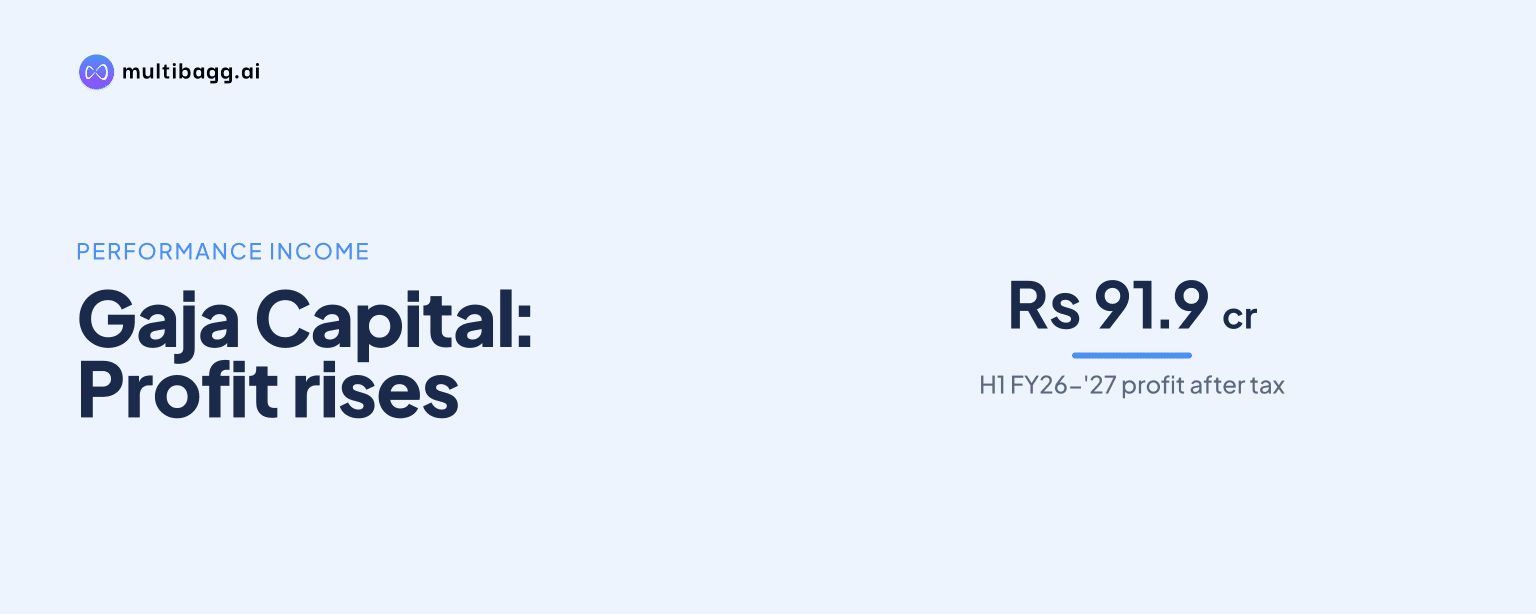
- Gaja Capital reported Rs 91.9 crore of first-half FY26-'27 profit after tax, up 48% year on year.
powered by IRIS
Gaja Alternative Asset Management Limited reported Rs 46.2 crore of performance income in the quarter ended September 30, 2026, up 55% from the first quarter, with carried interest from its substantially realised 3.8x Fund II an important contributor. Gaja Capital said Fund III had begun exits while Fund IV remained in its investment and value-building phase.
Know Gaja Alternative Asset Management inside out
Results, valuation, peers and who's buying, in one view.
Why is Fund II driving Gaja Capital’s current performance income?
Fund II is driving Gaja Capital’s current carried-interest income because it is substantially realised at a 3.8x gross multiple on invested capital. Management identified Fund II carry as an important contributor to quarterly performance income of Rs 46.2 crore, which rose 55% from the first quarter.
Gaja Capital records carry only on realised returns, rather than accruing it from fair-value gains or a fund’s internal rate of return. Management said a fund must first return investors’ principal and clear its hurdle before carry can be recognised. The timing of actual liquidations, therefore, determines when carry is reported.
Performance income has two disclosed elements: gains on Gaja Capital’s sponsor commitments and carried interest. The company earns the gross multiple on capital it commits to its own funds without paying management fees or carry to itself. In the first half of FY26-'27, performance income was Rs 75.9 crore, compared with Rs 78.5 crore in the first half of the prior year, which management attributed to the timing of realisations.
The funds are at different points in their investment cycles. Gaja Capital said Fund II was producing carry, while Fund III and Fund IV were producing sponsor gains. Management fees continue through a fund’s life, initially calculated on total invested capital and later on net invested capital.
How did Fund II carry affect Gaja Capital’s quarterly profit?
Fund II carry helped support profit after tax of Rs 64.7 crore in the quarter ended September 30, 2026, up 138% from the first quarter and 54% from the corresponding quarter a year earlier. Total income was Rs 65.5 crore, up 26% sequentially, and performance income was Rs 46.2 crore.
The reported quarterly profit also included a Rs 15 crore reversal of deferred-tax charge. Management said this arose from a revised estimate of potential tax liability on fair-value gains from sponsor commitments and did not affect profit before tax, which rose 13% in the quarter and 20% in the first half.
For the first half of FY26-'27, Gaja Capital reported total income of Rs 117.3 crore, up 6% year on year, and profit after tax of Rs 91.9 crore, up 48%. Total expenses fell 17% to Rs 34.6 crore from Rs 41.6 crore, reducing the cost-to-income ratio to 29% from 38%.
An analyst noted that trailing-12-month fee income of Rs 61.3 crore was close to total expenses of Rs 63.4 crore. Management said fees broadly covered expenses, while fee income plus treasury income covered them more substantially. Realised carry and sponsor gains can consequently have a material effect on earnings, although carry depends on exit timing.
Got a follow-up? Ask IRIS
When could Fund III and Fund IV contribute carried interest?
Gaja Capital expects carry from subsequent funds to emerge over coming years, but did not provide a date. Fund III is fully deployed across 10 investments, has begun exits and is partially realised at a 1.9x gross multiple, while Fund IV remains earlier in its investment cycle.
Fund III beginning exits does not itself establish an entitlement to carry. Under Gaja Capital’s realised-basis policy, the fund must return principal and clear the hurdle through liquidations before carry can be booked. Management said Gaja Capital was currently earning sponsor gains from Fund III and Fund IV rather than carry from those funds.
Fund IV held its final close in 2023 at Rs 1,775 crore and had made nine investments, including two in the reviewed quarter. It was 87% deployed and tracking a 2.0x gross multiple. Management said the multiple was not representative of mature-fund performance because Fund IV was still under deployment.
All four funds ranked in the first quartile against their industry benchmarks, according to management. Their reported multiples represent different stages: Fund I was fully realised at 5.6x, Fund II substantially realised at 3.8x, Fund III partially realised at 1.9x and Fund IV still deploying at 2.0x. Fund II’s realised position, rather than its multiple alone, makes it the current carry source.
What income supports Gaja Capital between fund exits?
Gaja Capital has four disclosed income streams: management fees, sponsor-commitment gains, carried interest and treasury income. Management fees recur through a fund’s life, sponsor-commitment gains accrue through the investment cycle, and carry is earned during exits after the required investor returns are achieved.
Treasury income has increased in relevance after the initial public offering lifted net worth to Rs 1,106.2 crore at September 30, 2026, from Rs 574.6 crore a year earlier. Cash and bank balances were Rs 450 crore, current investments were Rs 165.4 crore, and non-current investments, mainly sponsor commitments, were Rs 459.6 crore.
Of the Rs 450 crore fresh issue, Rs 372 crore was earmarked for sponsor commitments to Fund IV, Fund V and Eastgate Secondaries Fund I, while Rs 78 crore was allocated to general corporate purposes. As of September 30, 2026, about 10% of the sponsor-commitment allocation and about 80% of the general-corporate allocation had been used. Management said uncalled sponsor capital was held in treasury until funds close and call capital.
Fund V has approval from the Securities and Exchange Board of India to seek Rs 2,500 crore, while Eastgate Secondaries Fund I is seeking Rs 1,500 crore. Management said such funds typically take 18 months from launch to final close but begin earning management fees from their first close. Later investors pay a fee catch-up calculated from the first close.
Conclusion
Gaja Capital’s September-quarter results reflected Fund II’s later-stage position, with its 3.8x substantially realised performance enabling carried-interest recognition under the company’s realised-return policy. Fund III, at 1.9x and partially realised, and Fund IV, at 87% deployment and 2.0x, remain at stages where sponsor gains and management fees are more relevant than carry.
The next issues to watch are Fund III’s pace of realisations, Fund IV’s move from deployment towards exits, and progress in raising Fund V’s Rs 2,500 crore target and Eastgate’s Rs 1,500 crore target. Management said the remaining sponsor-commitment proceeds will be deployed only when the new funds close and call capital, leaving treasury income relevant until then.