










Ganesh Infraworld leasing targets 43% break-even in Year 1
Key highlights
- Ganesh Infraworld’s leasing division reported a Rs 6.75 crore pre-tax loss in H1 FY27.
- Ganesh Infraworld purchased Rs 179.24 crore of equipment and recorded Rs 211.50 crore of total outlay by 30 September 2026.
- Ganesh Infraworld’s Year 1 break-even model requires 43% utilisation and monthly rentals above about Rs 3.1 crore.
- Ganesh Infraworld’s maiden leasing order was worth Rs 35.75 crore over 36 months.
powered by IRIS
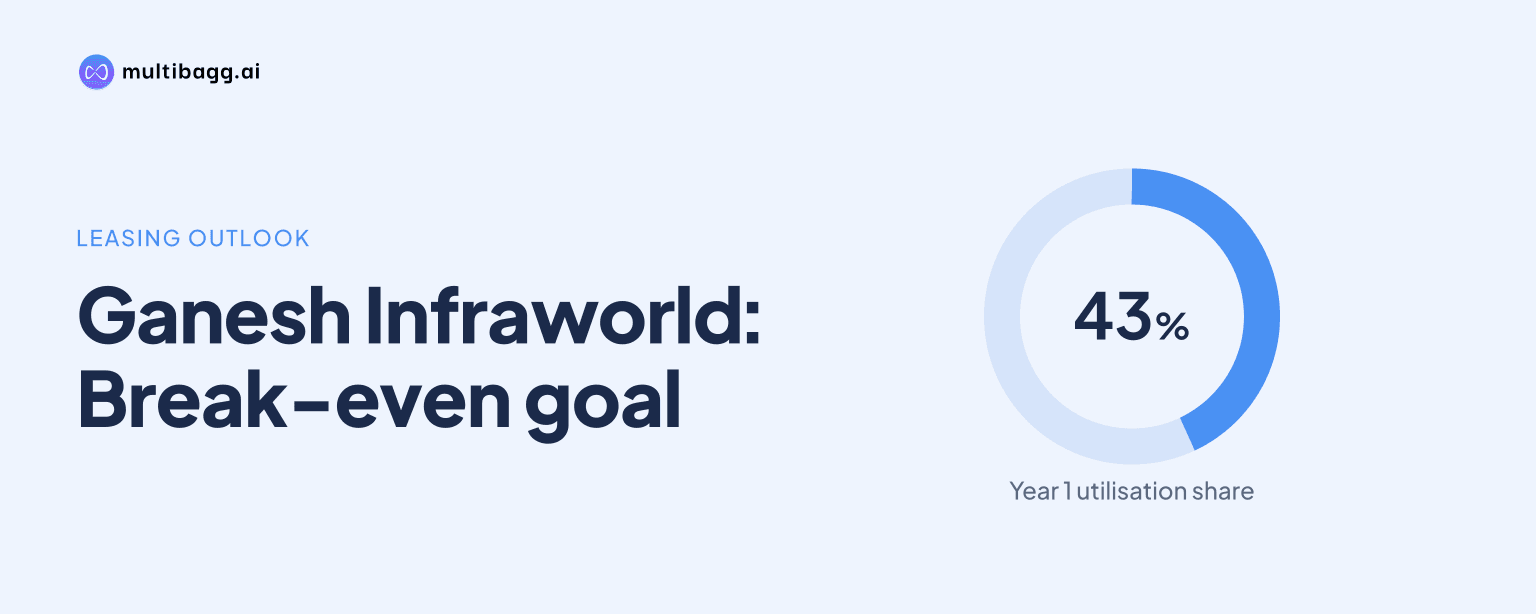
Ganesh Infraworld Ltd’s equipment rental and leasing unit recorded a Rs 6.75 crore pre-tax loss in H1 FY27 after Rs 179.24 crore of equipment purchases, while the presentation sets Year 1 break-even at 43% fleet utilisation, requiring monthly rentals above about Rs 3.1 crore. The loss followed Rs 8.56 crore of depreciation and Rs 0.56 crore of interest as fleet deployment began.
Know Ganesh Infraworld inside out
Results, valuation, peers and who's buying, in one view.
What does Ganesh Infraworld lease through its new division?
Ganesh Infraworld leases aerial work platforms, including scissor lifts and boom lifts, to third-party contractors and industrial clients through a division launched in FY27. The business is designed to monetise machinery outside the group’s own project sites and generate rental income linked to fleet utilisation rather than engineering, procurement and construction project execution.
The division had invested Rs 179.24 crore in equipment at basic value by 30 September 2026, while the launch slide rounded the investment to Rs 179 crore. Ganesh Infraworld describes the approach as asset-light for customers and asset-owning for the company, extending a model it says is already used in mining and transportation.
The presentation identifies heavy earth-moving machinery (HEMM), excavators, drilling rigs and concrete batching plants as a platform for possible further leasing lines. In H1 FY27, rental revenue was Rs 2.37 crore, while Q2 FY27 alone contributed Rs 2.16 crore, indicating that most reported first-half revenue came after the fleet was capitalised in Q2.
Ganesh Infraworld secured its maiden leasing order in April 2026, valued at Rs 35.75 crore over 36 months. The segment order book stood at Rs 33 crore on 30 September 2026, providing the disclosed contracted-demand measure alongside the first-half revenue figure.
How loss-making was Ganesh Infraworld’s leasing unit in H1 FY27?
Ganesh Infraworld’s leasing unit reported a Rs 6.75 crore segment profit-before-tax (PBT) loss in H1 FY27 despite earnings before interest, tax, depreciation and amortisation (EBITDA) of Rs 2.37 crore. Depreciation of Rs 8.56 crore and interest on the equipment term loan of Rs 0.56 crore exceeded rental revenue during the initial deployment phase.
EBITDA equalled the segment’s Rs 2.37 crore of rental revenue because the presentation assumes no material direct operating cost in H1 FY27. That measure excludes the depreciation charge that reduced earnings before interest and tax (EBIT) to a Rs 6.19 crore loss.
Depreciation is charged at 18.1% on a written-down-value (WDV) basis, and the presentation identifies it as the main initial earnings charge. Ganesh Infraworld states that the fleet was capitalised in Q2 FY27 and was still being deployed, while Q1 had no depreciation charge for this new segment.
Got a follow-up? Ask IRIS
How has Ganesh Infraworld funded the leasing fleet?
Ganesh Infraworld reported total fleet outlay of Rs 211.50 crore at 30 September 2026, comprising Rs 179.24 crore of equipment purchases at basic value and Rs 32.26 crore of goods and services tax (GST). The difference between the equipment’s basic value and total outlay is therefore the GST paid on the equipment.
Creditors for capital goods provided Rs 117.69 crore of the Rs 211.50 crore outlay, making them the largest disclosed funding source. Equipment term loans supplied Rs 53.78 crore, while internal accruals and other sources supplied Rs 40.03 crore, together matching the reported total outlay.
The segment balance sheet showed a net block of Rs 170.68 crore after depreciation and segment liabilities of Rs 209.19 crore at 30 September 2026. The equipment term loan has a five-year repayment period, whereas the presentation assigns the equipment a 15-year useful life and says its practical life can be about 20 years.
When does Ganesh Infraworld expect leasing to break even?
Ganesh Infraworld’s presentation sets Year 1 PBT break-even at 43% fleet utilisation, requiring monthly rentals above about Rs 3.1 crore. The calculation combines monthly depreciation at 18.1% WDV on Rs 179 crore of equipment with interest on the five-year equipment term loan, assuming no material direct operating cost.
The break-even threshold is modelled to decline each year as WDV depreciation falls and equipment-loan interest reduces. This is a projected economics path rather than a reported result: H1 FY27 rental revenue was Rs 2.37 crore for the full six months, while the Year 1 threshold is stated as monthly rental income.
The Year 5 break-even estimate of 18% is 25 percentage points below the Year 1 estimate of 43%. The presentation attributes the reduction to declining depreciation and interest, while the Rs 35.75 crore maiden order runs for 36 months during the initial five-year equipment-loan period.
Conclusion
Ganesh Infraworld has established an aerial-work-platform leasing business with Rs 179.24 crore of equipment purchases and Rs 211.50 crore of total outlay by 30 September 2026. Its H1 FY27 EBITDA of Rs 2.37 crore did not cover Rs 8.56 crore of depreciation and Rs 0.56 crore of interest, resulting in a Rs 6.75 crore PBT loss during early fleet deployment.
The next disclosed measure to watch is progress towards monthly rentals above about Rs 3.1 crore and the Year 1 utilisation threshold of 43%. The presentation’s planned reduction in break-even utilisation to 18% by Year 5 depends on declining WDV depreciation and interest over the five-year equipment-loan repayment period.