










Ganesh Infraworld Ltd water revenue rose 127% to Rs 224 crore
Key highlights
- Ganesh Infraworld’s water-infrastructure revenue rose 127% year on year to Rs 224 crore in FY26.
- Ganesh Infraworld reported a 15% water-infrastructure EBITDA margin in FY26, up 400 basis points.
- India’s wastewater-treatment technology market is projected to rise from Rs 28,500 crore in FY25 to Rs 45,200 crore in FY30E.
- AMRUT 2.0 had Rs 85,000 crore of contracts awarded against a stated Rs 2.99 lakh crore outlay.
powered by IRIS
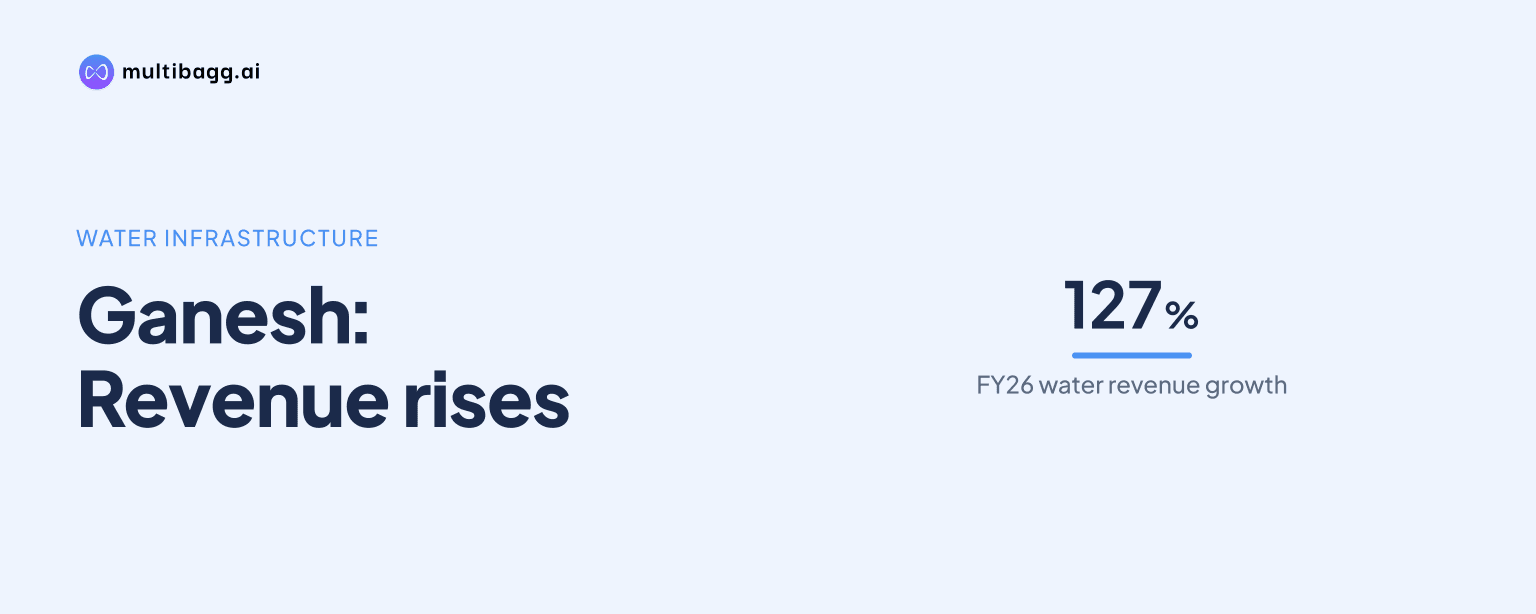
Ganesh Infraworld reported FY26 water-infrastructure revenue of Rs 224 crore, up 127% year on year, while segment EBITDA margin rose 400 basis points to 15%, as it pursued higher-margin sewerage, treatment and mission-linked projects instead of routine household pipeline work.
Know Ganesh Infraworld inside out
Results, valuation, peers and who's buying, in one view.
Why is India’s water and wastewater market expanding?
India’s wastewater-treatment technology market is projected to rise from Rs 28,500 crore in FY25 to Rs 45,200 crore in FY30E, representing a 9.6% compound annual growth rate. Ganesh Infraworld says installed treatment capacity must increase about 3.8 times by FY30 to meet the stated target of 100% urban wastewater treatment.
The gap between treatment capacity and sewage generation is the basis for that projected build-out. Installed sewage treatment plant capacity is shown at 38,600 million litres per day, or MLD, in FY26, compared with urban sewage generation of 95,900 MLD, leaving a stated gap of about 57,300 MLD.
The presentation projects capacity increasing by 81,400 MLD between FY26 and FY30E, while wastewater demand rises by 24,100 MLD over the same period. Ganesh Infraworld identifies urbanisation, an urban population expected to exceed 600 million by 2036, freshwater scarcity and zero-liquid-discharge requirements for red-category industries as sector drivers.
How did Ganesh Infraworld’s water business perform in FY26?
Ganesh Infraworld’s water-infrastructure segment generated Rs 224 crore of revenue in FY26, up 127% from the previous year, and reported an EBITDA margin of 15%, up 400 basis points. EBITDA means earnings before interest, tax, depreciation and amortisation.
The company says water infrastructure carries higher margins than its other segments and that higher-margin mission work is displacing routine, lower-margin household pipeline projects. Its FY27 growth outlook states that water infrastructure is expected to contribute more to the future order book, while civil work will remain a significant and stable revenue contributor.
Ganesh Infraworld disclosed FY25 water-infrastructure orders of more than Rs 50 crore in Odisha and more than Rs 150 crore in Madhya Pradesh. It is also executing a sewerage-network and pumping-station project in Bhubaneswar, Odisha, indicating a mix that includes wastewater networks and pumping assets rather than only household pipelines.
Which government programmes is Ganesh Infraworld targeting?
Ganesh Infraworld is targeting AMRUT 2.0 and Namami Gange Mission-II, which the presentation describes as the Government of India’s flagship water-sector programmes. AMRUT 2.0 has an indicative outlay of Rs 3 lakh crore for FY22 to FY26 and targets universal tap-water and sewerage coverage across 4,378 statutory towns and 500 cities.
Namami Gange Mission-II has a budgetary outlay of Rs 22,500 crore through 2026 and focuses on sewage treatment and pollution abatement in the Ganga basin. The presentation says its sewage treatment plant, or STP, projects are largely delivered through Hybrid Annuity Model, or HAM, public-private partnership structures.
AMRUT 2.0 had projects approved worth Rs 1.90 lakh crore and contracts awarded worth Rs 85,000 crore, against its stated Rs 2.99 lakh crore total outlay. Its annual Union Budget allocation is shown declining from Rs 10,000 crore in FY26 to Rs 8,000 crore in FY27, while Ganesh Infraworld also cites Rs 3 lakh crore or more committed under AMRUT 2.0, Jal Jeevan Mission and Swachh Bharat 2.0 for sewerage, septage and tertiary-reuse capacity.
Got a follow-up? Ask IRIS
How is Ganesh Infraworld seeking larger water tenders?
Ganesh Infraworld is building specialised bidding capability by hiring senior water-sector professionals, including people from large listed engineering, procurement and construction, or EPC, companies. Its stated aim is to strengthen technical pre-qualification credentials for larger and more demanding AMRUT and Namami Gange tenders.
Management’s stated bidding mechanism is that each completed project can strengthen eligibility for the next, larger bid as the company’s track record lengthens. Ganesh Infraworld says larger mission tenders carry better economics than routine pipeline projects, but the presentation does not disclose a water-order-book target, a tender-win target or a projected margin for those programmes.
The company’s existing participation includes subcontracting under the Jal Jeevan Mission in Jaunpur and other districts of Uttar Pradesh. Its Bhubaneswar project combines a sewerage network and pumping stations, while the FY25 orders in Odisha and Madhya Pradesh together exceeded Rs 200 crore based on the disclosed minimum values.
What water-infrastructure capabilities does Ganesh Infraworld list?
Ganesh Infraworld lists water-treatment plants, pumping stations and bulk and distribution pipelines as its end-to-end water-infrastructure capabilities. Its water-treatment scope includes flocculation, filters, pre-ozonization, chemical dosing, lamella settling, sludge systems, multi-layer filtration and industrial-water refining.
For pumping stations, the company lists horizontal, vertical and submersible systems for water supply, irrigation, wastewater and stormwater drainage. It also lists sewage pumping systems and operation and maintenance services, which align with the sewerage-network and pumping-station work it has disclosed in Bhubaneswar.
Its pipeline offering includes design, supply, laying, joining, testing and commissioning for domestic and industrial networks. Ganesh Infraworld lists mild steel, ductile iron, high-density polyethylene, polyvinyl chloride, glass-reinforced plastic, reinforced cement concrete and bar-wrapped steel cylinder pipes, with cross-country pipeline capability up to 4,000 millimetres in diameter.
Conclusion
Ganesh Infraworld’s FY26 disclosure shows water infrastructure becoming a faster-growing and higher-margin part of its operating mix. Revenue reached Rs 224 crore after 127% year-on-year growth, and the 15% EBITDA margin was 400 basis points above the prior-year level as the company shifted toward sewerage, treatment and mission-linked work.
The next point to watch is whether the company’s specialist hiring and stronger pre-qualification credentials convert into larger AMRUT 2.0 and Namami Gange awards. The presentation gives no water-order-book or margin target, while AMRUT’s annual Union Budget allocation is shown at Rs 8,000 crore for FY27, down from Rs 10,000 crore in FY26.