










Ganesh Infraworld: Mining and water drive H1 revenue growth
Key highlights
- Ganesh Infraworld's consolidated H1 FY27 revenue rose 78% to Rs 694 crore, while standalone revenue fell 9% to Rs 354 crore.
- Mining development operations revenue increased 628% to Rs 256.2 crore in H1 FY27.
- Water infrastructure revenue rose 65% to Rs 207.4 crore and had disclosed annualised return on capital employed of about 44%.
- Ganesh Infraworld's consolidated debt was Rs 586 crore at September 30, 2026, versus Rs 494 crore at March 31, 2026.
powered by IRIS
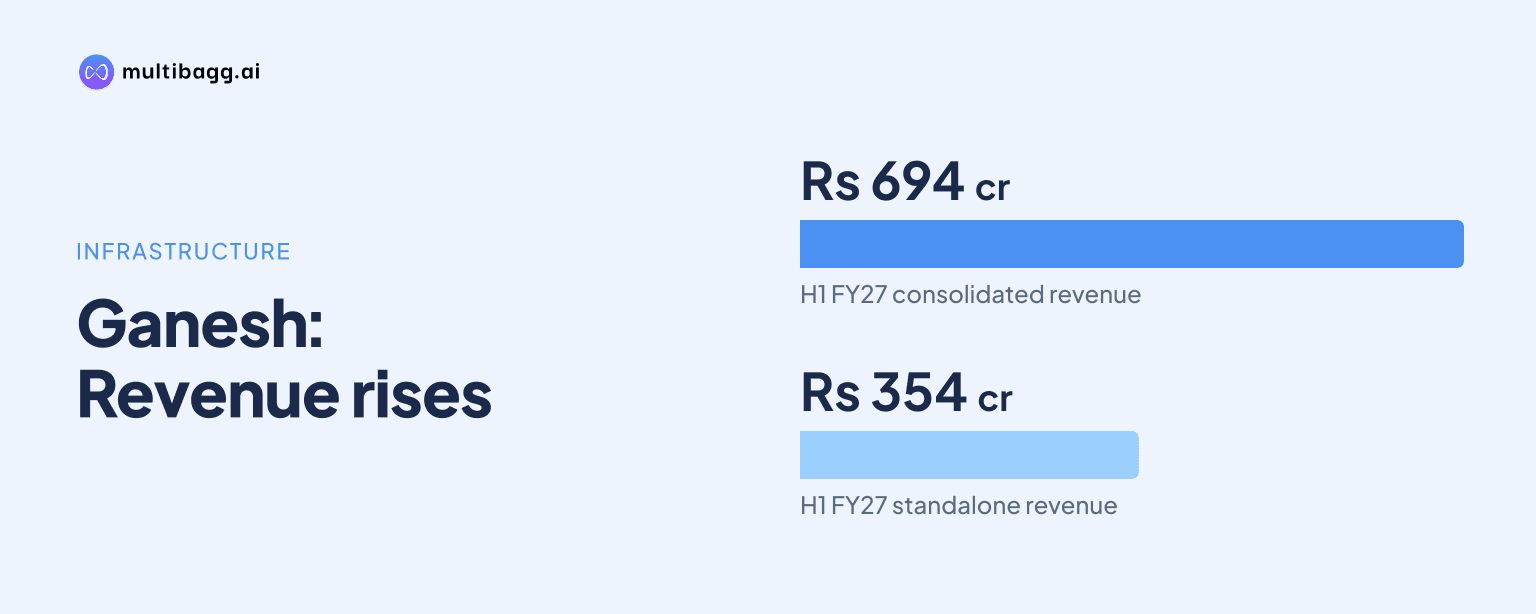
Ganesh Infraworld Ltd reported 78% consolidated revenue growth to Rs 694 crore in H1 FY27, while standalone revenue fell 9% to Rs 354 crore, as mining development operations, water infrastructure and transportation more than offset a decline in civil and electrical infrastructure.
Know Ganesh Infraworld inside out
Results, valuation, peers and who's buying, in one view.
Why did Ganesh Infraworld's H1 FY27 revenue rise 78%?
Ganesh Infraworld's consolidated revenue increased to Rs 694 crore in H1 FY27 from Rs 391 crore in H1 FY26, led by mining development operations and water infrastructure. Consolidated earnings before interest, tax, depreciation and amortisation (EBITDA) rose 128% to Rs 105 crore, while segment EBITDA rose 137% to Rs 113.6 crore before unallocable expenditure, net of unallocable income.
The pace moderated in the second quarter. Q2 FY27 consolidated revenue was Rs 315 crore, up 50% from Rs 210 crore a year earlier but down 17% from Rs 379 crore in Q1 FY27. Reported Q2 EBITDA was Rs 46 crore, compared with Rs 60 crore in Q1, and its margin was 15%, against 16% sequentially and 12% in Q2 FY26.
Gross profit also reflected the changed operating mix. Consolidated gross profit increased 140% to Rs 132 crore in H1 FY27 from Rs 55 crore in H1 FY26, lifting gross profit margin to 19% from 14%. Construction and other direct expenses rose 67% to Rs 561 crore, slower than the 78% increase in revenue.
Which businesses replaced Ganesh Infraworld's civil revenue?
Mining development operations and water infrastructure were the main revenue growth engines in H1 FY27, while civil and electrical infrastructure contracted. Mining revenue rose 628% to Rs 256.2 crore and water revenue rose 65% to Rs 207.4 crore, whereas civil and electrical infrastructure revenue declined 41% to Rs 128.8 crore from Rs 217.3 crore.
Transportation added Rs 83.6 crore of H1 FY27 revenue without a disclosed H1 FY26 comparison, while civic utilities increased revenue by Rs 3.1 crore to Rs 15.2 crore. Mining produced Rs 46.5 crore of segment EBITDA, up from Rs 5.1 crore, and water generated Rs 36.1 crore, up from Rs 18.3 crore. Civil and electrical infrastructure EBITDA fell 31% to Rs 15.8 crore.
The segment data show that growth was not uniform in Q2 FY27. Water revenue was Rs 89.2 crore, down from Rs 118.3 crore in Q1 FY27, while mining revenue declined to Rs 118.6 crore from Rs 137.6 crore. Transportation was the exception among the larger newer businesses, rising 5% sequentially to Rs 42.9 crore in Q2.
Got a follow-up? Ask IRIS
Why did Ganesh Infraworld's standalone profit fall despite group growth?
Ganesh Infraworld's standalone profit after tax (PAT) declined 34% to Rs 22 crore in H1 FY27 from Rs 33 crore in H1 FY26 because standalone revenue fell while depreciation and finance costs increased. Consolidated PAT rose 18% to Rs 39 crore, indicating that the half-year expansion came from businesses outside the standalone operation.
Standalone revenue was Rs 354 crore in H1 FY27 against Rs 391 crore a year earlier, while standalone EBITDA increased 12% to Rs 52 crore from Rs 46 crore. Its EBITDA margin improved to 15% from 12%, and gross profit increased 11% to Rs 61 crore. However, standalone depreciation rose to Rs 10 crore from Rs 2 crore and finance cost increased to Rs 14 crore from Rs 2 crore, reducing profit before tax by 34% to Rs 29 crore.
The divergence was sharper in Q2 FY27. Standalone revenue fell 27% year on year to Rs 153 crore and PAT fell 78% to Rs 4 crore from Rs 18 crore. Consolidated Q2 PAT also declined 50% to Rs 9 crore despite 50% revenue growth, as depreciation reached Rs 18.7 crore and finance cost reached Rs 15.6 crore.
How did fleet investment affect Ganesh Infraworld's earnings?
Ganesh Infraworld's newly capitalised equipment rental and leasing fleet increased depreciation and reduced reported operating profit, even though the segment generated Rs 2.4 crore of H1 FY27 revenue. Management said Rs 118 crore of fixed assets were acquired on credit in H1 FY27, and about Rs 8.6 crore of Q2 depreciation related to this segment.
Equipment rental and leasing reported Q2 earnings before interest and tax (EBIT) of negative Rs 6.4 crore and H1 EBIT of negative Rs 6.2 crore because depreciation exceeded rental income. The segment's H1 EBITDA was positive Rs 2.4 crore, showing the difference between EBITDA and EBIT once fleet depreciation is charged.
Financing requirements increased alongside the fleet investment. Consolidated debt was Rs 586 crore at September 30, 2026, compared with Rs 494 crore at March 31, 2026, including Rs 328 crore at subsidiary level. Q2 finance cost was Rs 15.6 crore against Rs 13 crore in Q1 FY27 and Rs 1.4 crore in Q2 FY26.
Water had the highest disclosed annualised return on capital employed of about 44% in H1 FY27. Its net capital employed rose to Rs 226.4 crore in September 2026 from Rs 93.8 crore in March 2026 as H1 revenue reached Rs 207.4 crore. Mining and transportation together accounted for Rs 386.7 crore, or about 52%, of reportable-segment capital employed.
Conclusion
Ganesh Infraworld's 78% consolidated H1 FY27 revenue increase came from a materially different business mix: mining, water and transportation more than offset the decline in civil and electrical infrastructure and the 9% fall in standalone sales. Higher depreciation and finance costs meant that revenue and EBITDA expansion did not translate proportionately into quarterly PAT.
The next results will show whether water and mining revenue recover from their Q2 sequential declines and whether equipment rental income catches up with fleet depreciation. Management disclosed Rs 118 crore of H1 fixed-asset purchases on credit and consolidated debt of Rs 586 crore at September 30, 2026, making fleet utilisation, depreciation and finance cost measures to watch.