










Tykoon Mines adds Rs 2,566 crore mining-transport order book
Key highlights
- Tykoon Mines’ order book rose to Rs 2,566 crore in H1FY27 from Rs 2,031 crore in FY26.
- Tykoon Mines became a 60% Ganesh Infraworld subsidiary in FY26.
- Tykoon Mines reported a 21% FY26 EBITDA margin versus Ganesh Infraworld’s 13% consolidated FY26 margin.
- Ganesh Infraworld reported Rs 586.4 crore of consolidated debt at September 2026, with subsidiaries accounting for 56%.
powered by IRIS
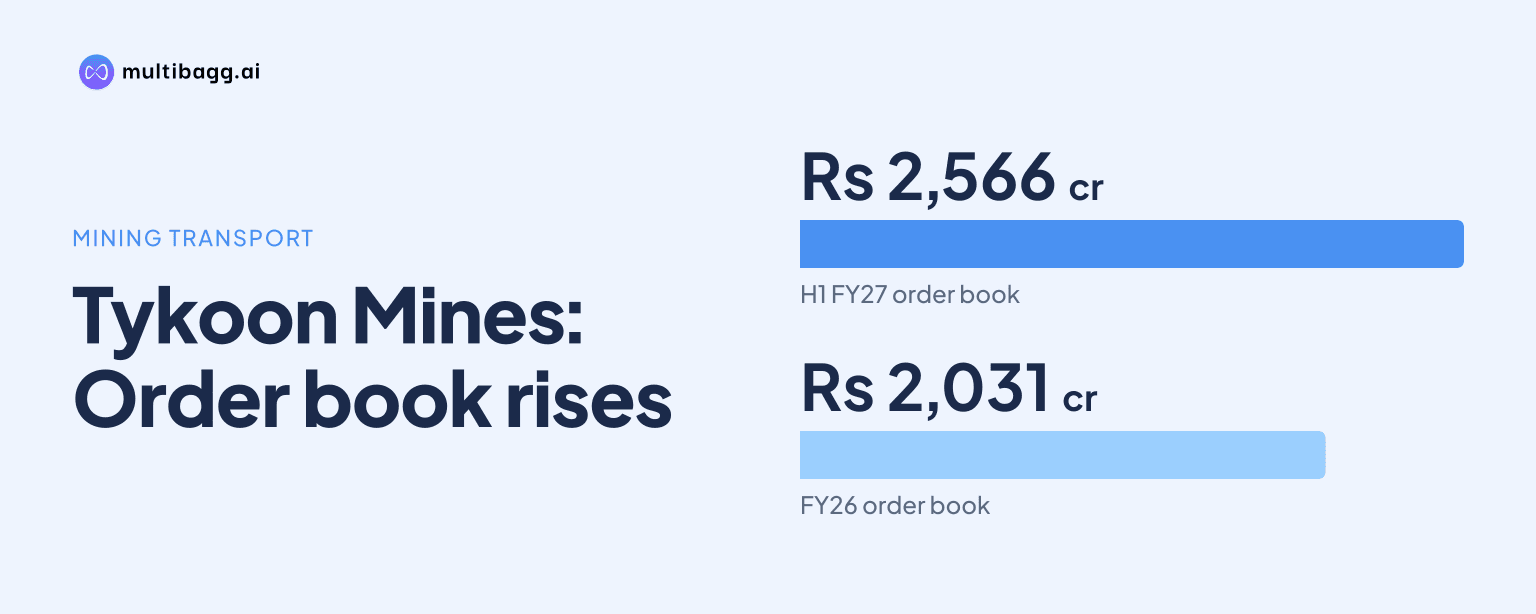
Tykoon Mines GK Ltd became a 60% subsidiary of Ganesh Infraworld Limited in FY26 and reported a Rs 2,566 crore order book in H1FY27, up Rs 535 crore from FY26. The acquisition added mining development operations and bulk transportation to Ganesh Infraworld’s consolidated business, with the presentation describing the Tykoon Mines backlog as four times its FY26 revenue.
Know Ganesh Infraworld inside out
Results, valuation, peers and who's buying, in one view.
What did the Tykoon Mines acquisition add to Ganesh Infraworld?
The acquisition added Tykoon Mines as a 60%-owned, consolidated subsidiary operating mining development operations and transportation, with a Rs 2,566 crore order book in H1FY27. Tykoon Mines, formerly Kandoi Transport, traces its history to 1976 and became a Ganesh Infraworld subsidiary in FY26 after the stake increased to 60%.
Tykoon Mines brought a bulk-transport fleet and mining-services capability that Ganesh Infraworld says can be combined with its mining development operations. The stated mechanism is better equipment utilisation across the combined fleet, intended to reduce idle capacity, while the group describes the combined offering as an end-to-end mining-services platform.
The acquired backlog is material relative to Ganesh Infraworld’s other disclosed workloads. Ganesh Infraworld reported a consolidated order book of about Rs 3,845 crore in H1FY27 and a standalone order book of Rs 1,280 crore across 11 states. On those disclosed figures, Tykoon Mines’ Rs 2,566 crore backlog represented about two-thirds of the consolidated order book.
How did Tykoon Mines’ order book and revenue change?
Tykoon Mines’ order book increased to Rs 2,566 crore in H1FY27 from Rs 2,031 crore in FY26, a rise of Rs 535 crore. The presentation describes the H1FY27 backlog as four times Tykoon Mines’ FY26 revenue of Rs 591 crore, establishing the scale of contracted work against its latest full-year sales.
Tykoon Mines reported Rs 340 crore of revenue in H1FY27, compared with Rs 591 crore for the full FY26. These periods are not directly comparable, so the presentation does not provide a full-year FY27 revenue growth rate. It does show Rs 256 crore of consolidated mining development operations revenue and Rs 84 crore of transportation revenue in H1FY27.
The reported segment mix changed alongside the acquisition. Civil and electrical infrastructure generated Rs 430 crore in FY26 and Rs 129 crore in H1FY27, while water infrastructure generated Rs 224 crore in FY26 and Rs 207 crore in H1FY27. Because H1FY27 covers only six months, these figures are not annual growth comparisons, but mining and transportation had become separately disclosed revenue lines.
Got a follow-up? Ask IRIS
Why does Tykoon Mines change Ganesh Infraworld’s margin and contract profile?
Tykoon Mines changes Ganesh Infraworld’s contract profile because mining contracts typically have seven-year tenures, according to the presentation. Ganesh Infraworld says this supports longer-duration revenue visibility than a business mix centred on engineering, procurement and construction, or EPC, projects, while adding recurring logistics and mining-support services.
The presentation describes the transaction as margin-accretive because Tykoon Mines reported a 21% earnings before interest, tax, depreciation and amortisation, or EBITDA, margin in FY26. Ganesh Infraworld’s consolidated EBITDA margin was 13% in FY26 and 15% in H1FY27. Tykoon Mines’ FY26 margin was therefore 8 percentage points above Ganesh Infraworld’s FY26 consolidated margin.
Ganesh Infraworld reported consolidated EBITDA of Rs 105 crore in FY26 and Rs 105 crore in H1FY27, compared with Rs 52 crore in FY25. Consolidated profit after tax was Rs 71 crore in FY26 and Rs 39 crore in H1FY27, against Rs 38 crore in FY25. The presentation says the equity base expanded sharply after the NSE Emerge listing, affecting return ratios even as absolute profits rose.
Ganesh Infraworld’s stated strategy extends beyond mining. It intends to rebalance segment mix further toward water and civic utilities through FY27, while its water order book was scaling toward about Rs 310 crore in H1FY27 from about Rs 10 crore in FY24. The acquisition therefore forms part of a wider plan combining mining and logistics work with water-sector expansion.
What debt and working-capital factors should readers track after the Tykoon Mines acquisition?
Debt and working capital are key disclosed factors because Ganesh Infraworld says the 60% Tykoon Mines stake was debt-funded. Consolidated net debt to equity increased to 1.19 times in FY26 from 0.15 times in FY25, a movement the presentation links to the acquisition and the subsidiary’s consolidation.
At September 2026, Ganesh Infraworld reported Rs 586.4 crore of consolidated debt, with subsidiaries accounting for Rs 327.9 crore, or 56%, and standalone operations accounting for Rs 258.6 crore. Term loans represented Rs 276.5 crore, cash credit and working-capital facilities represented Rs 223 crore, and other unsecured loans represented Rs 86.9 crore.
Working-capital timing remains relevant to converting the order book into cash. Ganesh Infraworld reported a working-capital cycle of about 94 days in H1FY27, comprising about 100 days of receivables, 37 days of inventory and 43 days of creditors. In FY26, receivable days were 99, inventory days 33 and payable days 32, compared with 53, 17 and 21 days respectively in FY25.
Conclusion
Tykoon Mines gave Ganesh Infraworld a Rs 2,566 crore mining-and-transport order book, a 60% controlled operating platform and a reported FY26 EBITDA margin of 21%. The acquisition made mining development operations and transportation visible parts of H1FY27 segmental revenue alongside water infrastructure and civil and electrical work.
The next disclosed measures to watch are conversion of the Rs 2,566 crore backlog into revenue and cash while consolidated debt stood at Rs 586.4 crore in September 2026. Management has also disclosed a Rs 14,432 crore bid pipeline and a plan to rebalance the business toward water and civic utilities through FY27, while mining contracts’ typical seven-year tenure is its stated basis for longer-term visibility.