










Ganesh Infraworld funded ₹176 crore working-capital build-up
Key highlights
- Ganesh Infraworld absorbed ₹175.7 crore of consolidated working capital in H1 FY27.
- Ganesh Infraworld funded ₹92.0 crore of H1 FY27 cash uses through net borrowings.
- Ganesh Infraworld received ₹18.9 crore from equity shares and warrant money in H1 FY27.
- Ganesh Infraworld's consolidated borrowings increased to ₹586 crore in H1 FY27 from ₹494 crore in March 2026.
powered by IRIS
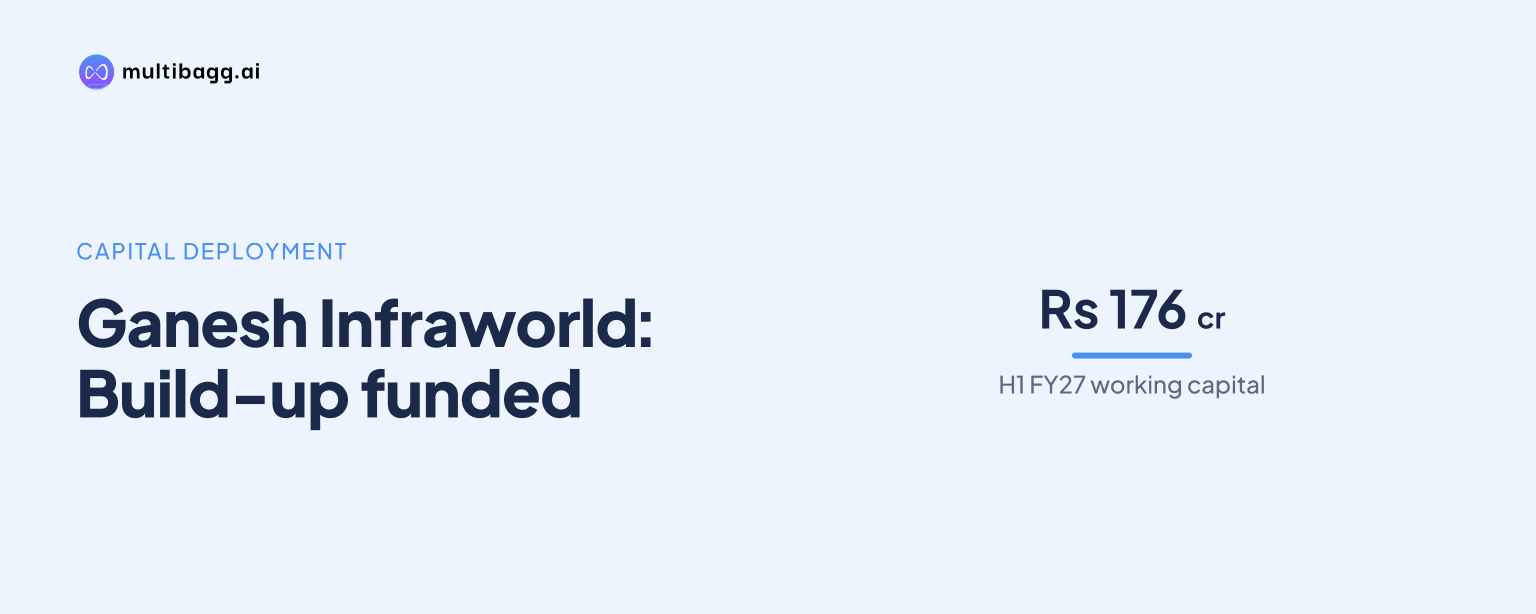
Ganesh Infraworld Ltd. funded a ₹175.7 crore consolidated working-capital build-up in H1 FY27 with ₹92.0 crore of net borrowings and ₹18.9 crore of equity and warrant money. Operating profit before working-capital changes was ₹106.8 crore, but operating activities used ₹81.9 crore of cash after the working-capital movement and ₹12.9 crore of tax payments.
Know Ganesh Infraworld inside out
Results, valuation, peers and who's buying, in one view.
Why did operating cash flow turn negative in H1 FY27?
Ganesh Infraworld recorded negative consolidated operating cash flow because its ₹175.7 crore working-capital absorption exceeded ₹106.8 crore of operating profit before working-capital changes. After ₹12.9 crore of income tax paid, net cash used in operating activities was ₹81.9 crore in H1 FY27, compared with an outflow of ₹29.7 crore in H1 FY26.
The larger cash requirement occurred despite higher operating profit. Operating profit before working-capital changes rose from ₹46.4 crore in H1 FY26 to ₹106.8 crore in H1 FY27, while working-capital absorption increased from ₹70.4 crore to ₹175.7 crore. Short-term loans and advances used ₹75.7 crore, against ₹8.7 crore a year earlier, whereas cash used in trade receivables fell to ₹42.1 crore from ₹71.9 crore.
What drove Ganesh Infraworld's working-capital build-up?
Ganesh Infraworld's ₹175.7 crore net working-capital absorption comprised ₹75.7 crore in short-term loans and advances, ₹42.1 crore in trade receivables and ₹27.2 crore in inventories. Other current and non-current assets accounted for ₹19.8 crore, while other current liabilities classified as operating uses added ₹37.4 crore; trade payables and provisions offset ₹26.5 crore.
The consolidated balance sheet shows expansion in the principal operating-asset categories between March 2026 and H1 FY27. Trade receivables rose from ₹337 crore to ₹380 crore, short-term loans and advances increased from ₹209 crore to ₹285 crore, and inventories rose from ₹112 crore to ₹139 crore. Total current assets increased by ₹164 crore to ₹959 crore over that period.
Ganesh Infraworld also acquired ₹117.7 crore of fixed assets on supplier credit during H1 FY27, which was a non-cash transaction excluded from the ₹8.5 crore investing outflow. Consolidated property, plant and equipment increased from ₹311 crore in March 2026 to ₹401 crore in H1 FY27, while total non-current assets rose from ₹359 crore to ₹450 crore.
How did Ganesh Infraworld fund its H1 FY27 cash uses?
Ganesh Infraworld funded total H1 FY27 uses of ₹226.2 crore through ₹106.8 crore of operating profit before working-capital changes, ₹92.0 crore of net borrowings, ₹18.9 crore of equity shares and warrant money, and an ₹8.5 crore drawdown of cash balances. The uses included ₹175.7 crore for working capital, ₹28.6 crore of interest and finance costs, ₹12.9 crore of tax, ₹8.5 crore of net investing outflow and ₹0.4 crore of dividend paid.
Net borrowings were the largest external source, but financing inflow was lower than the borrowing amount because Ganesh Infraworld paid ₹28.6 crore of interest and finance costs. Net cash from financing activities rose to ₹81.8 crore in H1 FY27 from ₹34.6 crore in H1 FY26, while net borrowings increased from ₹36.9 crore to ₹92.0 crore. No equity or warrant cash inflow was recorded in H1 FY26.
Cash declined by ₹8.5 crore after operating, investing and financing flows were combined. Closing consolidated cash and cash equivalents were ₹3.2 crore in H1 FY27, compared with ₹1.3 crore at the end of H1 FY26. The consolidated balance sheet reported cash and bank balances of ₹3 crore at H1 FY27, versus ₹12 crore in March 2026.
Got a follow-up? Ask IRIS
How did Ganesh Infraworld's borrowings and equity change?
Ganesh Infraworld's consolidated short-term and long-term borrowings increased from ₹494 crore in March 2026 to ₹586 crore in H1 FY27. Short-term borrowings rose by ₹59 crore to ₹407 crore and long-term borrowings increased by ₹33 crore to ₹179 crore, matching the cash-flow split of ₹58.8 crore in short-term and ₹33.2 crore in long-term net borrowings.
Total consolidated equity increased from ₹405 crore in March 2026 to ₹462 crore in H1 FY27, while total assets grew from ₹1,153 crore to ₹1,409 crore. Money received against share warrants was ₹9 crore at the half-year end. The balance-sheet movement accompanied the cash-flow disclosure of ₹18.9 crore from equity shares and warrant money.
Ganesh Infraworld allotted 52,32,800 fully convertible warrants to non-promoter investors on 14 July 2026 at ₹90 each, with 25% or ₹22.50 payable upfront. It converted 10,49,600 warrants into equity on 11 August 2026 for ₹9.45 crore. At 30 September 2026, 41,83,200 warrants remained outstanding, with ₹9.41 crore received and about ₹28.2 crore still receivable upon conversion.
Did Ganesh Infraworld improve working-capital days in H1 FY27?
Ganesh Infraworld reported consolidated working-capital days of 94 in H1 FY27, below 142 days in FY26, despite the ₹175.7 crore cash absorption. Debtor days fell from 147 to 100 and inventory days declined from 49 to 37, while creditor days reduced from 54 to 43. The days measures and the absolute cash increase moved differently as operating-asset balances expanded.
The quarterly movement was uneven: working-capital days increased from 64 in Q1 FY27 to 102 in Q2 FY27. Debtor days rose from 87 to 108, inventory days increased from 24 to 40, and creditor days moved from 48 to 47. Ganesh Infraworld attributed the Q2 effect partly to monsoon conditions that slow site execution and billing.
Q2 FY27 revenue was ₹315 crore, down 17% quarter on quarter and up 50% year on year. Management stated that construction typically records about 40% of annual revenue in H1 and 60% in H2, with July to September being seasonally weaker for execution and billing. That seasonal pattern provides context for Q2 days but does not change the cash outflow recorded through September 2026.
Conclusion
Ganesh Infraworld's H1 FY27 cash flow shows that operating profit of ₹106.8 crore did not cover the ₹175.7 crore working-capital build-up, interest, tax and investing uses. Net borrowings of ₹92.0 crore, equity and warrant proceeds of ₹18.9 crore, and an ₹8.5 crore cash drawdown funded total uses of ₹226.2 crore, while consolidated borrowings reached ₹586 crore.
The next disclosed developments to watch are H2 billing and collections, because management says H2 typically accounts for about 60% of annual construction revenue. Ganesh Infraworld also had 41,83,200 warrants outstanding at 30 September 2026, with about ₹28.2 crore receivable on their conversion, while H1 working-capital days stood at 94 versus 142 in FY26.