










Global Surfaces’ Q2 EBITDA Margin Fell to 2.17% on Costs
Key highlights
- Global Surfaces reported a 2.17% Q2 FY27 EBITDA margin, versus 12.69% in Q1 FY27.
- Q2 FY27 revenue was Rs 60 crore, up 10.7% year on year but down 8.4% sequentially.
- Raw-material prices rose 25% to 50%, while imported-input freight increased nearly fivefold.
- H1 FY27 EBITDA rose to Rs 9.6 crore from Rs 4.4 crore, lifting margin to 7.66% from 3.42%.
powered by IRIS
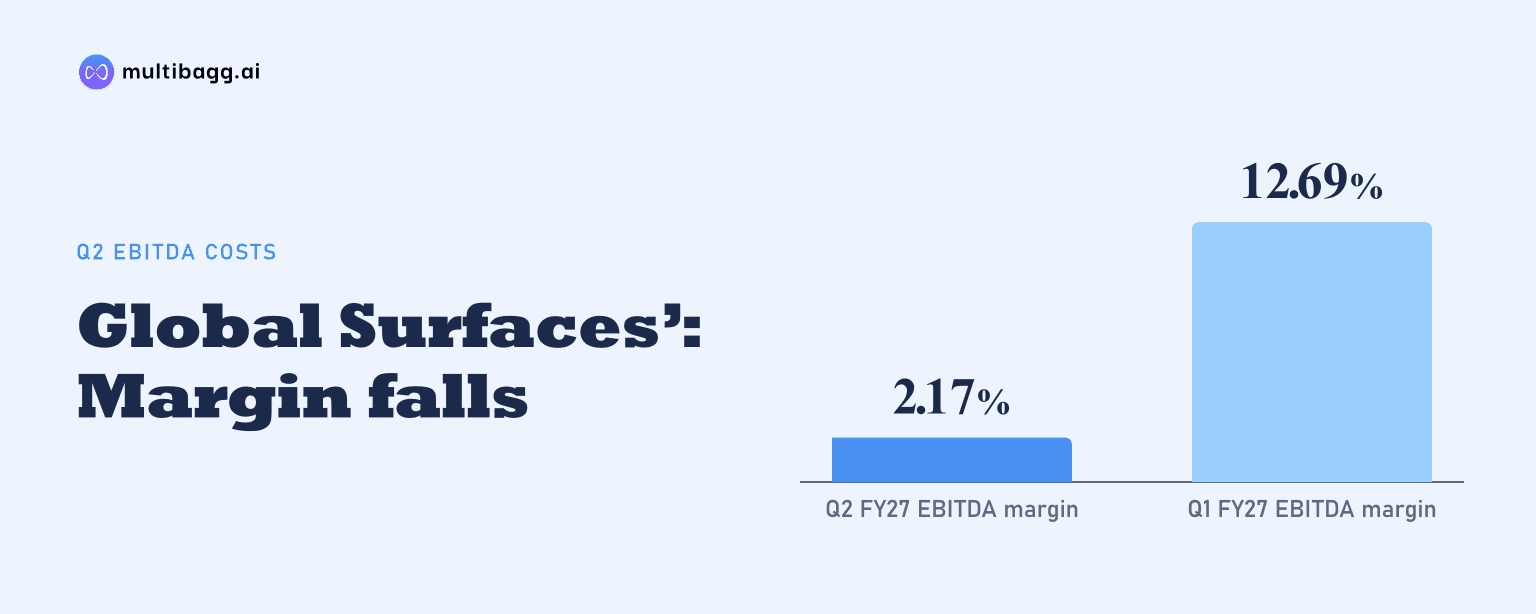
Global Surfaces Limited’s second-quarter (Q2) FY27 earnings before interest, tax, depreciation and amortisation (EBITDA) margin fell to 2.17% from 12.69% in Q1 FY27 as raw-material prices rose 25% to 50% and imported-input freight increased nearly fivefold. Global Surfaces said customer price increases remained limited, leaving the company to absorb most of the higher cost.
Know Global Surfaces inside out
Results, valuation, peers and who's buying, in one view.
Why did Global Surfaces’ Q2 EBITDA margin fall?
Global Surfaces’ Q2 EBITDA margin fell because higher raw-material and logistics costs were not broadly recovered through selling prices. Management said certain raw-material prices rose 25% to 50%, with an estimated average effect of around 10% on selling prices, while freight costs on imported raw materials increased nearly fivefold.
The Q1 FY27 margin also reflected inventory spillover from before the conflict-related disruption, according to management. That inventory effect did not recur in Q2, while raw-material shortages caused production breakdowns during the first half (H1) of FY27. Management said it had reduced internal costs, improved production efficiency and adjusted product mix, but those actions did not offset the quarter’s external cost pressure.
Q2 FY27 revenue from operations was Rs 60 crore, up 10.7% year on year but down 8.4% sequentially. EBITDA improved from a Rs 3.6 crore loss in Q2 FY26 to a Rs 1.3 crore profit, but the decline from Q1 shows that the latest input and freight escalation outweighed the earlier inventory benefit.
How much of the cost increase has Global Surfaces passed on?
Global Surfaces has passed on only a limited share of higher costs, principally through free-on-board (FOB) freight arrangements. Management said it had not made a meaningful selling-price increase because the engineered-quartz market is adjusting to trade disruption after the United States Section 201 safeguard took effect on August 15, 2026.
The safeguard applies an additional 25% duty in its first year to roughly 13 million square metres of imports within a global quota, while volume above that quota faces a 50% tariff. India and the United Arab Emirates, where Global Surfaces has manufacturing operations, were not exempted. Management said customers pay the Section 201 and Section 301 tariffs, but the changed market conditions have restricted the company’s ability to seek higher product prices.
Management said it may work on customer pricing if raw-material inflation and global uncertainty continue after the market adjusts. It also said costs could return to regular levels within one or two months if geopolitical conditions stabilise, which was management’s assessment rather than a committed forecast.
How did Global Surfaces perform in H1 FY27?
Global Surfaces improved H1 FY27 operating profitability despite lower revenue, with EBITDA more than doubling to Rs 9.6 crore from Rs 4.4 crore in H1 FY26. Revenue from operations was Rs 125 crore, down 2.6% year on year, while EBITDA margin increased by 424 basis points to 7.66% from 3.42%.
Reported earnings did not follow the EBITDA improvement because other income declined to Rs 1.8 crore from Rs 9.4 crore. Management attributed the reduction largely to lower unrealised foreign-exchange income. Finance costs fell by Rs 0.2 crore to Rs 7.1 crore, but this did not offset the Rs 7.6 crore reduction in other income, leaving H1 loss after tax at Rs 5.3 crore.
Management said the United Arab Emirates operation was not making a cash loss despite regional challenges and low utilisation. It also said Global Surfaces was at cash break-even in H1 FY27, although it did not disclose a specific utilisation level or a reported cash-profit figure for that period.
Got a follow-up? Ask IRIS
What is Global Surfaces doing to ease margin pressure?
Global Surfaces is seeking to source more inputs domestically, particularly for its United Arab Emirates facility, to reduce freight exposure. It also expanded its marketing team in India and said domestic dispatches commenced in November 2026, adding a new route for raising utilisation at the India plant.
Management said around 70% of products for the domestic launch will come from the India facility, while approximately 30% to 35% will come from the United Arab Emirates facility. Exports represented about 96% of revenue and domestic sales around 4%, so the India channel was still small during the period. Higher India-plant utilisation could spread fixed overheads across a larger revenue base, according to management.
The company is also using product mix to improve sales realisation. Management said Marquartz, its licensed premium engineered-quartz range, has selling prices around 20% to 30% above regular products and utilisation similar to the overall product line. It did not disclose Marquartz volumes, margins or its contribution to EBITDA.
Global Surfaces has narrowed its operational focus to engineered quartz after discontinuing its Natural Stone unit in Bagru from March 31, 2026, except for limited work to complete orders and close the operation. Engineered stone accounted for about 98% of H1 revenue, and the India and United Arab Emirates facilities together have annual capacity of about 1.14 million square metres.
Can Global Surfaces return to its earlier EBITDA margin?
Global Surfaces did not commit to restoring the 12.69% EBITDA margin reported in Q1 FY27. Management said profitability could improve through higher capacity utilisation, production efficiency and cost control, but it was difficult to say whether the Q1 margin could return if current input and geopolitical conditions continued.
An analyst asked about a quarterly revenue run rate of Rs 70 crore to Rs 80 crore as a potential operating-leverage level. Management said achieving that range was possible if geopolitical conditions stabilised, but identified Q4 FY27 as a more realistic timeframe after H1 raw-material shortages and production disruptions. That timing remains dependent on conditions management described as unpredictable.
Conclusion
Global Surfaces’ Q2 FY27 margin decline reflects an immediate mismatch between higher costs and limited pricing recovery. The company remained profitable at the EBITDA level, with Rs 1.3 crore in Q2 and Rs 9.6 crore in H1, but its Q2 margin fell to 2.17% as raw-material inflation of 25% to 50% and nearly fivefold freight growth reduced operating profitability.
The next issue is whether domestic dispatches begun in November 2026, greater local sourcing and a higher-value product mix can raise utilisation and reduce freight exposure. Management identified Q4 FY27 as a more realistic period to seek a Rs 70 crore to Rs 80 crore quarterly revenue run rate, contingent on geopolitical stability, raw-material availability and market acceptance of pricing changes.