










Global Surfaces faces 25%-50% US quartz quota tariffs
Key highlights
- The US quartz safeguard began on August 15, 2026, with 25% duty within an approximately 13-million-square-metre global quota and 50% above it.
- India and the UAE are both excluded from exemptions under the four-year US quartz safeguard.
- Exports contributed approximately 96% of Global Surfaces revenue, while domestic sales represented about 4%.
- Q2 FY27 revenue was Rs 60 crore and EBITDA was Rs 1.3 crore, with a 2.17% EBITDA margin.
powered by IRIS
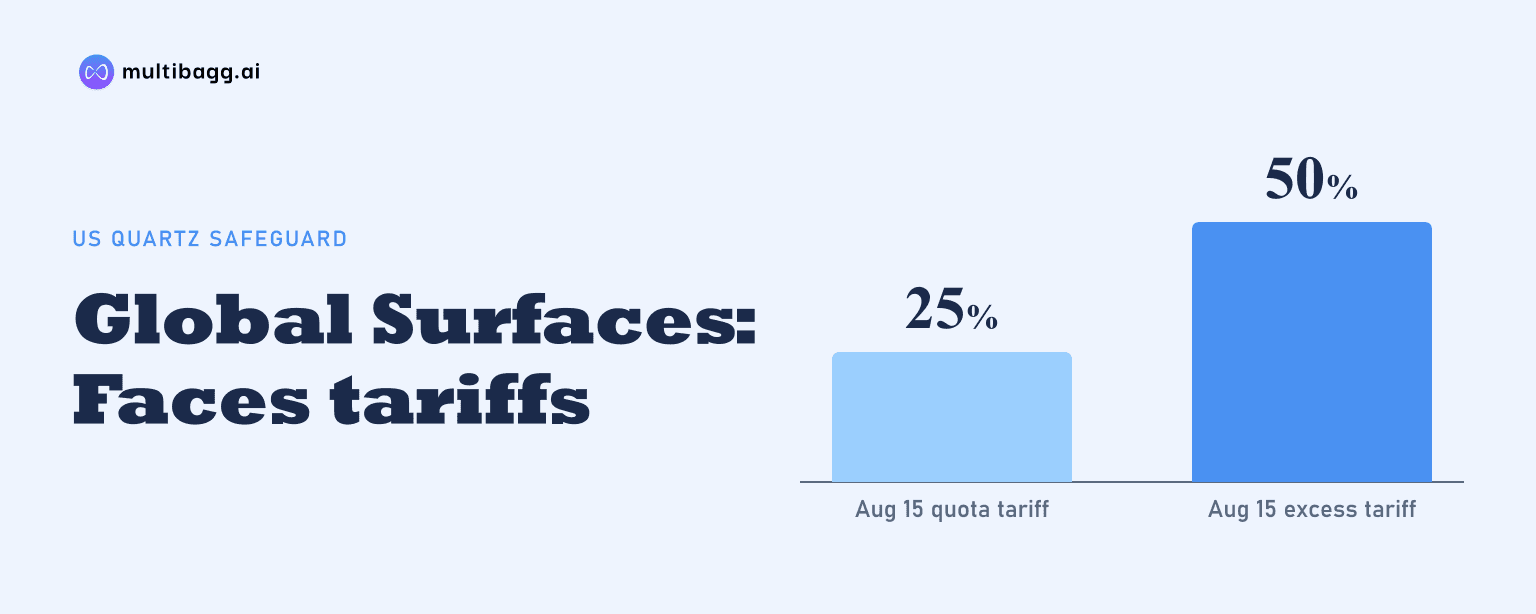
Global Surfaces Limited faces additional United States, or US, duties of 25% on quartz imports within a global quota and 50% above it from August 15, 2026, with India and the United Arab Emirates, or UAE, excluded from exemptions. The four-year safeguard directly affects both countries where Global Surfaces manufactures engineered stone.
Know Global Surfaces inside out
Results, valuation, peers and who's buying, in one view.
How does the US quartz safeguard apply to Global Surfaces?
The US safeguard applies a 25% additional duty to quartz surface-product imports within an approximately 13-million-square-metre global quota in its first year, while imports above that level face a 50% tariff. The Section 201 measure began on August 15, 2026, will run for four years, and is additional to normal duties and any applicable anti-dumping and countervailing duties.
Global Surfaces said the quota is global rather than allocated country by country, requiring non-exempt suppliers to compete for the same permitted import volume. India and the UAE have not received exemptions, according to management. Global Surfaces operates engineered-stone manufacturing facilities in Jaipur and Dubai through its wholly owned Global Surfaces FZE subsidiary, leaving output from both disclosed production locations within the safeguard framework for US sales.
Why does the US market matter to Global Surfaces?
The US matters because exports contributed approximately 96% of Global Surfaces revenue, compared with about 4% from India’s domestic market. Management cited industry estimates that Indian quartz-surface exports to the US were approximately 223 million in 2026 and accounted for around 72% of India’s total quartz exports, indicating the market’s relevance to Indian suppliers.
Global Surfaces has combined annual engineered-stone capacity of approximately 1.14 million square metres at its Jaipur and Dubai facilities. Its US distribution presence includes Global Surfaces Inc. and Superior Surfaces Inc. The company sells six engineered-quartz series, including Aurora, Kalmasa, Prismatic, Stratum, Quartzite and Marquartz, for countertops, flooring, wall cladding, vanities and other interior surfaces.
Has the wider US tariff backdrop eased?
Yes, the broader US tariff backdrop has eased from 2025, but management identified the quartz safeguard as the more immediate industry concern. The company said the earlier 50% tariff imposed in 2025 is no longer in force, while the temporary 10% global tariff expired in July 2026 following the Supreme Court’s February 2026 ruling.
The quartz measure remains a separate product-specific charge, with the 25% in-quota rate and 50% over-quota rate scheduled to decline to 19% and 47%, respectively, by the fourth year as the quota increases. Global Surfaces also said a 10% Section 301 tariff has applied to Indian goods since July 2024, while the interim India-US trade-agreement framework announced in February remains unsigned.
The Government of India has requested consultations with the World Trade Organization, management said, while Indian representatives continue discussions and representations with the US. Those actions do not change the safeguard’s August 15, 2026 effective date. The practical unresolved issue is how suppliers will use the shared global quota while trade discussions continue.
Got a follow-up? Ask IRIS
What operating pressures accompanied the safeguard?
The safeguard took effect as Global Surfaces faced higher raw-material and logistics costs during Q2 FY27. Management said prices of certain raw materials increased by 25% to 50%, with an estimated average impact of around 10% on selling prices, while freight costs for imported raw materials rose nearly fivefold.
Global Surfaces said it had passed on only part of freight costs through free-on-board, or FOB, terms and had not otherwise raised selling prices. Management attributed this limited pass-through to industry disruption after the August 15 safeguard, saying the market was still adjusting to new price parameters. It said future price increases would depend on geopolitical conditions, market acceptance and continuing cost pressure.
Revenue from operations was Rs 60 crore in Q2 FY27, up 10.7% year on year but down 8.4% sequentially. Earnings before interest, tax, depreciation and amortisation, or EBITDA, were Rs 1.3 crore, compared with an EBITDA loss of Rs 3.6 crore in Q2 FY26. EBITDA margin was 2.17%, down from 12.69% in Q1 FY27.
Management said Q1 FY27 benefited from inventory spillover that originated before the regional conflict, whereas Q2 FY27 reflected higher costs. Loss after tax was Rs 5.4 crore in Q2 FY27, against a Rs 4.6 crore loss in Q2 FY26 and near break-even in the preceding quarter. Management said a return to a margin near 12% was uncertain if prevailing conditions continued.
How is Global Surfaces responding to trade risk?
Global Surfaces is pursuing geographic and product diversification while expanding domestic sales in India. Management said it serves North America, the Middle East, Europe and other export markets, and began domestic dispatches in November 2026 after expanding its Indian marketing team.
The product strategy includes Marquartz, an engineered surface made with licensed technology that replicates marble and granite-style veining. Management said its proprietary vein-patterning process supports differentiated products for higher-value applications. The company identified design, quality, technology and service as its product differentiators.
Global Surfaces discontinued its natural-stone unit at Bagru effective March 31, 2026, following a board decision, with only limited activities continuing to complete existing orders and facilitate closure. Engineered stone therefore represented approximately 98% of H1 FY27 revenue, increasing the business’s concentration in the quartz segment affected by the US safeguard.
For H1 FY27, revenue was Rs 125 crore, down 2.6% year on year, while EBITDA rose to Rs 9.6 crore from Rs 4.4 crore. EBITDA margin improved by 424 basis points to 7.66% from 3.42%. Loss after tax widened to Rs 5.3 crore from Rs 5.1 crore as other income declined to Rs 1.8 crore from Rs 9.4 crore, largely due to lower unrealised foreign-exchange income; finance costs fell to Rs 7.1 crore from Rs 7.3 crore.
Conclusion
The safeguard creates a direct US trade constraint for Global Surfaces because India and the UAE, its two manufacturing locations, are not exempt. The expiry of the broader temporary tariff has eased the general backdrop, but the quartz-specific 25% in-quota and 50% over-quota duties affect a business in which engineered stone supplied approximately 98% of H1 FY27 revenue.
The next indicators are the domestic dispatches that began in November 2026, management’s ability to broaden sales across geographies, and customer acceptance of any pricing action if costs persist. Management also pointed to the rising quota and declining rates through year four, ongoing World Trade Organization consultations, and geopolitical conditions affecting costs and capacity utilisation.