










GMM Pfaudler sees HET and PPT lift bookings as PST falls
Key highlights
- GMM Pfaudler’s HET order intake rose 254% year on year to Rs 201 crore in Q2FY27.
- GMM Pfaudler’s PPT order intake rose 85% year on year to Rs 364 crore in Q2FY27.
- GMM Pfaudler’s PST order intake fell 69% year on year to Rs 157 crore in H1FY27 after a Rs 355 crore prior-year order.
- GMM Pfaudler’s CRT recorded the largest H1FY27 order intake at Rs 1,058 crore, up 19% year on year.
powered by IRIS
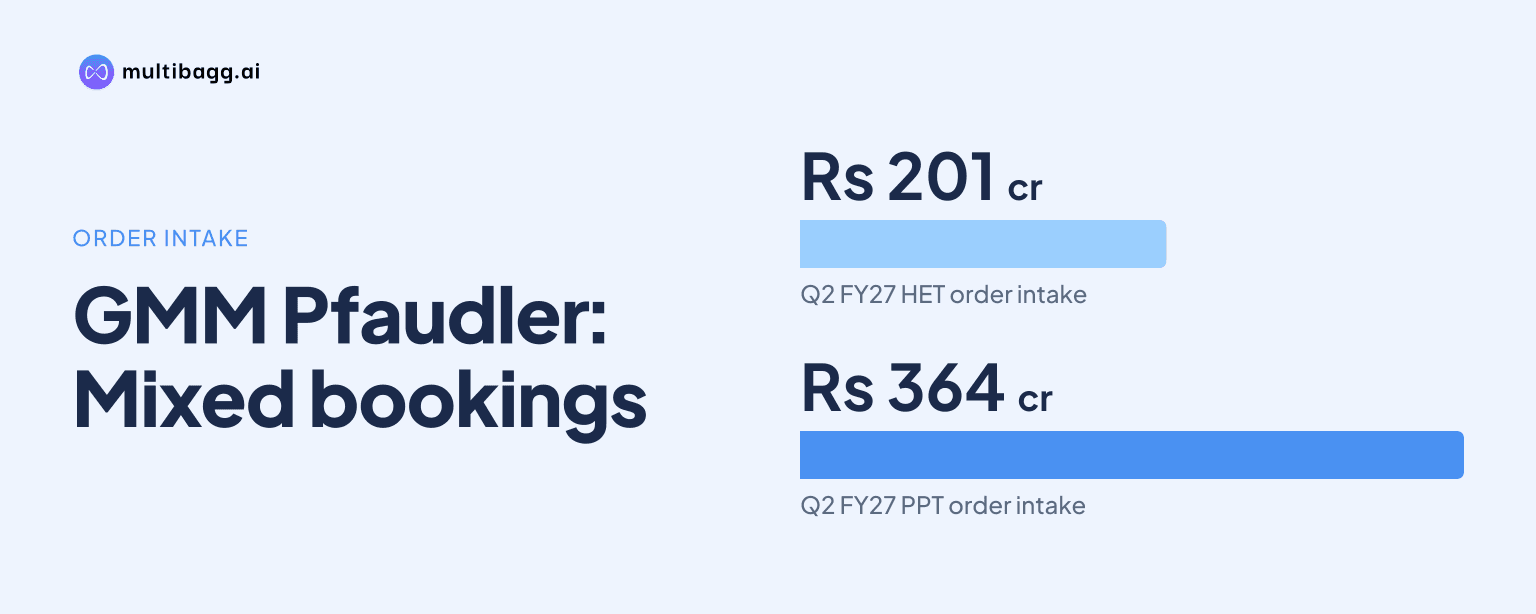
GMM Pfaudler’s Q2FY27 order momentum was led by Heavy Engineering Technologies, where intake rose 254% year on year to Rs 201 crore, and Process Performance Technologies, where it rose 85% to Rs 364 crore; Process System Technologies bookings fell 46% to Rs 78 crore.
Know GMM Pfaudler inside out
Results, valuation, peers and who's buying, in one view.
Which divisions drove GMM Pfaudler’s Q2FY27 order intake growth?
Process Performance Technologies and Heavy Engineering Technologies delivered the fastest year-on-year order-intake growth for GMM Pfaudler in Q2FY27, while Corrosion Resistant Technologies remained the largest booking division by value. HET recorded Rs 201 crore of intake, up 248% quarter on quarter and 254% year on year. PPT reported Rs 364 crore, unchanged from the preceding quarter and 85% higher year on year. CRT added Rs 556 crore, up 11% sequentially and 15% year on year, compared with PST’s Rs 78 crore.
HET’s Rs 201 crore of Q2FY27 bookings was more than double its Rs 92 crore quarterly revenue, whereas PST’s Rs 78 crore of bookings was below its Rs 142 crore revenue. This contrast shows that Q2 order intake was concentrated in CRT, PPT and HET rather than PST. CRT’s Rs 556 crore was the highest divisional intake, but its 15% year-on-year increase was lower than the increases reported by PPT and HET.
How did GMM Pfaudler’s H1FY27 booking mix change?
GMM Pfaudler’s H1FY27 booking mix shifted toward PPT and HET, whose order intake increased 74% and 306% year on year respectively, while PST intake declined 69%. CRT remained the largest division by first-half intake at Rs 1,058 crore, up 19% year on year. PPT booked Rs 731 crore and HET Rs 258 crore, compared with PST’s Rs 157 crore.
PST’s reported 69% decline needs to be read against the comparison period disclosed by GMM Pfaudler. H1FY26 PST intake included a single large order worth Rs 355 crore. The Rs 157 crore recorded in H1FY27 was therefore measured against an elevated prior-year base, rather than being directly comparable with the growth rates of PPT and HET, neither of which carries an equivalent disclosed prior-period order adjustment.
The first-half figures also show different scales across the expanding divisions. PPT’s Rs 731 crore of H1FY27 intake was nearly three times HET’s Rs 258 crore, even though HET’s 306% growth rate was higher. CRT’s Rs 1,058 crore intake exceeded PPT’s by Rs 327 crore, establishing CRT as the largest booking contributor while PPT and HET supplied the main year-on-year acceleration.
Got a follow-up? Ask IRIS
Which GMM Pfaudler divisions delivered the most revenue growth?
PST delivered the fastest H1FY27 revenue growth at 51% year on year to Rs 273 crore, while PPT generated the second-fastest growth at 29% to Rs 586 crore. HET revenue rose 17% to Rs 165 crore and CRT revenue increased 5% to Rs 966 crore. PST’s booking decline therefore coincided with the highest percentage revenue increase among the four divisions in the first half.
In Q2FY27, PPT revenue rose 30% sequentially and 34% year on year to Rs 331 crore. HET revenue increased 24% quarter on quarter and 38% year on year to Rs 92 crore. PST revenue reached Rs 142 crore, up 8% sequentially and 57% year on year, while CRT revenue was Rs 500 crore, up 7% from Q1FY27 and flat against Q2FY26.
The revenue and intake data do not move uniformly across the four divisions. PST had Q2 revenue of Rs 142 crore against new intake of Rs 78 crore, while HET had Rs 92 crore of revenue against Rs 201 crore of intake. PPT’s Rs 364 crore of intake exceeded its Rs 331 crore revenue, and CRT’s Rs 556 crore intake exceeded its Rs 500 crore revenue.
What do GMM Pfaudler’s quarterly trends show by division?
GMM Pfaudler’s Q2FY27 revenue increased from Q1FY27 in all four divisions, but quarterly order momentum varied sharply. PPT revenue climbed from Rs 255 crore in Q1FY27 to Rs 331 crore in Q2FY27, while its order intake remained almost unchanged at Rs 367 crore and Rs 364 crore. HET revenue rose from Rs 74 crore to Rs 92 crore, and its orders jumped from Rs 58 crore to Rs 201 crore.
CRT revenue recovered from Rs 466 crore in Q1FY27 to Rs 500 crore in Q2FY27, its highest level in the five quarters shown, while order intake rose from Rs 502 crore to Rs 556 crore. PST revenue increased from Rs 131 crore to Rs 142 crore, but intake slipped from Rs 80 crore to Rs 78 crore. Over the five-quarter series, PST orders had reached Rs 193 crore in Q4FY26 before declining to Rs 80 crore and Rs 78 crore in the first two quarters of FY27.
The division definitions show why the order mix spans varied industrial activities. CRT combines glass-lined and fluoropolymer businesses serving chemical, pharmaceutical and semiconductor industries. PPT includes mixing, filtration, drying, separation and sealing operations, while HET supplies engineered-to-order critical equipment for nuclear, power and oil and gas customers. PST provides integrated process systems and modular solutions for chemical and pharmaceutical customers, including acid-recovery applications.
Conclusion
GMM Pfaudler’s divisional data show that order growth in Q2FY27 and H1FY27 came principally from PPT and HET, alongside continued absolute-scale growth in CRT. HET’s Rs 201 crore Q2FY27 intake and 254% year-on-year increase were the most pronounced quarterly movements, while PPT combined Rs 364 crore of bookings with 85% growth. PST, in contrast, paired rising revenue with lower orders, with its H1 comparison affected by a disclosed Rs 355 crore order in H1FY26.
The next disclosures should show whether the Q2FY27 HET intake of Rs 201 crore is followed by further quarterly orders and whether PST booking levels recover beyond Rs 78 crore. Separately, management said in August 2026 that refinancing, debt reduction and termination of an intercompany loan were expected within 12 to 18 months, while its group tax-structure review was expected within 18 to 24 months.