










GMM Pfaudler guides double-digit FY27 growth, 10–11% margin
Key highlights
- GMM Pfaudler guides for double-digit FY27 revenue growth and a 10–11% reported EBITDA margin.
- GMM Pfaudler's adjusted FY27 EBITDA margin range is 14–15%, excluding loss-making European entities.
- GMM Pfaudler reported Q2 FY27 operational income of Rs 1,065 crore, up 18% year on year.
- GMM Pfaudler repaid approximately Rs 116 crore of net debt in H1 FY27 through internal accruals.
powered by IRIS
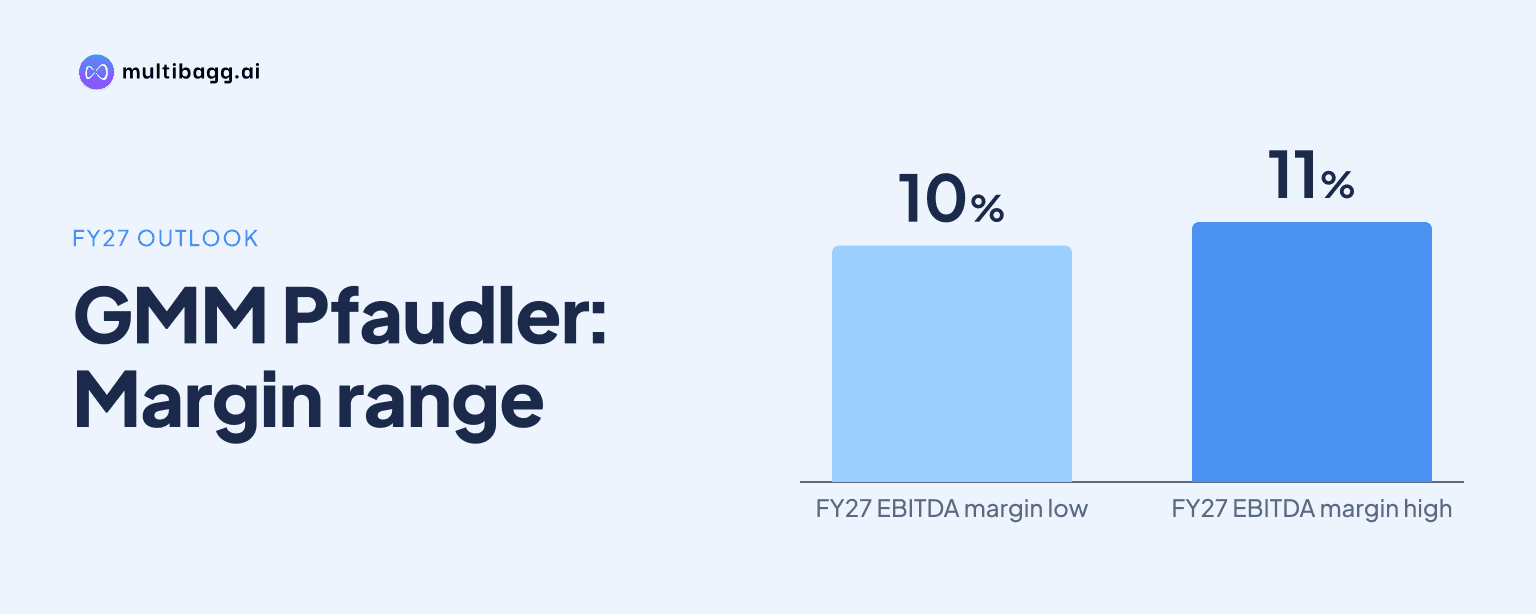
GMM Pfaudler guides for double-digit revenue growth in financial year 2027 (FY27) and a 10–11% reported earnings before interest, tax, depreciation and amortisation (EBITDA) margin, while its 14–15% adjusted range excludes loss-making European entities; its Q2 FY27 EBITDA margin was 10.3%, versus 13.5% in Q2 FY26.
Know GMM Pfaudler inside out
Results, valuation, peers and who's buying, in one view.
What is GMM Pfaudler's FY27 growth and margin guidance?
GMM Pfaudler's FY27 guidance is double-digit revenue growth and a 10–11% reported EBITDA margin. The presentation also gives a 14–15% adjusted EBITDA margin range, defined as excluding loss-making European entities. The reported range is therefore 4 to 5 percentage points below the adjusted range.
In Q2 FY27, operational income was Rs 1,065 crore, up 15% from Rs 925 crore in Q1 FY27 and 18% from Rs 902 crore in Q2 FY26. EBITDA rose 18% sequentially to Rs 110 crore from Rs 94 crore, but was 9% below Rs 122 crore a year earlier. The margin improved by 22 basis points from 10.1% in Q1 FY27 but was 312 basis points below the prior-year quarter.
Management's FY27 priorities are execution of the record order backlog, cost efficiencies, greater use of low-cost manufacturing sites, a European cost reset, refinancing and legal-entity simplification. The presentation says the backlog provides revenue visibility for the second half of FY27, but does not disclose its value or quantify savings from the initiatives.
Why is GMM Pfaudler's adjusted margin higher than its reported margin?
GMM Pfaudler's 14–15% adjusted EBITDA range is higher because it excludes loss-making European entities, while the 10–11% reported range includes them. Management identifies right-sizing European operations to market conditions as an FY27 priority and says reduced European drag should begin to contribute to group margins in FY28. The presentation does not disclose Europe’s standalone revenue, loss or margin.
Management also cites cost efficiencies and greater use of low-cost manufacturing sites in the global supply chain as FY27 margin-improvement mechanisms. These measures are priorities rather than quantified savings targets, so the presentation does not specify how much of the 4-to-5-percentage-point difference between reported and adjusted guidance may close in FY27.
The Q2 FY27 cost mix shows the year-on-year margin movement. Material cost rose 41% to Rs 466 crore from Rs 331 crore in Q2 FY26, while other costs increased 8% to Rs 488 crore from Rs 450 crore. Total operating expenses rose 22% to Rs 954 crore, compared with 18% operational-income growth to Rs 1,065 crore.
Got a follow-up? Ask IRIS
Which divisions support GMM Pfaudler's FY27 revenue outlook?
GMM Pfaudler's Process Performance Technologies and Heavy Engineering Technologies divisions delivered the fastest first-half (H1) FY27 order-intake growth, while Corrosion Resistant Technologies remained the largest revenue division. Corrosion Resistant Technologies recorded H1 FY27 revenue of Rs 966 crore, up 5% year on year, compared with Rs 586 crore for Process Performance Technologies, up 29%.
Heavy Engineering Technologies reported H1 FY27 revenue of Rs 165 crore, up 17%, while Process System Technologies reported Rs 273 crore, up 51%. Process System Technologies order intake fell 69% to Rs 157 crore because the H1 FY26 comparison included a single large order worth Rs 355 crore, according to the presentation.
Process Performance Technologies provided the largest quarterly revenue increase in Q2 FY27, reaching Rs 331 crore from Rs 255 crore in Q1 FY27 and Rs 247 crore in Q2 FY26. Heavy Engineering Technologies revenue reached Rs 92 crore, up 24% sequentially and 38% year on year. Corrosion Resistant Technologies reached Rs 500 crore and Process System Technologies reached Rs 142 crore in Q2 FY27.
How does GMM Pfaudler plan to improve earnings conversion by FY28?
GMM Pfaudler plans to improve the movement from earnings before interest and tax (EBIT) to PAT through refinancing, debt reduction, tax-structure work and termination of intercompany loans. It repaid approximately Rs 116 crore of net debt through internal accruals in H1 FY27. Management places the refinancing and debt-reduction programme within 12–18 months from August 2026.
The stated refinancing objective is to restructure and reduce group debt and remove the need for intercompany loans that create foreign-exchange fluctuations. Management says the intended outcome is lower interest cost and finance charges. Finance cost was Rs 31 crore in Q2 FY27, versus Rs 23 crore in Q1 FY27 and Rs 30 crore in Q2 FY26.
Management also plans to unwind intercompany loans between subsidiaries in different currencies within 12–18 months from August 2026, aiming to reduce foreign-exchange and tax exposure below EBIT. Separately, it is reviewing and simplifying the legal-entity structure within 18–24 months. Q2 FY27 profit before tax was Rs 50 crore, up from Rs 40 crore sequentially but below Rs 62 crore a year earlier, while PAT increased to Rs 35 crore from Rs 22 crore in Q1 FY27.
Conclusion
GMM Pfaudler's outlook separates revenue momentum from the European profitability effect within its consolidated result. Double-digit FY27 revenue growth is linked to record-backlog execution and growth across three divisions, while the 10–11% reported EBITDA-margin guidance retains the impact of loss-making European entities. The 14–15% adjusted range indicates the margin measure excluding those entities, not the reported target.
The next disclosures to watch are second-half FY27 backlog execution, European right-sizing and the progress of refinancing and debt reduction. Management has set a 12–18 month timeline from August 2026 for refinancing, debt reduction and intercompany-loan termination, and an 18–24 month timeline for legal-entity simplification. Its FY28 framework anticipates reduced European drag and improved earnings conversion, without numerical FY28 guidance.