










GMM Pfaudler's Europe losses cut H1 EBITDA by Rs 43 crore
Key highlights
- GMM Pfaudler reported a Rs 43 crore EBITDA loss from European entities in H1 FY27.
- H1 FY27 EBITDA margin was 10.2%, compared with 15.2% excluding loss-making European entities.
- GMM Pfaudler's Q2 FY27 backlog reached Rs 2,446 crore, up 14% year on year.
- GMM Pfaudler repaid approximately Rs 116 crore of net debt in H1 FY27.
powered by IRIS
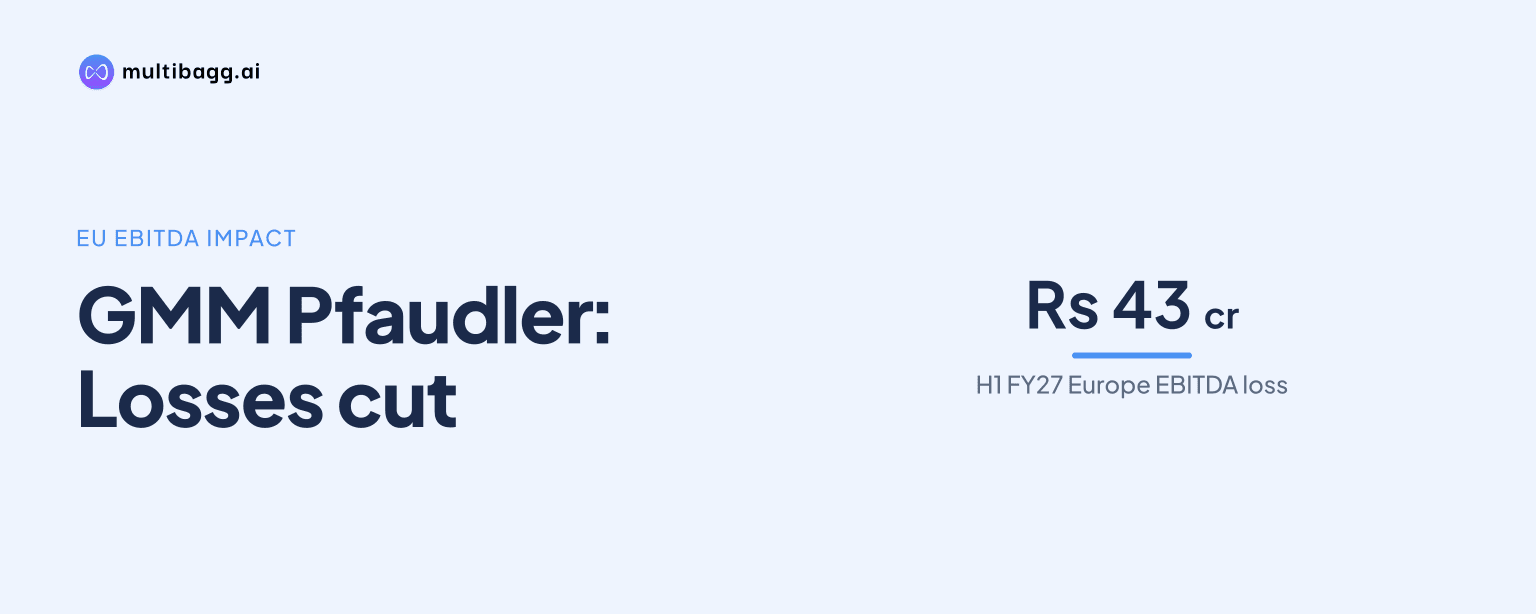
In the first half of financial year 2027 (H1 FY27), GMM Pfaudler reported a Rs 43 crore earnings before interest, tax, depreciation and amortisation (EBITDA) loss from loss-making European entities, reducing reported EBITDA margin to 10.2% from 15.2% excluding them. The company is shifting Europe-serving production to India and Poland under an ongoing restructuring.
Know GMM Pfaudler inside out
Results, valuation, peers and who's buying, in one view.
How much did European losses affect GMM Pfaudler's H1 FY27 profitability?
European loss-making entities reduced GMM Pfaudler's H1 FY27 EBITDA by Rs 43 crore and lowered its reported margin by 5.0 percentage points. Reported H1 FY27 EBITDA was Rs 204 crore at a 10.2% margin, compared with Rs 247 crore at a 15.2% margin excluding the loss-making entities.
The same effect was apparent in Q2 FY27. Reported Q2 EBITDA was Rs 110 crore at a 10.3% margin, versus Rs 139 crore at a 15.9% margin excluding the European entities, a difference of Rs 29 crore and 5.6 percentage points. The H1 gap was larger in rupee terms because it covers two quarters, while the margin gap narrowed to 5.0 points from Q2's 5.6 points.
At group level, H1 FY27 revenue rose 17% year on year while EBITDA declined 8% year on year. In Q2 FY27, revenue increased 15% quarter on quarter and 18% year on year, while EBITDA rose 18% quarter on quarter but fell 9% year on year. GMM Pfaudler identifies the loss-making European entities as a specific drag despite what it describes as healthy core performance.
Why are GMM Pfaudler's European entities making losses?
GMM Pfaudler attributes the losses to a structural reset in Europe's chemicals industry, marked by plant closures and lower investment in new large-scale capacity. The presentation does not disclose European revenue, individual entity losses or a timetable for a market recovery, but it directly links the Rs 43 crore H1 FY27 loss to European entities.
The company describes chemicals investment as subdued because of global overcapacity, while pharmaceutical investment remains strong, driven by contract development and manufacturing organisations and peptides. This contrast is relevant to the restructuring because GMM Pfaudler is addressing European manufacturing costs while continuing to serve traditional industries with different investment conditions.
Group order flow was higher despite the European chemicals backdrop. H1 FY27 order intake reached Rs 2,204 crore, and backlog was Rs 2,446 crore at the end of Q2 FY27. Q2 order intake of Rs 1,198 crore was 19% above Q1 FY27 and 36% above Q2 FY26, while backlog was 7% higher quarter on quarter and 14% higher year on year.
What restructuring actions is GMM Pfaudler taking in Europe?
GMM Pfaudler is consolidating its European glass-lined manufacturing footprint, closing a UK facility in Q3 FY25 and implementing workforce reduction measures in Germany in Q3 FY26. It says India operations are being used as a lower-cost manufacturing base for the European business.
The restructuring also covers its Western European process systems operations, where work remains ongoing. GMM Pfaudler has designated Poland and India as lower-cost hubs for Europe, but it has not disclosed restructuring charges, affected headcount, a completion date or a specific EBITDA target from the programme.
The disclosed sequence shows that the reset has extended across multiple periods: the UK closure in Q3 FY25, German workforce actions in Q3 FY26, and continuing Western European restructuring in H1 FY27. Management's plan is to change the production footprint, rather than only reduce capacity, by moving more Europe-serving manufacturing to India and Poland.
The operating programme sits alongside a group leadership realignment announced among H1 FY27 corporate highlights. GMM Pfaudler appointed Gregory Gelhaus as Group Chief Executive Officer and Ankit Nayyar as Group Chief Financial Officer to provide direction and oversight across four business divisions. The presentation does not state a date for these appointments or assign a separate financial target to the new structure.
Got a follow-up? Ask IRIS
What does GMM Pfaudler's order book show during restructuring?
GMM Pfaudler's H1 FY27 order intake of Rs 2,204 crore was 59% of the Rs 3,714 crore recorded in the full FY26, while Q2 FY27 backlog of Rs 2,446 crore exceeded the Rs 2,194 crore reported at FY26-end. Backlog therefore increased by Rs 252 crore between FY26-end and the end of Q2 FY27.
The latest quarterly trend was positive on both comparisons provided by the company. Q2 FY27 order intake of Rs 1,198 crore followed Rs 1,007 crore in Q1 FY27 and was above Rs 878 crore in Q2 FY26. The backlog rose from Rs 2,289 crore in Q1 FY27 to Rs 2,446 crore in Q2 FY27.
Management points to varying demand across end markets. It cites capacity expansion in domestic markets, the Middle East and Africa for petrochemicals; a sustained European defence spending upcycle; and Indian investment in nuclear and thermal power. It also identifies investment linked to data centres, grid expansion and electrification in metals and minerals, alongside a multi-year US semiconductor cycle powered by artificial intelligence.
These order figures do not establish when European chemicals demand will recover. They do show that the group entered H2 FY27 with Rs 2,446 crore of backlog while its production-cost reset continued, separating the group-wide order environment from the performance of the loss-making European entities.
How does GMM Pfaudler's balance sheet frame the restructuring?
GMM Pfaudler repaid approximately Rs 116 crore of net debt in H1 FY27, including Rs 100 crore of net long-term borrowings and Rs 16 crore of net short-term borrowings. Total borrowings stood at Rs 732 crore on September 30, 2026, down from Rs 835 crore on March 31, 2026, while cash and bank balances declined from Rs 688 crore to Rs 482 crore.
Net debt to equity was 0.2 times on September 30, 2026, compared with 0.1 times at FY26-end, while net debt to EBITDA was 0.6 times against 0.4 times. Shareholders' equity rose to Rs 1,296 crore from Rs 1,204 crore over the same dates. GMM Pfaudler does not state how much cash the European restructuring has consumed.
Working-capital funding increased over the period. Net funding for inventory rose to Rs 337 crore on September 30, 2026 from Rs 210 crore on March 31, 2026, and inventory days net of customer advances increased to 32 from 22. Receivable days remained at 48, payable days increased to 57 from 49, and the cash conversion cycle rose to 24 days from 21 days.
Conclusion
GMM Pfaudler's disclosed data show that the European businesses were a material difference between group-level operating demand and reported profitability in H1 FY27. Revenue growth of 17% year on year, H1 order intake of Rs 2,204 crore and a Q2 backlog of Rs 2,446 crore occurred alongside an EBITDA decline of 8% year on year, reflecting the losses from the European entities.
The next reported results will show progress on the continuing Western European restructuring and the planned use of India and Poland as lower-cost hubs for Europe. Management has not disclosed the programme's completion date, cost, headcount impact or margin target, leaving those items and the future performance of the European entities unresolved.