










GMM Pfaudler European losses cut H1 EBITDA by ₹43 crore
Key highlights
- GMM Pfaudler's loss-making European entities reduced H1 FY27 EBITDA by ₹43 crore.
- H1 FY27 reported EBITDA was ₹204 crore at a 10.2% margin, versus ₹247 crore and 15.2% excluding loss-making entities.
- GMM Pfaudler closed a UK CRT facility in Q3 FY25 and implemented Germany workforce reductions in Q3 FY26.
- GMM Pfaudler's H1 FY27 backlog was ₹2,446 crore, up 14% year on year.
powered by IRIS
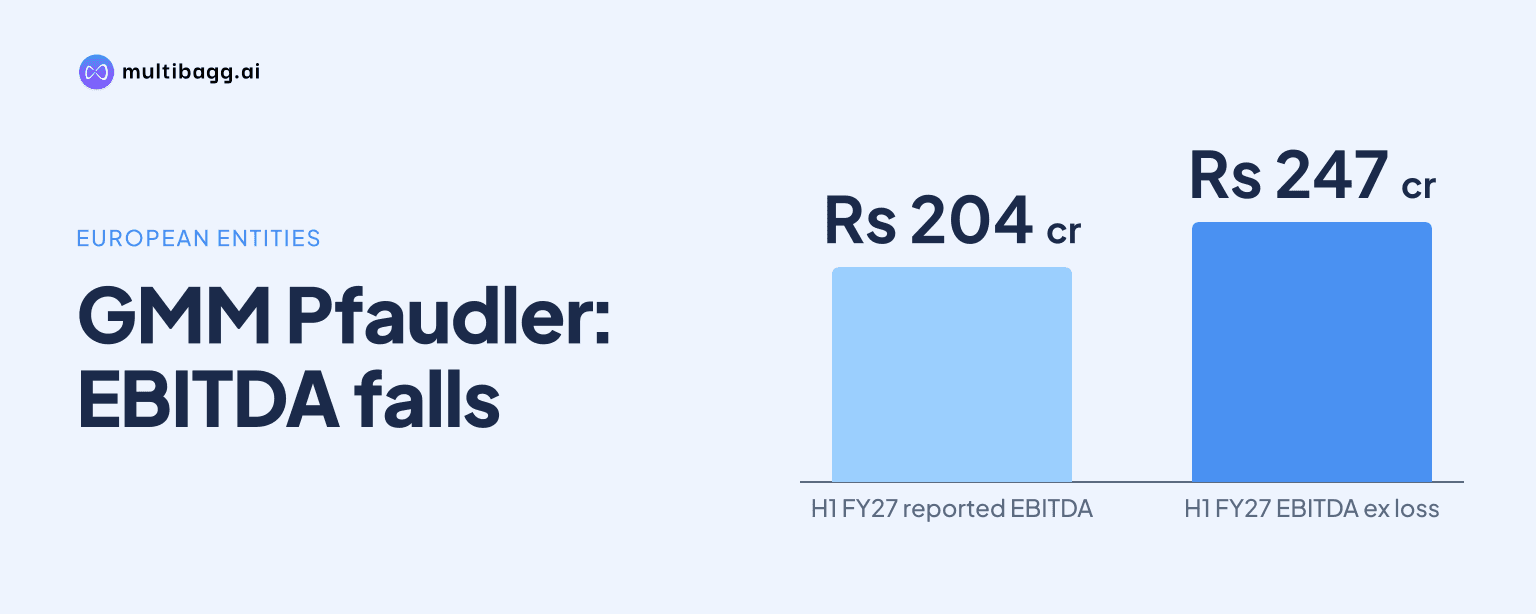
GMM Pfaudler reported that loss-making European entities reduced H1 FY27 EBITDA by ₹43 crore, leaving reported EBITDA at ₹204 crore and the margin at 10.2%, versus ₹247 crore and 15.2% excluding those entities. The company is restructuring European manufacturing and increasing use of India and Poland as lower-cost production hubs.
Know GMM Pfaudler inside out
Results, valuation, peers and who's buying, in one view.
How much did European losses affect GMM Pfaudler's H1 FY27 EBITDA?
European losses reduced GMM Pfaudler's H1 FY27 EBITDA by ₹43 crore. Reported EBITDA was ₹204 crore at a 10.2% margin, compared with ₹247 crore at a 15.2% margin excluding loss-making entities. The difference was 5.0 percentage points of margin.
The effect was also visible in Q2 FY27, when reported EBITDA was ₹110 crore and the margin was 10.3%. EBITDA excluding loss-making European entities was ₹139 crore at a 15.9% margin, a ₹29 crore difference and a 5.6-percentage-point margin gap. The quarterly gap was therefore wider than the H1 gap of 5.0 percentage points.
GMM Pfaudler said H1 FY27 revenue rose 17% year on year while EBITDA declined 8%. In Q2 FY27, operational income increased 18% year on year to ₹1,065 crore, but EBITDA fell 9% from ₹122 crore in Q2 FY26 to ₹110 crore. The reported EBITDA margin declined from 13.5% to 10.3%, a 312-basis-point change, with one basis point equal to one-hundredth of a percentage point.
Why are GMM Pfaudler's European entities loss-making?
GMM Pfaudler attributes the losses to a structural reset in the European chemicals market, including plant closures and lower investment in new large-scale capacity. The presentation does not quantify European chemical demand or identify individual loss-making legal entities, but it explicitly states that the entities affected group performance in H1 FY27.
The company distinguishes this backdrop from several other end markets. It says chemical investment remains subdued because of global overcapacity, while pharmaceutical investment is supported by contract development and manufacturing organisations and peptides. GMM Pfaudler also cites capacity expansion in petrochemicals, European defence spending, Indian power investment, electrification-related metals demand and United States semiconductor growth, without providing revenue figures for those markets.
The restructuring covers Corrosion Resistant Technologies, or CRT, and Process Performance Technologies, or PPT. CRT includes glass-lined and fluoropolymer businesses, while PPT includes mixing, filtration, drying, separation and sealing. In H1 FY27, CRT revenue was ₹966 crore, up 5% year on year, and PPT revenue was ₹586 crore, up 29%.
Orders increased in both divisions despite the European losses. CRT order intake rose 19% year on year to ₹1,058 crore in H1 FY27, while PPT order intake increased 74% to ₹731 crore. The presentation identifies both businesses in the European manufacturing reset, indicating that higher order intake had not yet eliminated losses in the affected operations.
What manufacturing changes is GMM Pfaudler making in Europe?
GMM Pfaudler is consolidating CRT's European glass-lined manufacturing footprint, using India as a lower-cost manufacturing base. It closed a UK facility in Q3 FY25 and implemented workforce-reduction measures in Germany in Q3 FY26. The presentation does not state the facility's output, the workforce affected or the cost of either action.
For PPT, GMM Pfaudler says Western European restructuring remains ongoing, with Poland and India becoming lower-cost hubs for Europe. It does not disclose how many sites may be closed, the timetable for completion, expected restructuring charges or expected savings. These remain unresolved matters in the H1 FY27 presentation.
The plan forms part of GMM Pfaudler's FY27 priorities, which include a global supply-chain ramp-up through greater use of lower-cost manufacturing sites and a European cost reset to align operations with market conditions. The group backlog was ₹2,446 crore in H1 FY27, up 7% quarter on quarter and 14% year on year, while Q2 FY27 order intake was ₹1,198 crore, up 19% quarter on quarter and 36% year on year.
Got a follow-up? Ask IRIS
Which divisions are supporting GMM Pfaudler's revenue and orders?
CRT remained GMM Pfaudler's largest division by H1 FY27 revenue at ₹966 crore, while PPT, Heavy Engineering Technologies, or HET, and Process System Technologies, or PST, reported faster growth. PPT revenue rose 29% year on year to ₹586 crore, HET revenue increased 17% to ₹165 crore, and PST revenue rose 51% to ₹273 crore.
In Q2 FY27, PPT revenue increased 30% quarter on quarter and 34% year on year to ₹331 crore. CRT revenue was ₹500 crore, up 7% quarter on quarter but flat year on year. HET generated ₹92 crore, up 24% sequentially and 38% year on year, while PST revenue reached ₹142 crore, up 8% sequentially and 57% year on year.
Order trends varied by division. HET recorded H1 FY27 order intake of ₹258 crore, up 306% year on year, and PPT's ₹731 crore was 74% higher. PST order intake declined 69% year on year to ₹157 crore because H1 FY26 included a large ₹355 crore order, according to GMM Pfaudler.
GMM Pfaudler also repaid ₹116 crore of net debt in H1 FY27 through internal accruals, including ₹100 crore of net long-term borrowings and ₹16 crore of net short-term borrowings. At September 30, 2026, borrowings were ₹732 crore, down from ₹835 crore at March 31, 2026, while cash and bank balances were ₹482 crore, down from ₹688 crore.
What are GMM Pfaudler's margin targets after the European reset?
GMM Pfaudler's FY27 guidance is for double-digit revenue growth, reported EBITDA margin of 10% to 11%, and adjusted EBITDA margin of 14% to 15% excluding loss-making European entities. Its H1 FY27 reported margin of 10.2% was within the reported guidance range, while the 15.2% measure excluding those entities was above the stated adjusted range.
For FY28, management says reduced European drag, cost efficiencies and greater use of lower-cost manufacturing sites should begin to show in group margins. The presentation also identifies four global divisions, refinancing, debt reduction and legal-entity simplification as drivers of earnings conversion, but does not provide a quantified FY28 margin target.
GMM Pfaudler's refinancing and debt-reduction plan had a 12-to-18-month timetable as of August 2026. In the same period, it plans to unwind intercompany loans between subsidiaries in different currencies to reduce foreign-exchange and tax exposure below earnings before interest and tax. A review and simplification of the legal-entity structure has an 18-to-24-month timetable.
Conclusion
GMM Pfaudler's H1 FY27 disclosures quantify the profitability effect of its European operations: ₹43 crore separated reported EBITDA of ₹204 crore and a 10.2% margin from ₹247 crore and 15.2% excluding loss-making entities. Revenue and orders rose in several divisions, notably PPT and HET, but European losses continued to affect consolidated EBITDA.
The next items to watch are execution of the ongoing PPT restructuring, increased production from India and Poland for European customers, and the FY27 outcome against management's 10% to 11% reported and 14% to 15% adjusted margin guidance. Management also plans refinancing and intercompany-loan termination within 12 to 18 months, while legal-entity simplification is scheduled over 18 to 24 months.