










GMM Pfaudler reports Rs 1,198 crore orders and Rs 2,446 crore backlog
Key highlights
- GMM recorded Rs 1,198 crore of second-quarter FY 2027 order intake, up 36% year-on-year.
- HET quarterly order intake reached Rs 201 crore, up 254% year-on-year.
- GMM's consolidated order backlog stood at Rs 2,446 crore, up 14% year-on-year.
- H1 FY 2027 revenue was Rs 1,989 crore, up 17% year-on-year.
powered by IRIS
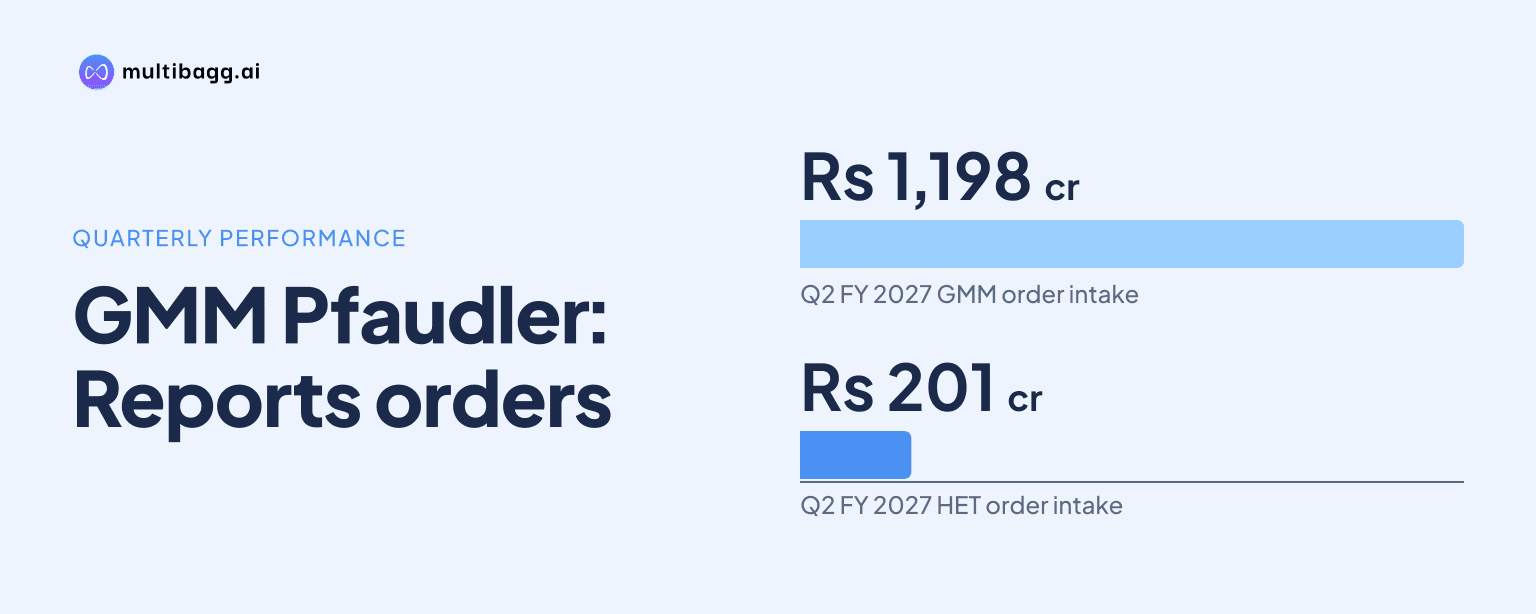
GMM Pfaudler recorded Rs 1,198 crore of order intake in the second quarter of fiscal year 2027, up 36% year-on-year, and its consolidated backlog reached a record Rs 2,446 crore, up 14%. The quarterly result included Rs 201 crore of HET orders, up 254% year-on-year, as demand broadened across divisions.
Know GMM Pfaudler inside out
Results, valuation, peers and who's buying, in one view.
What drove GMM's record quarterly order intake?
GMM's record Rs 1,198 crore quarterly intake was driven by demand across its technology portfolio, with orders increasing 36% year-on-year and 19% sequentially. For the first half of fiscal year 2027, or H1 FY 2027, order intake was also a record Rs 2,204 crore, up 17% year-on-year, while management said all four divisions contributed to commercial momentum.
India recorded its highest-ever quarterly order intake of Rs 483 crore, more than double sequentially, driven by large orders in HET, the division label used by management for heavy engineering. Non-traditional industries accounted for 44% of quarterly orders. Management said this mix reflected efforts to diversify the revenue base and reduce reliance on traditional end markets, though it did not disclose order values by industry.
HET supplied the sharpest increase, reporting Rs 201 crore of orders in the quarter. Management said a large African order spanned oil and gas, petrochemicals and fertiliser, while its work with Nuclear Power Corporation of India and Megha Engineering supported nuclear-sector activity. It also cited orders for low-pressure and high-pressure heaters as its entry into thermal-power equipment.
Which GMM divisions produced the order growth?
HET produced the fastest growth, with quarterly intake rising 254% year-on-year and 248% sequentially to Rs 201 crore. Its H1 order intake was Rs 258 crore, up 306% year-on-year, while its H1 revenue increased 17% to Rs 165 crore. Quarterly HET orders exceeded its Rs 92 crore of revenue in the period, indicating that new business was added faster than it was converted into sales.
The PPT division, the label used by management, reported quarterly order intake of Rs 364 crore, up 85% year-on-year but flat sequentially. PPT revenue rose 34% year-on-year and 30% sequentially to Rs 331 crore. For H1 FY 2027, it reported Rs 731 crore of orders, up 74%, and Rs 586 crore of revenue, up 29%.
Corrosion Resistant Technologies remained the largest revenue division at Rs 500 crore in the quarter, with sales flat year-on-year and up 7% sequentially. Its Rs 556 crore of orders rose 15% year-on-year. PST, another division label used on the call, recorded Rs 77 crore of quarterly orders and Rs 142 crore of revenue, with revenue up 57% year-on-year and 8% sequentially.
How much business does GMM carry into the second half?
GMM entered the second half of FY 2027 with a Rs 2,446 crore consolidated order backlog, 14% above the prior-year level. Management said the record backlog provided visibility for the second half, but it did not disclose a division-wise backlog split, a full execution timetable or a margin profile for the entire order book.
Quarterly consolidated revenue was Rs 1,065 crore, up 18% year-on-year and 15% sequentially. H1 revenue reached Rs 1,989 crore, up 17% year-on-year, compared with H1 order intake of Rs 2,204 crore. Orders therefore exceeded revenue by Rs 215 crore during the first half, consistent with the increase in the reported backlog.
Management said its Indian factory was full and that heavy engineering was booked until the second quarter of the following year. It also said glass-lined equipment pricing in India had improved and expected a strong second half. These are management assessments, and the call did not provide capacity volumes, delivery dates or a numerical estimate of the pricing change.
Got a follow-up? Ask IRIS
Why has order growth not fully lifted GMM's reported profitability?
GMM reported quarterly earnings before interest, tax, depreciation and amortisation, or EBITDA, of Rs 110 crore, up 18% sequentially, at a reported margin of 10.3%. Management said gross margins remained affected by loss-making entities in Europe and transformation-related costs, although operating leverage from higher revenue supported the sequential improvement.
Excluding loss-making entities, management estimated quarterly EBITDA of about Rs 139 crore and a 15.9% margin. For H1 FY 2027, reported EBITDA was Rs 204 crore at a 10.2% margin, compared with about Rs 247 crore and a 15.2% margin excluding those entities. The Rs 43 crore H1 difference was management's measure of the effect of loss-making operations.
Quarterly profit after tax was Rs 35 crore, compared with Rs 38 crore in the corresponding quarter a year earlier and up 59% sequentially. H1 profit after tax was Rs 57 crore, up 20% year-on-year, and management said it had surpassed the full-year FY 2026 profit. During H1, GMM repaid approximately Rs 116 crore of net debt as part of its refinancing and debt-reduction programme.
What does GMM expect from restructuring and FY 2027?
Management expects double-digit revenue growth in FY 2027 and a reported EBITDA margin of about 10% to 11%, including loss-making entities. It said approximately 80% of the business was operating at EBITDA margins of 14% to 15%, while the adjusted group margin excluding loss-making entities was guided at 14% to 15%.
The European restructuring includes the closure of the United Kingdom facility, workforce reductions in Germany and a progressive shift of selected manufacturing activities to Poland. Management said the major German restructuring cost was accounted for in the previous year and it did not expect large additional European restructuring costs. It expects benefits to begin appearing in the second half of FY 2027 and to have fuller effect from FY 2028.
GMM also said its Swiss operations were being reduced and restructured, with some benefits expected in the next financial year. CRISIL maintained the group's AA- credit rating with a stable outlook. Management expects refinancing, lower debt, legal-entity simplification and tax initiatives to reduce finance costs and foreign-exchange volatility over time.
Conclusion
GMM's Rs 1,198 crore quarterly order intake shows that growth was not limited to its traditional corrosion-resistant equipment operations. Corrosion Resistant Technologies remained the largest revenue unit at Rs 500 crore, while PPT delivered 85% order growth and HET delivered 254% order growth, lifting the group's backlog to Rs 2,446 crore.
The next measure to watch is conversion of the record backlog into second-half FY 2027 revenue and margins. Management has guided for double-digit FY 2027 revenue growth and a 10% to 11% reported EBITDA margin, while identifying the end of FY 2027 and FY 2028 as the periods when European restructuring benefits should become more visible.