










GMM Pfaudler targets tax rate of 30% or less by FY2028
Key highlights
- GMM targets an effective tax rate of 30% or less by FY2028, versus about 49% in FY2026.
- An analyst cited a tax rate of about 30% for the quarter discussed, compared with about 45% in the preceding quarter.
- GMM addressed Rs 116 crore of debt repayment in the first half of FY2027.
- Management expects German restructuring benefits in Q3 and Q4, with a larger effect in the following Q1.
powered by IRIS
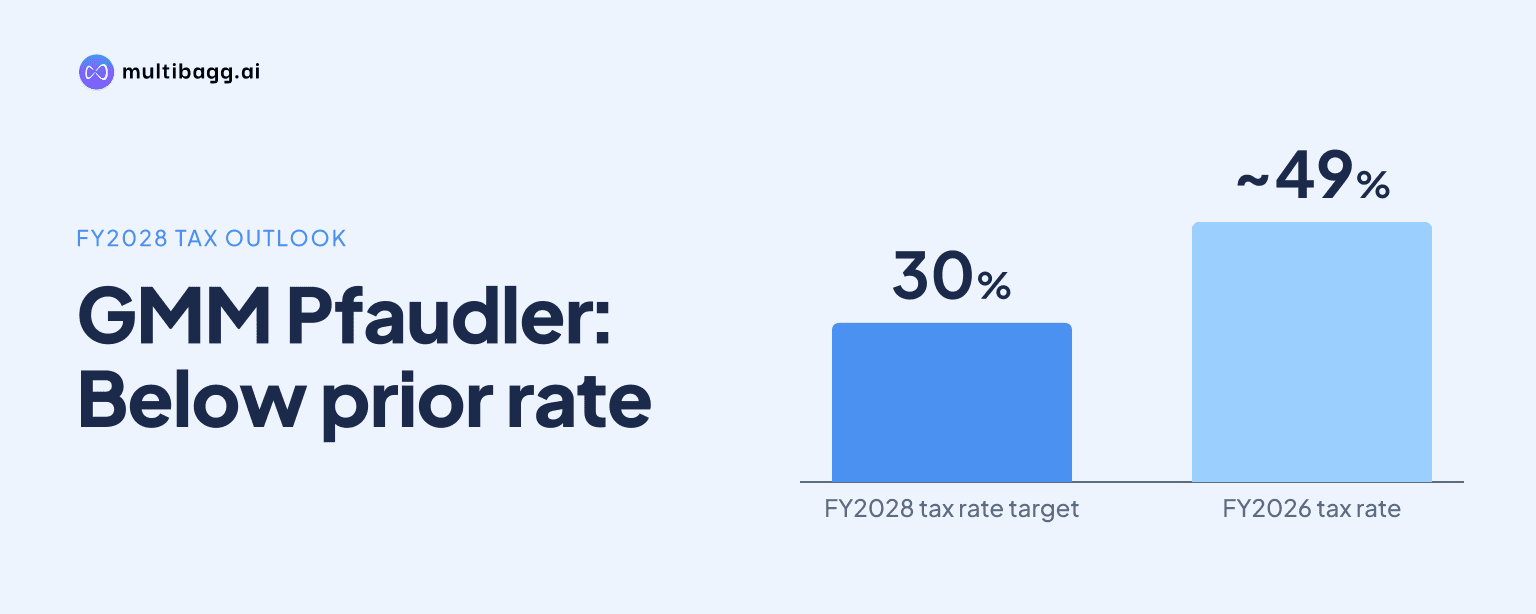
GMM Pfaudler is targeting an effective tax rate of 30% or less by FY2028, compared with about 49% in FY2026, as tax restructuring and refinancing are intended to lift profit after tax. Management said tax initiatives had begun appearing in financial results and expects finance cost to be lower than last year.
Know GMM Pfaudler inside out
Results, valuation, peers and who's buying, in one view.
What tax rate is GMM targeting by FY2028?
GMM is targeting an effective tax rate, or ETR, of 30% or less by FY2028, from about 49% in FY2026. Management described the target as an endeavour and said tax restructuring had made good progress, with some initiatives beginning to show an effect in the financial statements.
The target applies to the conversion of earnings before interest, tax, depreciation and amortisation, or EBITDA, into profit after tax, or PAT, rather than to gross margin or revenue. Management said GMM would show year-on-year tax-rate improvement from the FY2026 ETR of about 49% and hoped to be in the targeted range by FY2028.
An analyst said the tax rate was about 30% in the quarter under discussion, compared with about 45% in the preceding quarter. Management did not provide a separate confirmation of those quarterly rates, but said its tax-restructuring actions had started to show in financials and that quarterly improvement should continue as the initiatives progress.
GMM did not disclose taxable profit, a rupee value of prospective tax savings, or a specific ETR forecast for FY2027. The difference between the FY2026 rate of about 49% and the FY2028 target of 30% or less therefore indicates the direction of management's plan, rather than a quantified PAT benefit for either year.
How will refinancing change GMM's finance costs?
GMM expects refinancing to reduce finance costs by removing inefficiencies in its present debt structure and intercompany loans. Management said FY2026 included certain notional losses arising from those arrangements, and said cleaner finance costs should be recorded once the refinancing initiatives are completed.
This is a separate profitability lever from tax restructuring. A lower ETR affects the tax charge after pre-tax profit, while refinancing is intended to reduce interest and other finance-cost effects between EBITDA and PAT. Management said these two actions would add to PAT when they take effect.
GMM did not give a rupee estimate for finance-cost savings in FY2027 or FY2028, despite an analyst seeking a numerical reduction. Management said only that interest cost should be lower than last year and that it had made good progress on both the refinancing and tax-restructuring programmes.
Management also did not provide a completion date for refinancing in the discussion. It said timelines had been shared in the previous quarter and that progress had been faster than expected, but did not restate those timelines or quantify the finance-cost impact in the supplied call.
Got a follow-up? Ask IRIS
How much debt has GMM repaid in FY2027?
GMM repaid Rs 116 crore of debt in the first half of FY2027, according to an analyst's question that management addressed. Management cautioned that foreign-exchange effects influenced the quarter-on-quarter debt movement, meaning repayment should not be treated as the reported balance-sheet change for the same period.
The company did not disclose a closing debt balance, net-debt target or deadline for debt reduction in this discussion. Management said its capital-allocation approach would seek lower debt as cash flows improve, and linked that approach to its expectation that finance cost will be lower than last year.
The analyst characterised GMM as free-cash-flow positive, but management did not provide a quantified free-cash-flow outlook in its reply. Its stated position was that debt had been repaid during the first half of FY2027 and that further debt reduction would remain an objective as cash generation improves.
Debt repayment and refinancing address different mechanisms. Lower borrowings can reduce interest expense over time, while the refinancing programme is intended to remove notional losses associated with the current debt structure and intercompany loans. GMM has not disclosed how much of the expected finance-cost change would come from each mechanism.
What other actions could improve GMM's profit conversion?
GMM is combining tax and finance initiatives with an organisational redesign intended to improve EBITDA from a gross-margin base of about 60%. Management said it moved from a regional organisation to four global technology divisions and aligned support teams around those divisions to streamline operations and raise productivity.
Management said the new structure creates opportunities to improve the movement from gross margin to EBITDA while maintaining customer service. It described gross margin of about 60% as the starting point for the programme, while presenting tax restructuring and refinancing as the separate EBITDA-to-PAT levers.
European restructuring is part of the EBITDA plan. Management said the United Kingdom operation, restructured two years earlier, is profitable, while Germany was the main driver of the European EBITDA loss. GMM said Germany could break even in the next few quarters after restructuring undertaken last year.
Management expects some German cost benefits in the third quarter, more in the fourth quarter and a greater benefit in the first quarter of the following year. It said the larger German restructuring costs are behind it, while Swiss changes should involve no material restructuring cost despite the entity having about 30 employees.
In Switzerland, management said reducing eight, nine or 10 roles could produce a significant cost benefit because the location is expensive. It also said improved order intake could fill factories and increase operating leverage. GMM cited India EBITDA margins of 13% to 14% in a first half it described as not favourable for shipments, but declined to provide an aggregate margin forecast before its investor day.
Conclusion
GMM's plan to improve PAT rests on identifiable below-EBITDA measures: lowering its ETR from about 49% in FY2026 toward 30% or less by FY2028, reducing finance-cost inefficiencies through refinancing, and repaying debt as cash flows allow. These actions sit alongside the four-division reorganisation and European cost measures intended to improve EBITDA.
The next disclosed milestones are German restructuring benefits expected to emerge in the third and fourth quarters and become larger in the following first quarter. Management also plans an investor day in the coming months, when it said it expects to provide clearer detail on restructuring savings, operating leverage and other margin actions.