










Gokul Agro targets 10%-15% volume growth after expansion
Key highlights
- Gokul Agro expects about 8 lakh tonnes per annum of added capacity to start operating from October 2027.
- Management expects 10% volume growth in the next year and 10% to 15% annual growth thereafter.
- H1 FY27 revenue rose 10% to Rs 12,763 crore while EBITDA including other income increased 46% to Rs 493 crore.
- Gokul Agro’s H1 FY27 EBITDA margin rose to 3.86% from 2.92% a year earlier.
powered by IRIS
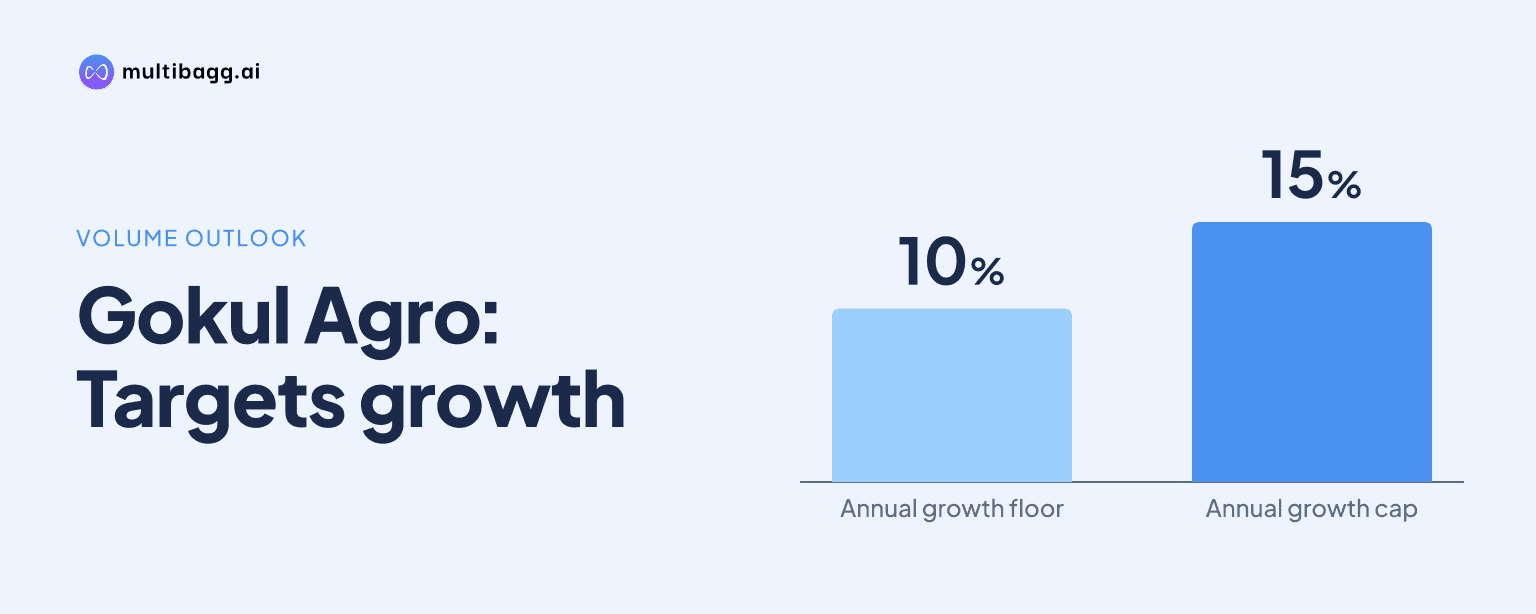
Gokul Agro Resources Limited said capacity additions of about 8 lakh tonnes per annum, scheduled to become operational from October 2027, should support annual volume growth of 10% to 15% thereafter. Management linked the target to full optimum use of existing capacity, which it said will limit volume growth in FY27 despite higher revenue.
Know Gokul Agro Resources inside out
Results, valuation, peers and who's buying, in one view.
Why is Gokul Agro adding capacity?
Gokul Agro is adding capacity because key refining operations are at high utilisation and management said it had reached full optimum capacity. In the half year ended September 30, 2026, revenue from operations rose 10% year on year to Rs 12,763 crore, but management said the increase was broadly driven by better price realisations rather than volume growth.
The planned additions cover Gandhidham, Krishnapatnam, Haldia and Mangalore and are expected to add about 8 lakh tonnes per annum. Gandhidham, the largest site, has refining capacity of about 3,400 tonnes per day, seed-crushing capacity of 3,200 tonnes per day and biodiesel capacity of 300 tonnes per day; Krishnapatnam and Haldia have refining capacity of about 1,400 tonnes per day and 1,350 tonnes per day, respectively.
When will Gokul Agro’s new capacity start operating?
Gokul Agro said the added capacity will become operational only by October 2027, with capacity introduced gradually at each location. Management did not disclose the project cost, the capacity split by site or a plant-by-plant commissioning schedule during the call.
Management expects volume growth of 10% in the next year, considering prevailing commodity prices across India, followed by annual growth of 10% to 15% thereafter. It said the capacity is intended to provide greater throughput, improved fixed-cost absorption, shorter supply-chain lead times and additional room for both business-to-business, or B2B, and business-to-consumer, or B2C, demand.
How did Gokul Agro perform before the expansion?
Gokul Agro reported H1 FY27 revenue from operations of Rs 12,763 crore, up 10% year on year, while earnings before interest, tax, depreciation and amortisation, or EBITDA, including other income rose 46% to Rs 493 crore. Profit after tax increased 54% to Rs 274 crore, showing that reported profitability grew faster than revenue during the half year.
EBITDA margin expanded to 3.86% in H1 FY27 from 2.92% a year earlier, while profit-after-tax margin rose to 2.14% from 1.54%. In Q2 FY27, revenue increased 13% to Rs 7,481 crore and EBITDA rose 41% to Rs 276 crore; management said average commodity market prices had increased by 15% to 20%.
A September 24, 2026 revision to import duties on key edible oils caused dealers and distributors to defer purchases while awaiting price clarity, according to management. Gokul Agro said this reduced September off-take and lifted quarter-end inventory, but channel activity had started normalising after the duty announcement.
Got a follow-up? Ask IRIS
Which businesses will drive Gokul Agro’s growth?
Gokul Agro said edible oils will remain the main source of volume growth, while B2C and value-added products are additional growth drivers. Edible oils accounted for about 85% of consolidated volume in H1 FY27, while B2B contributed about 79% of channel revenue, exports 13% and B2C retail 8%.
B2C revenue share increased from around 5% in FY26 to 8% in H1 FY27. Gokul Agro sells brands including Vitalife, Mahek, Sun Premium and Farm Jyoti through more than 650 dealers and distributors across 28 states and Union Territories, and management has earmarked less than Rs 25 crore for B2C marketing, to be deployed gradually based on market response.
Management said B2C margins are currently more or less in line with the consolidated margin rather than substantially higher. It expects branding and advertising costs during the medium-term build-out, while citing higher turnover, wider distribution and increased market visibility as mechanisms that could gradually support B2C volumes and margins.
Biodiesel is another newer revenue platform, although management identified edible oils as the larger volume engine. The 300-tonnes-per-day Gandhidham biodiesel facility became fully operational in Q1 FY27 and generated Rs 237 crore of revenue in Q2 FY27 and Rs 596 crore in H1 FY27.
How is Gokul Agro managing commodity and currency exposure?
Gokul Agro said it uses back-to-back selling and hedging rather than speculation to manage edible-oil price risk. Management said inventory is generally sold through physical forward markets or hedged on exchanges for palm and soybean oil, and that only 10% to 15% of inventory is kept open.
About 80% of Gokul Agro’s raw-material procurement is imported, according to management, creating exposure to both commodity prices and the rupee-dollar rate. Management said import payments are hedged through simple forward policies and cited the Chicago Board of Trade and Malaysian exchanges as venues used to protect commodity margins.
Management said EBITDA per tonne is a preferable measure when assessing price realisations because percentage margins can be affected by commodity-price movements. It also said lower edible-oil prices could stimulate higher volumes, although it did not provide a quantified relationship between price declines, volume growth and absolute EBITDA.
Conclusion
Gokul Agro’s plan is to move from a period of capacity constraints to one of higher throughput after October 2027. The proposed 8 lakh tonnes per annum addition supports management’s 10% to 15% annual volume-growth expectation, while H1 FY27 results showed revenue growth of 10% and EBITDA growth of 46% before the expansion begins.
The next disclosures to watch are the phased commissioning of the four-site expansion from October 2027 and the delivery of management’s stated 3.5% to 4% EBITDA-margin expectation. Investors can also monitor whether B2C rises beyond its 8% H1 FY27 channel-revenue share and whether biodiesel maintains momentum after contributing Rs 596 crore in H1 FY27.