










Gokul Agro keeps only 10%-15% inventory open to risk
Key highlights
- Gokul Agro said only 10% to 15% of edible-oil inventory is open to price movements.
- Gokul Agro reported H1 FY27 EBITDA including other income of Rs 493 crore, up 46% year on year.
- Gokul Agro said about 80% of raw-material procurement is imported.
- Gokul Agro expects about 8 lakh tonnes of annual capacity additions to begin operating by October 2027.
powered by IRIS
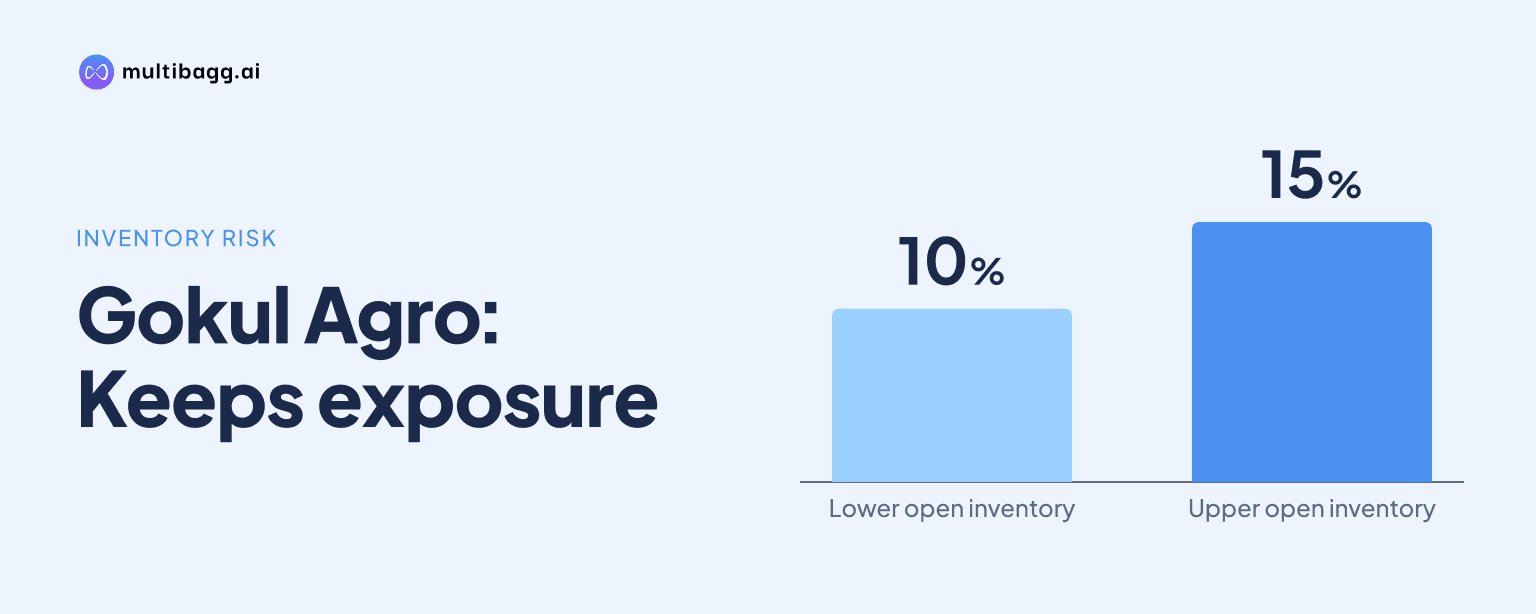
Gokul Agro said during its H1 FY27 earnings call that only 10% to 15% of its edible-oil inventory remains open to price movements, with the balance sold forward or hedged on exchanges. Management said this structure, alongside forward hedging of import payments, is intended to limit commodity and currency volatility.
Know Gokul Agro Resources inside out
Results, valuation, peers and who's buying, in one view.
How does Gokul Agro protect edible-oil inventory from price swings?
Gokul Agro says it protects most inventory through back-to-back sales, physical forward contracts and exchange hedges, leaving no more than 10% to 15% open. Management said the company is predominantly a business-to-business, or B2B, supplier, so inventory is mostly already sold and hedged rather than retained as an unprotected market position.
For palm and soya exposures, Gokul Agro said it can use export exchanges, including the Chicago Board of Trade, or CBOT, and Malaysian markets. Management said the company does not speculate in commodities and uses hedging to protect prices and margins. It did not disclose the respective shares covered by physical forward contracts and exchange hedges.
Management addressed a hypothetical 20% edible-oil price decline by saying that the effect should not be large because open inventory is limited to 10% to 15%. This was management’s view rather than a quantified sensitivity analysis: the call did not disclose the potential effect of such a decline on earnings before interest, tax, depreciation and amortisation, or EBITDA, working capital or profit after tax.
How does Gokul Agro manage foreign-currency exposure?
Gokul Agro says it forward-hedges all import payments against movements in the US dollar and Indian rupee, or USD/INR. Management described these as simple forward-hedging policies and said it does not use derivatives for this foreign-exchange protection.
The foreign-currency policy is relevant because management said about 80% of raw-material procurement is imported. A forward contract can fix the exchange rate for a future import payment, but the transcript did not specify the maturity of its contracts, their cost, their notional value or any foreign-currency amount that remains unhedged.
Gokul Agro also said vessel shipments can be larger than the requirements of a single one of its four plant locations. It therefore sells part of imported supply outright rather than holding it at plants, with stock-in-trade sales generally in a 10% to 20% range and below 15% in H1 FY27. This sales mechanism can reduce physical inventory held at individual sites, separately from the stated hedge coverage.
Did earnings rise alongside Gokul Agro's hedging discipline?
Yes. Gokul Agro reported that profit grew faster than revenue in Q2 FY27 and H1 FY27, while management cited sourcing discipline, operating leverage, product mix and commodity-exposure management as contributing factors. The transcript does not separately quantify how much of the profit change resulted from hedging.
In Q2 FY27, revenue from operations rose 13% year on year to Rs 7,481 crore, while EBITDA including other income increased 41% to Rs 276 crore. Profit after tax, or PAT, increased 40% to Rs 150 crore, and EBITDA margin rose to 3.68% from 2.94%, an increase of about 74 basis points.
For H1 FY27 ended September 30, 2026, revenue rose 10% year on year to Rs 12,763 crore, whereas EBITDA including other income increased 46% to Rs 493 crore and PAT grew 54% to Rs 274 crore. EBITDA margin expanded to 3.86% from 2.92%, while PAT margin rose to 2.14% from 1.54%.
Management said better price realisations broadly drove the 13% Q2 FY27 revenue growth and 10% H1 FY27 growth. It also said existing capacity was fully utilised and it did not expect volume growth during the year, making the faster EBITDA and PAT growth a change in profitability relative to sales growth rather than a volume-led outcome.
Got a follow-up? Ask IRIS
What exposure remains despite Gokul Agro's hedging policy?
Gokul Agro remains exposed to the effect of commodity prices on realised sales values even when inventory is covered. Management said average commodity-market prices had increased by 15% to 20%, and better realisations supported the higher EBITDA result. It told an analyst that EBITDA per tonne is a preferable measure to assess realisations, but it did not disclose product-level realisations or EBITDA per tonne.
Management said lower edible-oil prices could result in higher volumes and therefore support revenue, but it did not provide a forecast or price-volume sensitivity. The call consequently leaves unresolved how a broad price correction would affect absolute revenue and EBITDA after the benefit of its inventory hedges.
Inventory also rose at the end of Q2 FY27 after the government revised import duties on key edible oils on September 24, 2026. Management said dealers and distributors deferred purchases before the announcement, reducing September off-take; it described the higher inventory as a temporary timing effect and said channel activity had started normalising afterward.
How could capacity growth affect Gokul Agro's risk controls?
Gokul Agro is adding capacity across four manufacturing locations, expected to increase annual capacity by about 8 lakh tonnes. Management said the additional capacity would become operational only by October 2027, increasing the scale at which procurement, imports, physical sales and hedging practices would need to operate.
Based on prevailing commodity prices, management expects volume growth of 10% in the next year and 10% to 15% year on year thereafter. It also expects EBITDA margin to remain in a 3.5% to 4% range. These are management expectations, and the transcript does not provide a target for inventory levels or hedge coverage after the capacity additions begin.
Gokul Agro is also adding revenue streams beyond conventional edible oils. Its 300-tonne-per-day biodiesel facility at Gandhidham became fully operational in Q1 FY27 and generated Rs 237 crore of revenue in Q2 FY27 and Rs 596 crore in H1 FY27. Management identified B2B and business-to-consumer distribution, value-added products and biodiesel as growth areas, but did not disclose separate hedging policies for biodiesel or specialty products.
Conclusion
Gokul Agro has made a specific risk-management disclosure: it says only 10% to 15% of inventory is unhedged, while the remainder is covered by forward sales or commodity hedges and import payments are forward-hedged for USD/INR exposure. The approach accompanied H1 FY27 EBITDA growth of 46% to Rs 493 crore and a 94-basis-point increase in EBITDA margin to 3.86%, although the company has not quantified hedging’s direct contribution to profit.
The next disclosed milestone is the planned October 2027 start of capacity additions across four sites, expected to add about 8 lakh tonnes annually. Investors can watch whether Gokul Agro maintains the stated open-inventory limit as procurement expands, and whether management’s expected 10% to 15% annual volume growth and 3.5% to 4% EBITDA margin range are achieved after new capacity becomes available.