










Shalby targets 30%-40% implant cost cut via supply chain
Key highlights
- Shalby expects a new supply chain to reduce current implant manufacturing cost by a further 30%-40%.
- Shalby said implant manufacturing cost has already fallen by more than half from its acquisition-era level.
- MedTech EBITDA rose to Rs 36 lakh in Q2 FY27 from Rs 16 lakh in the preceding quarter.
- MedTech inventory days fell to 784 in H1 FY27 from about 1,200 a year earlier.
powered by IRIS
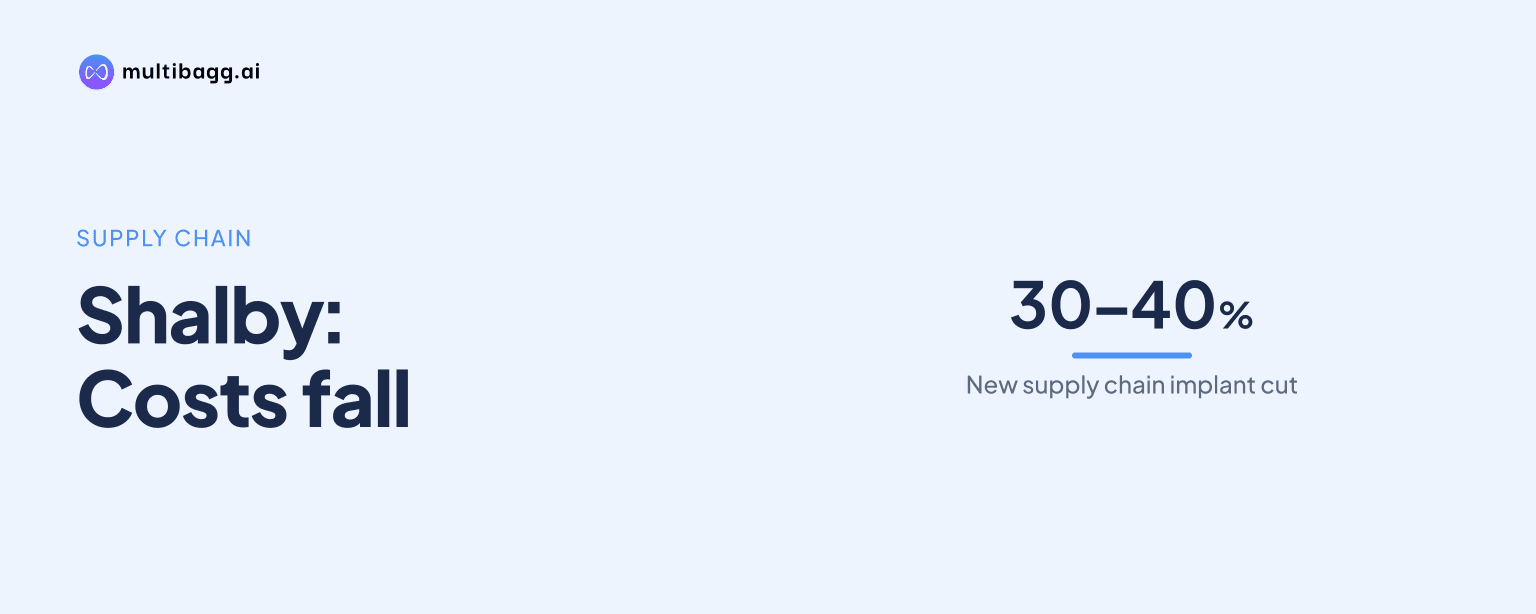
Shalby Limited said in Q2 FY27 that its new MedTech supply chain should cut current implant manufacturing cost by a further 30%-40%, after costs had already fallen by more than half from the acquisition-era level. Management expects savings to begin reaching the profit and loss account in Q4 FY27.
Know Shalby inside out
Results, valuation, peers and who's buying, in one view.
How much has Shalby cut implant manufacturing cost?
Shalby has reduced implant manufacturing cost by more than half from the level at which it acquired the facility in 2021, according to management. The company did not disclose its present per-implant cost, so the planned further reduction cannot be translated into a precise rupee amount from the call.
The next planned reduction is 30%-40% from the current cost level, rather than from the cost at acquisition. Management identified the embedded expense of manufacturing in the US, a higher-labour-cost market, as the earlier hurdle, and said the new supply chain is intended to address that constraint.
Shalby has also made manufacturing and quality changes in MedTech. It increased processing volumes in Clean, Pack & Sterile operations, reinstated the passivation line in-house, recommissioned a secondary clean line and improved inspections. Management said these actions improved first-pass acceptance and reduced contract-manufacturer defects and scrap, improving yield and reducing rework.
When will Shalby’s supply-chain savings affect earnings?
Shalby expects the new supply-chain benefits to begin accruing in the profit and loss account in Q4 FY27, with a full-quarter impact in Q1 FY28. Management identified completion of the supply-chain transition as a MedTech priority for the second half of FY27.
Management gave two closely related timing descriptions during the call. Opening remarks said Q4 FY27 would mark the start of profit-and-loss benefits and Q1 FY28 would provide a full-quarter effect, while the finance discussion said the model would take its full benefit in Q4 FY27. The disclosed timetable therefore points to a financial effect late in FY27, followed by a clearer comparable quarter in FY28.
The supply-chain programme follows earlier operational efficiencies. MedTech consolidated earnings before interest, tax, depreciation and amortisation, or EBITDA, was Rs 36 lakh in Q2 FY27, compared with Rs 16 lakh in the preceding quarter. Management described Q2 as MedTech’s fifth consecutive EBITDA-positive quarter and said efficiency benefits should build through the remainder of FY27.
Why does the supply-chain change matter for Shalby MedTech margins?
Shalby says lower cost of goods sold is necessary to turn surgeon engagement and geographic expansion into more profitable MedTech volume. Management said product reception among surgeons in India and overseas had been strong, based on product design and US Food and Drug Administration status, but said manufacturing cost had constrained the business economics.
The commercial programme is expanding alongside the manufacturing work. Shalby has used fellowships, clinical education, product demonstrations and in-clinic branding, entered West Bengal and Odisha, and appeared at AOTS in Kolkata. It also said it was reactivating Central India, including Nagpur and Assam, before Uttar Pradesh and Uttarakhand.
Outside India, Shalby reported operations in North America, Japan and Indonesia, as well as approvals in Malaysia, Argentina and Nepal. The chief financial officer also said management expected a National Pharmaceutical Pricing Authority, or NPPA, price revision around mid-November after a two-year delay, which could support India MedTech revenue and EBITDA. That was management’s expectation rather than a confirmed price decision.
Got a follow-up? Ask IRIS
What does lower inventory mean for Shalby MedTech cash needs?
Shalby reported MedTech inventory days of 784 in H1 FY27, down from about 1,200 a year earlier and 16% lower over the preceding six months. Management linked the decline to using existing inventory, reducing cash requirements and improving cash flow in the implant operation.
The company said sales rose while absolute inventory declined in the last six months, although it did not disclose a like-for-like H1 MedTech sales figure. Management also said it did not plan to add many products beyond those already under development and planned for launch, a strategy intended to avoid a large new inventory build-up.
At the group level, net debt was about Rs 458 crore in Q2 FY27 and gearing was 0.45 times. Management said net debt had decreased during the year despite dollar appreciation limiting the reported reduction, and it linked faster future debt reduction to the supply chain and lower MedTech cash needs. It gave no numerical debt target for the next one to one-and-a-half years.
How is Shalby allocating capital between MedTech and hospitals?
Shalby said 80%-90% of new capital would be invested in hospitals, while MedTech is expected to become self-sustaining in a short period without significant fresh capital. Management said internal accruals over the next couple of quarters would support hospital facility upgrades, technology and additional beds.
The allocation reflects management’s assessment that existing hospitals have further capacity to use. It said the current facilities could generate 50% more revenue, with operating leverage contributing to EBITDA as utilisation rises. In Q2 FY27, standalone revenue was Rs 250 crore, up from Rs 229 crore a year earlier, while occupancy rose to 52% from 48%.
Excluding Shalby International in Gurgaon, standalone occupancy was 55% in Q2 FY27, compared with 50% a year earlier. Shalby International’s revenue increased about 50% year on year to about Rs 30 crore from Rs 20 crore, while average revenue per occupied bed rose 18% to Rs 96,388.
Management said Shalby International was EBITDA-positive for a second consecutive quarter and expected cash breakeven near the exit of Q4 FY27. It added that 20%-30% further growth from current levels could make the unit profit-before-tax neutral, making its hospital utilisation plan separate from the MedTech cost-reduction programme.
Conclusion
Shalby’s MedTech margin plan rests on a sequence of disclosed measures: manufacturing and quality changes have improved acceptance and reduced scrap, while the new supply chain is expected to lower current implant manufacturing cost by a further 30%-40%. The increase in MedTech EBITDA to Rs 36 lakh in Q2 FY27 from Rs 16 lakh in the preceding quarter shows operational progress, but does not yet quantify the planned gross-margin effect.
The next items to watch are completion of the supply-chain transition in Q4 FY27 and the full-quarter comparison expected in Q1 FY28. Management also plans to direct 80%-90% of fresh capital to hospitals, where it cites 50% revenue headroom in existing facilities, while Shalby International targets cash breakeven around the end of Q4 FY27.