










Shalby Limited expects FY27 replacement capex after Rs 160 crore
Key highlights
- Shalby spent Rs 10 crore on FY27 H1 capex versus Rs 160 crore last year.
- Management expects FY27 H2 capex to be about Rs 10 crore, mainly replacement spending.
- Shalby said consolidated net debt declined during the quarter, the first reduction in many quarters.
- PK Gurugram revenue rose about 50% year on year and management expects cash break-even by the exit of the third or fourth quarter.
powered by IRIS
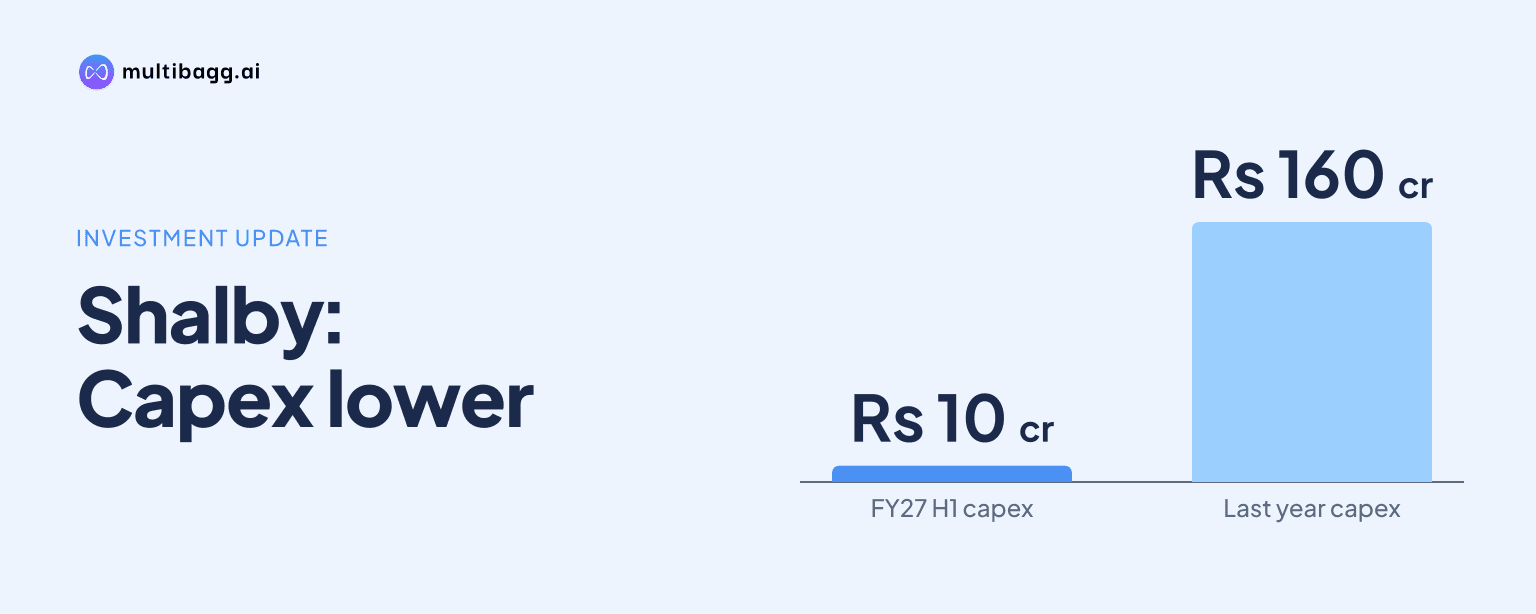
Shalby Limited expects FY27 capital expenditure of about Rs 20 crore, focused on replacement needs, after spending Rs 160 crore last year, management said. Shalby spent Rs 10 crore in the first half and does not expect a materially different second-half figure, which management said should increase cash available for debt reduction.
Know Shalby inside out
Results, valuation, peers and who's buying, in one view.
Why is Shalby cutting FY27 capital expenditure?
Shalby is limiting FY27 capital expenditure because management sees mainly replacement requirements for hospital equipment rather than a significant new spending need. Chief Financial Officer Amit Kumar said first-half capex was Rs 10 crore and that second-half spending was not expected to be materially different, compared with Rs 160 crore invested last year.
The planned spending is intended to maintain hospital operations and necessary medical equipment, rather than finance a large new expansion programme. Management said the MedTech business was already resourced for capex during the year. The change follows investments over the last year in technology and capacity, rather than an indication that Shalby is withdrawing investment from its operating businesses.
How could lower capex affect Shalby debt reduction?
Lower capex should leave Shalby with more internal cash accruals for debt reduction, according to management. Kumar said group cash-flow requirements had fallen significantly, citing Rs 10 crore of current-year replacement capex against Rs 160 crore last year. He said management expected debt to decline consistently in coming quarters, but did not provide a numerical target.
Management said consolidated net debt declined during the quarter, the first reduction in many quarters. Kumar added that the reduction came despite a stronger dollar and would have been greater if the dollar had remained at the same level. The call did not disclose total net debt or quantify the currency effect in rupees.
Management also linked the lower cash requirement to two operating businesses. It said PK Gurugram had become earnings before interest, tax, depreciation and amortisation, or EBITDA, positive, reducing its cash requirement. MedTech was EBITDA positive for a fifth consecutive year, with EBITDA about double the previous quarter, according to management.
What did Shalby invest in before FY27 replacement capex?
Shalby invested in technology over the preceding year, including robotics across most hospitals, linear accelerators and bunkers, and a new positron emission tomography-computed tomography, or PET CT, scan. Those investments help explain why management now expects FY27 capex to be largely limited to replacing equipment rather than matching last year's Rs 160 crore outlay.
Management still outlined selected capacity initiatives, meaning replacement-led FY27 capex does not rule out future expansion. Shalby expects to use additional floor space index, or FSI, at its Gurugram hospital to add beds, with that capacity expected to become operational in the next 12 to 18 months. The company did not disclose the bed count, project cost or whether it is included in the replacement-capex estimate.
The Mumbai expansion remains unresolved. Management said it was working with trustees, that the project had been delayed significantly, and that certain approvals were pending. It gave neither a commissioning timeline nor a capex estimate, so the FY27 outlook reflects management's spending visibility at the time of the call.
Got a follow-up? Ask IRIS
Why does Shalby expect MedTech to need less capital?
Shalby expects MedTech to need less fresh capital because a new supply chain is intended to lower product costs while existing inventory supports sales. Management said implant manufacturing cost had fallen to less than half the level at which it acquired the facility and could decline by a further 30% to 40% from current levels under the new supply chain.
The company said implant-business inventory days had fallen by about half from roughly 1,200 to 1,500 days, while sales rose over the last six months and absolute inventory declined. Management linked lower inventory to better cash flow and potential debt reduction. It said it did not plan to add many products beyond those already under development.
Management's stated capital-allocation priority is increasingly the hospital business. Shanay Shah said 80% to 90% of new capital would be invested in hospitals, including facility upgrades, technology and beds, while MedTech moves toward becoming self-sustaining. That comment concerns future fresh capital and is separate from the FY27 replacement-capex run rate.
What other FY27 cash-flow factors did management identify?
Shalby also expects a lower tax burden to support cash flow. Kumar said the stand-alone tax rate had fallen to 24% from 35% last year, while the effective tax rate, or ETR, had reduced to about 49% from about 65%. For FY27, he indicated an ETR of around 45% to 50%, with scope for a further small reduction if PK Gurugram and MedTech profitability improves.
Revenue growth is another management assumption behind the cash-flow outlook. Management said it was seeking double-digit top-line growth in FY27, citing a stronger hospital performance in the first half and MedTech compound annual growth rate, or CAGR, of about 40% to 50% in recent years. The call did not provide a consolidated FY27 profit forecast.
At PK Gurugram, management said revenue increased about 50% year on year and EBITDA was positive for a second consecutive quarter. It expects the unit to become cash break-even by the exit of the third or fourth quarter. Shah added that a further 20% to 30% rise in revenue from current levels could make the unit profit before tax, or PBT, neutral.
Conclusion
Shalby's FY27 plan represents a shift from Rs 160 crore of capital expenditure last year to an implied run rate of about Rs 20 crore, focused on replacing necessary equipment. Management links the lower cash requirement with the first quarterly net-debt reduction in many quarters, reduced funding needs at PK Gurugram and MedTech, and an expected ETR of about 45% to 50%.
The next disclosures to watch are whether second-half capex remains close to the Rs 10 crore first-half level, whether consolidated net debt continues to decline, and whether PK Gurugram reaches cash break-even by the exit of the third or fourth quarter. Shalby also expects Gurugram bed additions to be operational within 12 to 18 months, while Mumbai approvals remain pending without a disclosed cost or commissioning date.