










Shalby directs 80%-90% of fresh capital to hospitals
Key highlights
- Shalby said 80%-90% of fresh capital and internal accruals will be directed to hospitals over the next couple of quarters.
- MedTech EBITDA was Rs 36 lakh in Q2 FY '27, compared with Rs 16 lakh in the preceding quarter.
- Shalby spent Rs 10 crore on replacement capex in H1 FY '27, versus Rs 160 crore in the prior year.
- Gurugram revenue rose 50% year on year to about Rs 30 crore in Q2 FY '27.
powered by IRIS
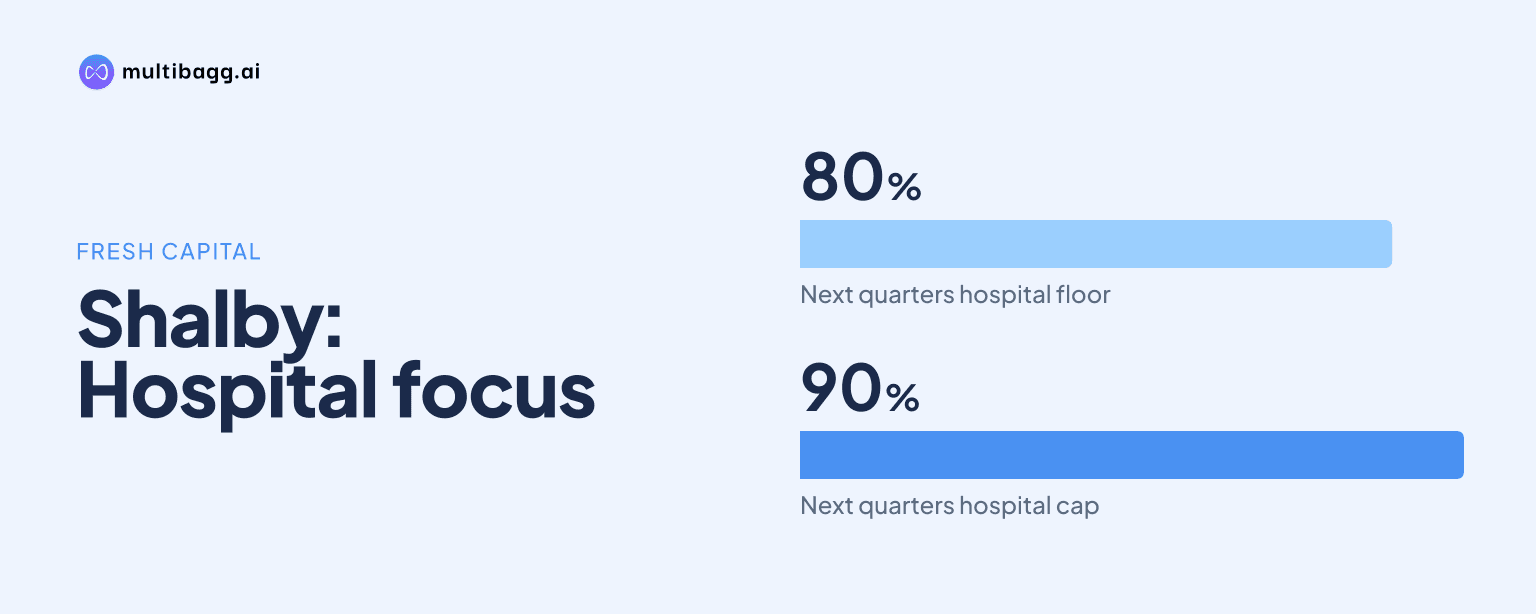
Shalby Limited said in Q2 FY '27 that 80%-90% of fresh capital and additional internal accruals over the next couple of quarters will be directed to its hospitals business, after MedTech recorded its fifth consecutive EBITDA-positive quarter. Management cited about 50% revenue headroom in existing hospitals and lower future MedTech capital needs.
Know Shalby inside out
Results, valuation, peers and who's buying, in one view.
Why is Shalby directing most fresh capital to hospitals?
Shalby is prioritising hospitals because management said its existing facilities have capacity to generate about 50% more revenue. Shanay Shah said higher utilisation would also bring operating leverage to earnings before interest, tax, depreciation and amortisation, or EBITDA, while the hospitals business was already profitable and growing in Q2 FY '27.
Management said 80%-90% of new capital would be used for hospital facility upgrades, technology and beds, as well as adding specialist doctors in orthopaedic and non-orthopaedic fields. Shah described this as the direction for additional internal accruals over the next couple of quarters and said the mandate came directly from the chairman.
The shift does not mean Shalby is closing or neglecting its medical-implant operation. Management said MedTech has built the products, instrumentation and team required for future growth, but should become self-sustaining in a short period and therefore not require significant fresh capital. Its priorities in FY '27 include completing the new supply chain, adding capacity and converting surgeon engagement and new geographies into volumes.
What has reduced Shalby’s need to fund MedTech?
Shalby expects the new supply chain to reduce implant manufacturing costs and lift MedTech cash generation. Management said the cost of manufacturing an implant had fallen to less than half the roughly US$1,100 cost at the time of acquisition, and could decline by a further 30%-40% from current levels under the new supply-chain model.
MedTech delivered its fifth consecutive EBITDA-positive quarter in Q2 FY '27, according to management. Consolidated MedTech EBITDA was Rs 36 lakh, compared with Rs 16 lakh in the preceding quarter, while management said all the business’s entities were now EBITDA positive. It expects the supply-chain changes initiated in the second half to have their full effect in Q4 FY '27.
Inventory reduction is another part of the funding plan. MedTech inventory days stood at 784 in H1 FY '27, versus about 1,200 days a year earlier, after falling 16% during the six-month period and 20% over two years. Management said absolute inventory had declined even as sales rose, and it does not plan substantial product-pipeline additions beyond products already under development.
Management also expects a National Pharmaceutical Pricing Authority, or NPPA, implant-price revision around mid-November, which it said had been due for two years. The company did not quantify the revenue or margin impact. Management said there were no current discussions around further price caps on consumables or MedTech implants.
How do hospital operating results support the allocation?
Shalby’s hospital metrics improved in Q2 FY '27, although consolidated EBITDA growth lagged revenue growth. Consolidated revenue rose 9.8% year on year to Rs 318 crore, while EBITDA increased 0.8% to Rs 46.4 crore and the EBITDA margin declined to 14.6% from 15.9% in Q2 FY '26.
Standalone revenue, representing the hospital business, rose 9.1% to Rs 250 crore in Q2 FY '27. Occupancy increased to 52% from 48%, while occupancy excluding the Gurugram unit was 55%, compared with 50% a year earlier. Average revenue per occupied bed, or ARPOB, increased 4.3% to Rs 42,581, and average length of stay fell to 3.58 days from 3.74 days.
The payer mix in Q2 FY '27 was about 33% self-pay, 38% insurance and 29% government payers. Management’s stated focus for the remaining half of FY '27 is to improve hospitals operating below potential, using specialist recruitment, operating discipline and asset productivity to build on the 400-basis-point occupancy increase.
Got a follow-up? Ask IRIS
Where will Shalby add hospital capacity and technology?
Shalby plans to use hospital capital for technology already being deployed and for beds at Gurugram. Management said it had invested in robotics across most hospitals, linear accelerators and related bunkers, high-end radiology equipment and a new positron emission tomography-computed tomography, or PET CT, scan over the previous year.
At Gurugram, Shalby expects to use its additional Floor Space Index, or FSI, to add beds within 12 to 18 months. Management did not disclose the number of beds, the project cost or a commissioning date. The Mumbai expansion, meanwhile, remains delayed because approvals are pending and Shalby is working with the trustees.
The Gurugram unit generated about Rs 30 crore of revenue in Q2 FY '27, up 50% from Rs 20 crore a year earlier. Its ARPOB rose 18% to about Rs 96,388 from about Rs 81,185, and it was EBITDA positive for the second consecutive quarter. Management expects cash breakeven around the exit of Q4 and said another 20%-30% revenue increase from current levels could make the unit profit-before-tax neutral.
What are Shalby’s capex and debt-reduction plans?
Shalby expects lower capital expenditure, or capex, to leave more cash for debt reduction and hospital priorities. It spent Rs 10 crore on replacement capex in H1 FY '27, compared with Rs 160 crore in the prior year, and management said H2 FY '27 should require a similar Rs 10 crore, largely for necessary medical-equipment replacement.
Management said key investments were largely in place and MedTech was adequately resourced for FY '27 capex. Consolidated net debt was about Rs 458 crore in Q2 FY '27, with gearing of 0.45 times. Management said net debt had decreased during the year and should continue to decline, but did not provide a numerical debt target.
Standalone debt declined to Rs 14.5 crore from Rs 54.5 crore a year earlier. Standalone profit after tax rose to Rs 23.5 crore from Rs 19.8 crore, with the margin increasing to 9.4% from 8.6%; annualised return on capital employed was 9.4%. Management said the effective tax rate could be about 45%-50% in FY '27 after reaching about 49%, versus about 65% in the prior year.
Conclusion
Shalby’s stated allocation framework puts hospitals at the centre of its next investment cycle: 80%-90% of fresh capital is intended for capacity, technology and clinical capability, while MedTech is expected to fund more of its own requirements. The basis is improving hospital utilisation, lower replacement capex and a MedTech plan centred on supply-chain savings and inventory reduction.
The next items to watch are the expected full Q4 FY '27 benefit from the MedTech supply chain, the planned Gurugram cash breakeven around the exit of Q4 and the management-expected NPPA price revision in mid-November. Shalby also plans to make the additional Gurugram beds operational in 12 to 18 months, while Mumbai expansion timing remains unresolved pending approvals.