










Shalby expects Gurugram cash breakeven by FY27 Q4 exit
Key highlights
- Shalby's Gurugram unit reported revenue of about Rs 30 crore in Q2 FY27, up about 50% year-on-year.
- Gurugram ARPOB increased 18% year-on-year to about Rs 96,388 in Q2 FY27.
- Management expects Gurugram cash breakeven near the exit of Q4 FY27.
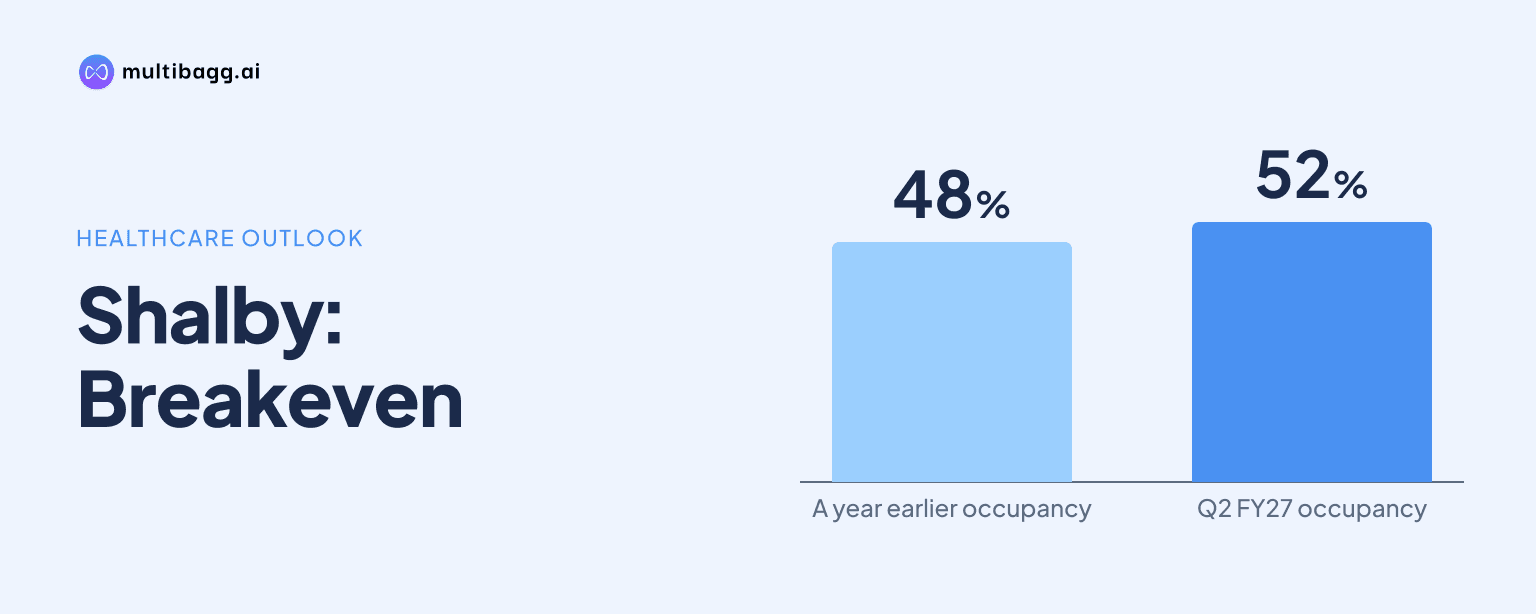
- Shalby's stand-alone occupancy rose to 52% in Q2 FY27 from 48% a year earlier.
powered by IRIS
Shalby Limited expects its Gurugram hospital, Shalby International, to reach cash breakeven near the exit of Q4 FY27 after Q2 FY27 revenue increased about 50% year-on-year to about Rs 30 crore and the unit recorded its second consecutive EBITDA-positive quarter. Management cited higher occupancy, better revenue per occupied bed and growth in domestic and international business.
Know Shalby inside out
Results, valuation, peers and who's buying, in one view.
When does Shalby expect Gurugram cash breakeven?
Shalby expects the Gurugram unit to reach cash breakeven near the exit of Q4 FY27. Chief Financial Officer Amit Kumar said the hospital had reported positive earnings before interest, tax, depreciation and amortisation, or EBITDA, in each of the first two quarters of FY27 and was also EBITDA-positive for the first half, or H1, of FY27.
The target concerns cash breakeven rather than reported profit before tax, or PBT. During the call, President Shanay Shah said a further 20% to 30% revenue increase from the unit's Q2 FY27 level could make it PBT-neutral. Kumar also referred in the question-and-answer session to a cash-breakeven outcome around the exit of Q3 and Q4, while his prepared remarks identified the Q4 FY27 exit as the expected timing.
The unit's Q2 FY27 revenue was about Rs 30 crore, compared with about Rs 20 crore in Q2 FY26. The transcript does not disclose Gurugram's EBITDA amount, cash loss, PBT or net profit. The two consecutive EBITDA-positive quarters therefore show an operating-profit milestone, but do not establish profitability after depreciation, interest and tax.
What is driving Shalby's Gurugram hospital turnaround?
Shalby attributes the Gurugram unit's progress to rising occupancy, higher average revenue per occupied bed, or ARPOB, and growth in domestic and international patient business. ARPOB increased 18% year-on-year to about Rs 96,388 in Q2 FY27 from about Rs 81,185 a year earlier, while average length of stay, or ALOS, stood at 3.3 days.
Domestic business at the unit grew 56% year-on-year, while international business increased about 22%, management said. The call did not disclose the respective rupee revenues, patient numbers, bed count or occupancy rate for Gurugram. It therefore does not quantify how much of the roughly Rs 10 crore revenue increase came from volume, pricing, payer mix or changes in specialty mix.
Management said specialties on which the hospital is concentrating are generating better yield. Shah also said the unit's domestic and international businesses were both expanding, while Kumar cited growing occupancy and ARPOB as the mechanisms supporting the cash-breakeven expectation. These are management statements, rather than a disclosed quarterly operating plan with numerical targets.
How does Gurugram compare with Shalby's wider hospital business?
Gurugram grew faster than Shalby's wider stand-alone hospital business in Q2 FY27. The unit's revenue rose about 50% to about Rs 30 crore, whereas stand-alone revenue increased 9.1% to Rs 250 crore from Rs 229 crore in Q2 FY26. On that basis, Gurugram represented about 12% of stand-alone revenue during the quarter.
Network operating measures also improved in Q2 FY27. Stand-alone occupancy rose to 52% from 48% a year earlier, an increase of 400 basis points, while occupancy excluding the Gurugram unit increased to 55% from 50%. Network ARPOB rose 4.3% to Rs 42,581 from Rs 40,794, and ALOS declined to 3.58 days from 3.74 days.
At the consolidated level, revenue rose 9.8% to Rs 318 crore from Rs 290 crore in Q2 FY26. EBITDA increased marginally to Rs 46.4 crore from Rs 46.1 crore, but the EBITDA margin declined to 14.6% from 15.9%. Consolidated PBT fell to Rs 16.5 crore from Rs 19.1 crore, while profit after tax remained Rs 7.9 crore and the margin stayed at 2.5%.
Got a follow-up? Ask IRIS
What could change Shalby's Gurugram breakeven timeline?
The Q4 FY27 timing depends on continued revenue growth being converted into cash generation at the Gurugram unit. Management has identified occupancy growth, higher yield from selected specialties and domestic and international business expansion as the relevant drivers. Shah's estimate of another 20% to 30% growth for PBT neutrality indicates that further scale is still needed beyond Q2 FY27 revenue of about Rs 30 crore.
Shalby is also pursuing efficiency measures across its Hospitals business, with management expecting benefits to start flowing into the profit and loss account from Q3 FY27. The initiatives cover outsourced manpower, materials and consumables, which management described as a large part of costs. The company did not quantify expected savings or state the share of these measures that would apply specifically to Gurugram.
The company plans to use additional floor-space index, or FSI, at the Gurugram hospital to add beds. Management expects the added capacity to become operational within 12 to 18 months, a period extending beyond the Q4 FY27 cash-breakeven objective. The near-term target is therefore based on improving the utilisation and yield of the existing operation, rather than on the proposed extra beds.
Shalby's broader cash-flow plans also provide context for the turnaround. Consolidated net debt was about Rs 458 crore at Q2 FY27 and gearing was 0.45 times. Management said H1 FY27 capital expenditure was about Rs 10 crore and expected H2 expenditure to be similar, mainly replacement spending, compared with Rs 160 crore of capital expenditure in the prior year.
Conclusion
Shalby's Gurugram unit has moved closer to management's stated cash-breakeven target through about 50% revenue growth to Rs 30 crore, an 18% increase in ARPOB and two consecutive EBITDA-positive quarters in FY27. Its revenue growth exceeded the 9.1% rise in stand-alone hospital revenue, although the company has not disclosed the unit's absolute EBITDA, cash loss or PBT.
The next markers are the expected Q3 FY27 benefits from hospital cost measures and management's Q4 FY27 cash-breakeven objective. Investors can also watch whether the additional 20% to 30% growth management linked to PBT neutrality is delivered, and whether the proposed Gurugram bed addition is operational within the disclosed 12-to-18-month timeframe.