










Gokul Agro Resources Limited B2C reaches 8% of H1 channel revenue
Key highlights
- Gokul Agro’s B2C retail channel represented 8% of H1 FY27 channel revenue, versus around 5% in FY26.
- Gokul Agro’s H1 FY27 channel mix was 79% B2B, 13% exports and 8% B2C retail.
- Gokul Agro has earmarked less than Rs 25 crore for B2C spending, with deployment linked to market response.
- Gokul Agro’s H1 FY27 EBITDA including other income rose 46% to Rs 493 crore and margin reached 3.86%.
powered by IRIS
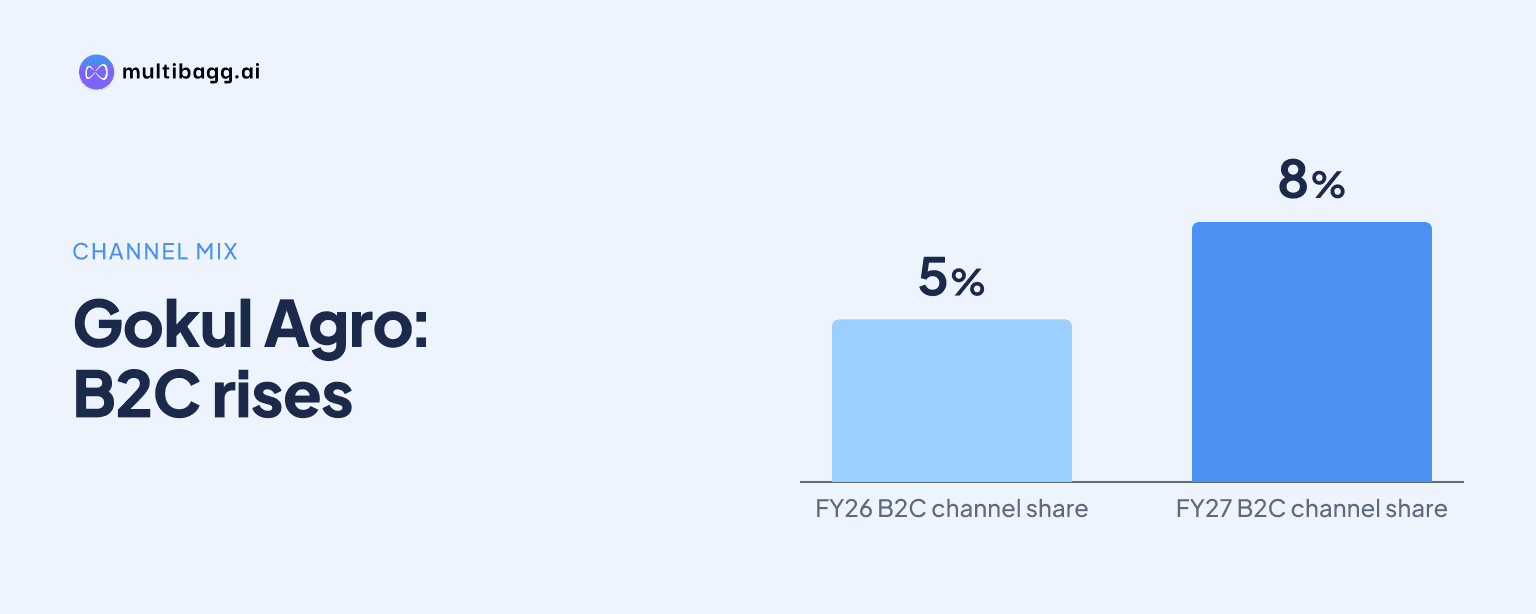
In H1 FY27, Gokul Agro’s B2C retail channel accounted for 8% of channel revenue, up from around 5% in FY26, as it expanded branded edible-oil distribution while management earmarked less than Rs 25 crore for gradual marketing. Management said B2C margins are currently broadly in line with consolidated margins.
Know Gokul Agro Resources inside out
Results, valuation, peers and who's buying, in one view.
How large is Gokul Agro’s consumer business now?
Gokul Agro’s B2C retail business represented 8% of H1 FY27 channel revenue, compared with around 5% in FY26. B2B contributed 79% and exports 13%, showing that the company’s branded consumer operation is growing from a relatively small base while institutional and other business customers remain its principal channel.
Edible oils supplied about 85% of Gokul Agro’s consolidated volume in H1 FY27. The portfolio includes palm, soybean, sunflower, mustard, groundnut, cottonseed and rice-bran oils, as well as palmolein and vanaspati, giving the consumer business access to products already handled through the company’s sourcing, refining and packaging network.
B2B remains the scale business, with customers including Parle Biscuits, ITC, Britannia and Balaji Wafers. Gokul Agro operates four manufacturing sites at Gandhidham, Krishnapatnam, Haldia and Mangalore; Gandhidham has about 3,400 tonnes per day of refining capacity and 3,200 tonnes per day of seed-crushing capacity. Management said planned additions of about 8 lakh tonnes per annum are intended to support both B2B and B2C demand.
Which brands and markets is Gokul Agro targeting?
Gokul Agro is developing Vitalife as a broader pan-India growth brand, while Sun Premium has an established focus in Karnataka. Mahek and Farm Jyoti are also part of its consumer portfolio, which covers oils including soybean, sunflower, mustard, groundnut, cottonseed, rice bran and palm.
The company has more than 650 dealers and distributors across 28 states and Union Territories. During Q2 FY27, Gokul Agro appointed a clearing and forwarding depot and distributors in Jammu and Kashmir, while strengthening Vitalife’s presence in Punjab, Haryana, Gujarat and Karnataka.
Management said its sequence is to build distribution, establish repeat consumption and consumer trust, and then lift branded-sales contribution. It has introduced visibility initiatives in modern retail, social media and point-of-purchase communication, alongside sales-force automation intended to track secondary sales, stock movement and field-force productivity.
Exports remain a separate channel-development priority, representing 13% of H1 FY27 revenue and reaching 33 countries across Asia, Europe, the Middle East and America. Markets named by management include Singapore, China, Germany, the United Arab Emirates and the United States, meaning the consumer initiative sits within a broader push across channels and value-added products.
Got a follow-up? Ask IRIS
Will Gokul Agro’s consumer push lift margins immediately?
No. Management said it does not expect much higher margin expansion from B2C in the medium term because the business is a new entrant that needs marketing, branding and advertising expenditure. The chief financial officer said B2C margins are more or less in line with Gokul Agro’s consolidated margin, rather than materially higher.
For H1 FY27, earnings before interest, tax, depreciation and amortisation, or EBITDA, including other income rose 46% year on year to Rs 493 crore. Revenue from operations increased 10% to Rs 12,763 crore, while EBITDA margin expanded to 3.86% from 2.92% in H1 FY26. Management attributed the wider group margin to sourcing discipline, operating leverage, customer and product mix, capacity utilisation, branding and cost controls.
In Q2 FY27, EBITDA margin rose to 3.68% from 2.94% a year earlier, while profit after tax increased 40% to Rs 150 crore. Management said it expects overall EBITDA margin of 3.5% to 4%, but this was management’s outlook for the overall business and not a target for the B2C segment.
The near-term purpose of B2C is therefore distribution and turnover expansion rather than an immediate margin premium. Management expects rising market visibility and turnover to support volume and margin expansion gradually, but did not disclose a specific B2C revenue-share target for FY27 or FY28.
How much will Gokul Agro spend on consumer marketing?
Gokul Agro has earmarked less than Rs 25 crore, mostly for B2C, and management said spending will be gradual. The company plans to assess consumer response and identify which markets offer better B2C growth before deploying the allocation.
Management did not disclose FY26 B2C marketing expenditure when asked on the October 29, 2026 call, saying the number was specific and could be discussed after the year’s completion. The transcript therefore provides neither a year-on-year advertising-spend comparison nor a quarterly B2C marketing budget.
The gradual spending approach comes while existing operations are at optimum capacity, according to management. Management said H1 FY27 revenue growth was broadly driven by better price realisations, with market prices for commodities rising 15% to 20%; it said new capacity additions are expected to become operational only by October 2027.
Commodity-risk controls remain relevant to the spending plan because edible oils account for about 85% of volume. Management said it generally keeps only 10% to 15% of inventory open, using physical forward sales and exchange hedging for palm and soybean oils, while import payments are hedged through forward policies.
Conclusion
Gokul Agro is adding a consumer-sales engine to a business still led by B2B volume, edible-oil processing and exports. Its more than 650 dealers and distributors, brand activity across four consumer labels and expansion in Jammu and Kashmir, Punjab, Haryana, Gujarat and Karnataka show that the strategy is focused first on availability and repeat demand rather than a rapid change in the group’s margin mix.
The next items to watch are the pace and market allocation of the less-than-Rs 25 crore B2C marketing budget, the rollout of capacity additions expected by October 2027, and management’s stated expectation of 10% volume growth in the next year and 10% to 15% growth thereafter. Management has not yet set a separate B2C share or margin target.