










Greaves says major clean-up largely complete after Rs 60.1 crore charge
Key highlights
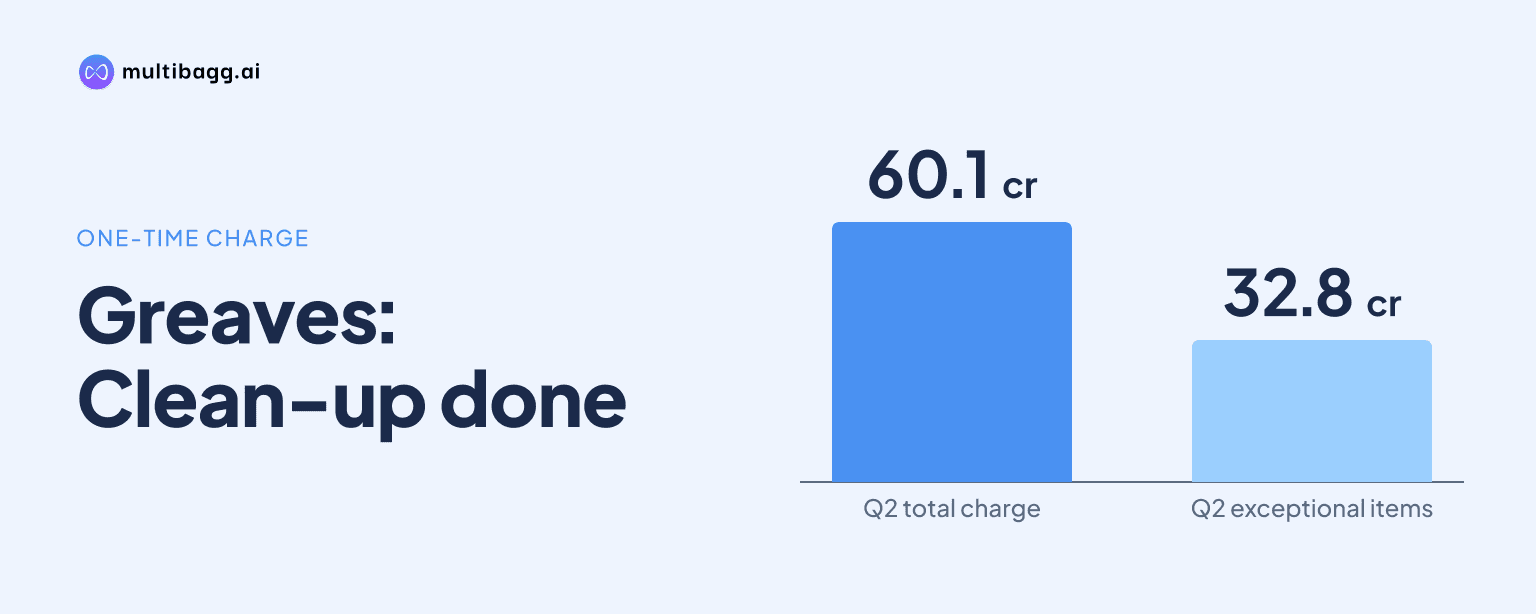
- Greaves said Rs 27.3 crore of accelerated depreciation and Rs 32.8 crore of exceptional items totalled Rs 60.1 crore in Q2.
- Greaves exited low-margin farm equipment and said Industrial Solutions grew 9% like-for-like after excluding that business.
- Greaves said its electric two-wheeler business grew about 130% year-on-year and had orders pending beyond current fulfilment.
- Greaves said Excel grew 30% in the quarter after becoming a 100% owned subsidiary.
powered by IRIS
Greaves Cotton Limited said its Rs 60.1 crore electric-mobility charges in Q2 covered the remaining major portfolio clean-up, following exits from retail activities and low-margin farm equipment. Management said the GREAVES.NEXT review, launched in November last year, has addressed the key decisions for the current business plan, although routine period-end accounting reviews will continue.
Know Greaves Cotton inside out
Results, valuation, peers and who's buying, in one view.
What did Greaves remove from its portfolio?
Greaves removed several retail activities and exited its farm-equipment business as part of the portfolio review launched with GREAVES.NEXT in November last year. Management said the group had previously been trying to operate across too many retail activities. It did not identify the specific retail businesses on the call, but said the remaining retail operation had returned to being a cash-generating engine.
The farm-equipment exit was a deliberate response to low margins and competition, including imports from China, management said. The business had included not only engines but also equipment supplied to India’s domestic farming sector. The exit means that prior-period Industrial Solutions revenue included farm equipment, reducing the usefulness of an unadjusted year-on-year comparison.
Management said Industrial Solutions grew 9% on a like-for-like basis after excluding the farm-equipment activity from the comparative period. Its continuing applications include firefighting pumps, marine products, agricultural engines used in power tillers and pumps, and small construction equipment. The comparison indicates that the segment’s reported growth profile changed after the removal of farm equipment, while its retained engine applications still expanded.
What made up Greaves' Rs 60.1 crore Q2 charge?
Greaves said the Q2 charge comprised Rs 27.3 crore of accelerated depreciation and Rs 32.8 crore of exceptional items, totalling Rs 60.1 crore. Management linked these items to a review of the electric-mobility platform and said it had focused the platform on selected portfolios and brands.
The Q2 charge followed an earlier Core business write-off associated with the farm-equipment exit in March '26. Management described the latest electric-mobility exercise as similar in purpose: accelerating amortisation or depreciation where appropriate after reassessing the relevant portfolio. The transcript does not provide the amount of the March '26 Core business write-off.
Chief Financial Officer Manish Poddar said management believed that whatever needed to be amortised or accelerated had been dealt with in Q2 and that there was “nothing more at this stage” for further write-offs or accelerated depreciation. That statement is management’s view at the time of the call, rather than a commitment that no future accounting charge can arise.
Why does Greaves view the clean-up as largely complete?
Greaves views the major clean-up as largely complete because management said all key portfolio decisions required at this stage of its business plan had been addressed. Chief Executive Officer Parag Satpute said the company could now build from a solid platform, concentrating on execution, revenue growth, market share and margins in the retained businesses.
The stated evidence includes the retail exits, the farm-equipment withdrawal, the March '26 Core business write-off and the Q2 electric-mobility charges. Greaves also completed the acquisition of 100% ownership of Excel, which management said creates an auto-components platform. Excel recorded 30% growth in the quarter, according to management, faster than in the preceding quarter.
However, Greaves also gave an important accounting qualification. Poddar said impairment, amortisation and write-off assessments are standard exercises performed at quarter-end or period-end and will continue in future quarters. The company is therefore saying the identified major restructuring actions are complete at this stage, not that its normal review process has stopped.
Got a follow-up? Ask IRIS
What operating priorities follow Greaves' portfolio review?
Greaves said its next priority is execution in the businesses retained under GREAVES.NEXT. In Industrial Solutions, management identified firefighting engines as a growth area, supported by Factory Mutual/Underwriters Laboratories, or FM/UL, certification, and launched a 750 horsepower firefighting engine during the quarter. It also unveiled a prototype 160 cubic centimetre gasoline engine as it develops smaller gasoline engines under the strategy.
In Energy Solutions, Greaves said it had expanded its high-horsepower generating-set range with 625 kilovolt-ampere and 650 kilovolt-ampere products launched two quarters earlier. Management also said it shipped its first batch of generating sets to the Middle East during the quarter, where it has established an entity and is building sales and servicing capability. The Middle East and Africa are its identified export focus markets.
Electric mobility remains an execution issue rather than a further portfolio exit. Management reported about 130% year-on-year two-wheeler growth and said orders pending delivery were above current fulfilment. It said the task is to expand the supplier and partner ecosystem to accommodate a higher growth rate, but declined to give a capacity target for the next three to four quarters.
Greaves also expects commodity-cost recovery to affect results over different timelines. In automotive operations, management said multi-year contracts include raw-material indexation with a lag and that price recovery should begin from Q4. In Energy Solutions and Industrial Solutions, price changes made at the end of Q1 were expected to have an impact in Q3 and Q4, after a lag of roughly four to five months.
Conclusion
Greaves has narrowed its portfolio by leaving retail activities and low-margin farm equipment, then taking Rs 60.1 crore of Q2 electric-mobility accounting charges. Management’s position is that the principal decisions and associated accelerated depreciation are now addressed, separating the operating performance of Industrial Solutions, Energy Solutions, Mobility Solutions and Excel from these identified clean-up actions.
The next disclosed milestones are capacity-building for electric-mobility suppliers after 130% two-wheeler growth, Q3 and Q4 pricing effects from Q1 changes, and Q4 automotive raw-material recovery. Routine quarter-end accounting reviews will also continue, even though management said it had identified no further major write-off or accelerated-depreciation requirement at this stage.