










Greaves Electric Mobility cuts two-wheeler EBITDA loss 70%
Key highlights
- Greaves Electric Mobility cut e-two-wheeler EBITDA loss per unit 70% to under Rs 6,300 in Q2 FY27.
- Greaves Electric Mobility recorded more than 37,000 e-two-wheeler units in Q2 FY27, up 114% year on year.
- Greaves Electric Mobility's Q2 FY27 consolidated revenue rose 106% to Rs 410 crore.
- Average e-two-wheeler realisation increased by Rs 5,000 to roughly Rs 93,000 per unit in Q2 FY27.
powered by IRIS
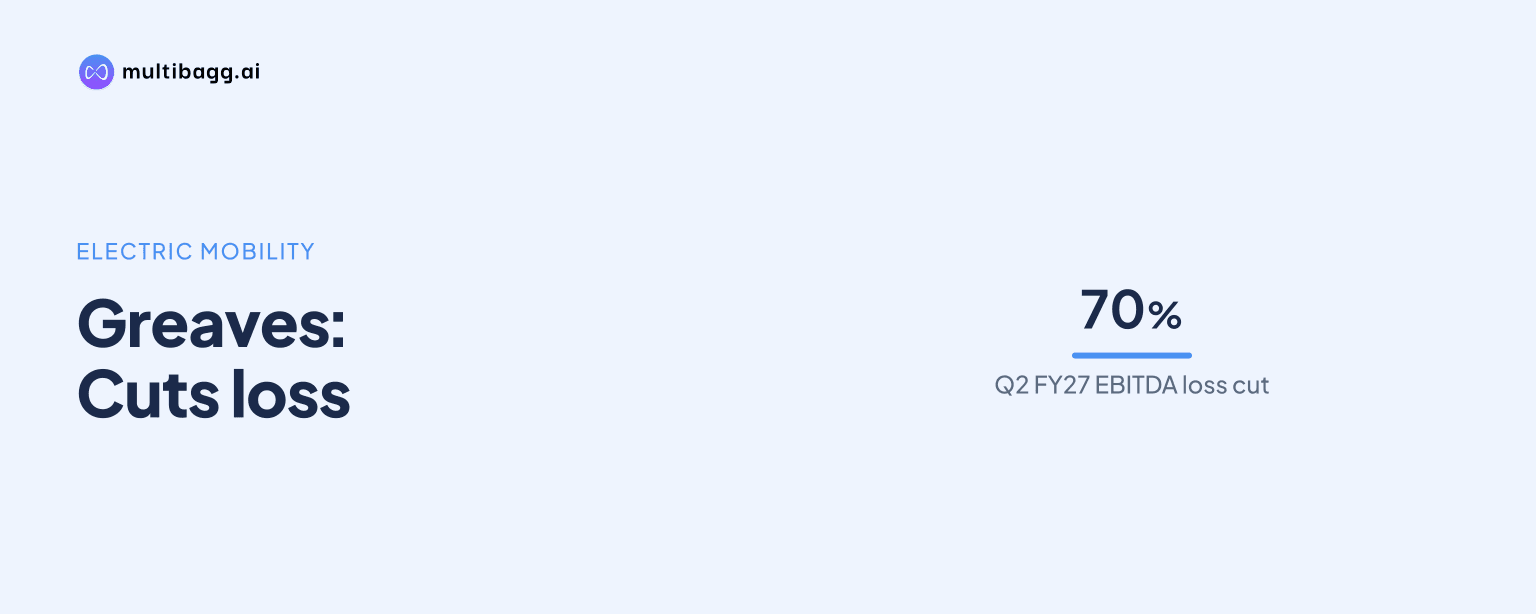
Greaves Electric Mobility Limited cut its e-two-wheeler earnings before interest, tax, depreciation and amortisation (EBITDA) loss per unit by 70% in Q2 FY27, to under Rs 6,300 from roughly Rs 20,000 a year earlier, as volume exceeded 37,000 units and average realisation reached about Rs 93,000 per unit.
Know Greaves Cotton inside out
Results, valuation, peers and who's buying, in one view.
How much did Greaves Electric Mobility reduce its e-two-wheeler loss?
Greaves Electric Mobility reduced its e-two-wheeler EBITDA loss per unit by 70% in Q2 FY27, from roughly Rs 20,000 in Q2 FY26 to under Rs 6,300. Management linked the reduction to greater scale as e-two-wheeler volume exceeded 37,000 units, up 114% year on year. It also said the e-two-wheeler EBITDA margin improved to negative 7% from negative 24% a year earlier.
The wider electric-vehicle business remained loss-making, but its reported loss narrowed as revenue rose. Greaves Electric Mobility reported consolidated revenue of Rs 410 crore in Q2 FY27, up 106% from Rs 199 crore a year earlier, while the EV business loss declined to Rs 25 crore from Rs 42 crore. The combination indicates that higher revenue and lower unit losses occurred in the same quarter, although EBITDA break-even had not yet been reached.
Two-wheeler revenue was Rs 350 crore in Q2 FY27, up 134% year on year, while L5 electric three-wheeler revenue was almost Rs 60 crore, up 55%. For the first half of FY27, consolidated revenue was almost Rs 680 crore versus Rs 335 crore in the corresponding prior-year period. Management said the increase in scale benefits was flowing through to the bottom line.
What drove Greaves Electric Mobility's record e-two-wheeler volume?
Greaves Electric Mobility's record Q2 FY27 e-two-wheeler volume was driven by dealer additions, higher dealer throughput, business-to-business sales and e-commerce. Registrations on VAHAN rose 107% year on year in H1 FY27 to about 53,700 units, while H1 billing volume reached almost 91% of the company's full-year FY26 volume. The Q2 volume of more than 37,000 units was its highest quarterly result in the segment.
Network development supplied part of the volume expansion. Greaves Electric Mobility issued letters of intent for 160 new dealerships in H1 FY27, and existing dealers opened nearly 20 branches. Average monthly dealer throughput increased almost 40% year on year, from 18 units to 25 units, while business-to-business volume increased 18% and e-commerce volume grew almost three times from the prior-year period.
Market share also rose during the half year. Greaves Electric Mobility reported a 4.8% e-two-wheeler market share in H1 FY27, compared with 4.1% in H1 FY26, and said its peak share was 5.6% in June 2026. In Q2 FY27, it ranked first in Bihar at about 18% share and second in Tamil Nadu at about 15% share; Southern and Eastern markets represented nearly half of industry volumes, according to management.
Got a follow-up? Ask IRIS
How did realisation and products improve Greaves Electric Mobility's economics?
Greaves Electric Mobility increased average e-two-wheeler realisation by Rs 5,000 in Q2 FY27 to roughly Rs 93,000 per unit without compromising volume growth. Management said Internet of Things solutions and accessories added incremental realisation and carried significantly higher margins. It also identified the Reo VYB low-speed model as a contributor to the growth trajectory.
Product upgrades formed part of the company's pricing proposition. The Nexus EX Plus received a 5-kilowatt motor, while the Magnus G Max with the IntelliPack connectivity suite offers more than 30 connected features through the Ampere Connect application. These include cruise control, hill-hold assist, turn-by-turn navigation and remote vehicle diagnostics, which management cited when discussing its balance between pricing, volume and margins.
Greaves Electric Mobility also secured a design registration for an in-house ferrite-assisted synchronous reluctance motor. Management said this motor uses no rare-earth magnetic material, is intended to reduce reliance on imported rare-earth minerals from China and will begin deployment in the two-wheeler portfolio soon. New product introductions using the technology are planned for Q4 FY27, and management said the design provides performance improvement and cost reduction against a traditional rare-earth motor.
When does Greaves Electric Mobility expect e-two-wheeler break-even?
Greaves Electric Mobility expects e-two-wheeler break-even fairly soon, but management did not give an exact date or a volume threshold. At the time of the Q2 FY27 call, it put capacity at about 40,000 units a month and utilisation at about 40%. Management said that, at prevailing volume growth, this capacity should cover the next couple of years and break-even was running ahead of its earlier plan.
Monthly cash burn in the e-two-wheeler business reached a record low, though Greaves Electric Mobility did not disclose the amount. Its L5 electric three-wheeler business recorded nearly 2,800 billing units in Q2 FY27, up 61% year on year, while VAHAN registrations rose 74%. Management said it is strengthening the L5 network in Northern and Eastern regions, where it said the largest share of EV industry volumes is located.
Funding and a potential listing remain separate from the operating break-even timetable. Greaves Cotton invested Rs 331 crore in Greaves Electric Mobility's rights issue during the quarter, and management said the rights equity was fully subscribed and the business was well funded. An initial public offering remains under review by an IPO committee, but management gave no date while it assesses market conditions and the enterprise-valuation trajectory.
Conclusion
Greaves Electric Mobility's Q2 FY27 performance shows that its rapid e-two-wheeler volume growth is coinciding with a material reduction in unit losses. More than 37,000 quarterly units, an average realisation of roughly Rs 93,000 and a 70% reduction in EBITDA loss per unit helped narrow the EV business loss from Rs 42 crore to Rs 25 crore, though the business remained below break-even.
The next disclosed milestones are higher use of the roughly 40,000-unit monthly capacity and deployment of the rare-earth-free motor, followed by related product introductions in Q4 FY27. Management has said break-even should come fairly soon but has not specified a timing or threshold, and it has also not set a date for the proposed initial public offering.