










Greaves Electric Mobility says motor cuts cost, lifts performance
Key highlights
- GEML says its in-house motor uses no rare-earth magnetic material and will enter two-wheelers very soon.
- GEML’s two-wheeler EBITDA loss per unit fell 70% to less than Rs 6,300 in Q2 FY27.
- GEML reported Q2 FY27 consolidated revenue of Rs 410 crore, up 106% year on year.
- GEML’s e-two-wheeler market share rose to 4.8% in H1 FY27 from 4.1% a year earlier.
powered by IRIS
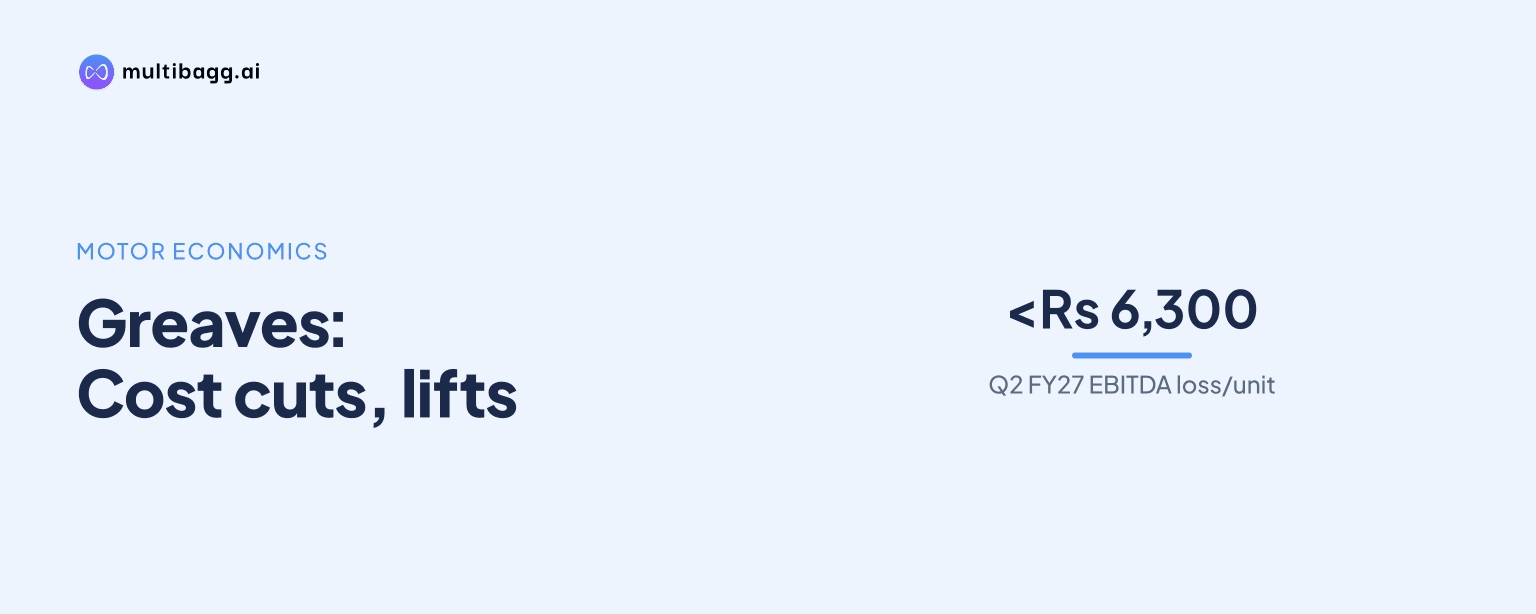
Greaves Electric Mobility said in Q2 FY27 that its in-house rare-earth-free motor will lower cost and outperform traditional rare-earth motors, while its two-wheeler earnings before interest, tax, depreciation and amortisation (EBITDA) loss per unit fell 70% year on year to less than Rs 6,300.
Know Greaves Cotton inside out
Results, valuation, peers and who's buying, in one view.
What is GEML's new rare-earth-free motor?
GEML’s new motor is a ferrite-assisted synchronous reluctance motor developed in-house that uses no rare-earth magnetic material. GEML said its research and development team secured a design registration for the architecture in Q2 FY27, moving the technology beyond a stated product concept.
The motor is intended to reduce GEML’s dependence on imported rare-earth minerals from China while increasing localisation of its powertrain. In response to an analyst question, management said the design beats a traditional rare-earth motor on performance metrics and provides cost optimisation, but it did not disclose a percentage improvement in efficiency, output or manufacturing cost.
Management did not compare the motor with rivals’ products or say whether the design is unique within the industry. Its stated comparison was with a conventional rare-earth motor, and its claimed benefits were better performance and lower cost rather than a specified range, acceleration or battery-life target.
When will GEML put the motor into vehicles?
GEML plans to start deploying the motor in its two-wheeler portfolio very soon, followed by new product introductions in Q4 FY27. Management gave that sequence in its Q2 FY27 update but did not identify the first scooter model, production volumes or an exact launch date.
The initial two-wheeler rollout applies to a business that recorded more than 37,000 units in Q2 FY27, up 114% year on year. GEML’s e-two-wheeler registrations on the VAHAN vehicle-registration system also rose 107% year on year to about 53,700 units in H1 FY27, compared with H1 FY26.
The planned motor rollout follows separate upgrades to GEML’s scooter range. GEML said the Nexus EX Plus has a 5-kilowatt motor with higher gradeability, while the Magnus G Max has the IntelliPack connectivity suite and more than 30 connected features through the Ampere Connect application, including cruise control, hill-hold assist, navigation and remote diagnostics. GEML did not say that these existing features use the new rare-earth-free motor.
How does the motor relate to GEML's financial progress?
GEML’s motor programme is intended to support vehicle economics as its two-wheeler unit losses narrow. EBITDA loss per two-wheeler fell 70% in Q2 FY27, from about Rs 20,000 in Q2 FY26 to less than Rs 6,300, while the segment’s EBITDA margin improved to negative 7% from negative 24%.
The improvement coincided with higher revenue and scale rather than reported savings from the motor, which had not yet been deployed. GEML’s consolidated Q2 FY27 revenue was Rs 410 crore, up 106% from Rs 199 crore in Q2 FY26, while its electric-vehicle business loss narrowed to Rs 25 crore from Rs 42 crore. Two-wheeler revenue rose 134% year on year to Rs 350 crore, while L5 three-wheeler revenue increased 55% to nearly Rs 60 crore.
Average e-two-wheeler realisation increased by Rs 5,000 in Q2 FY27 to roughly Rs 93,000 per unit, according to management. GEML attributed its unit-economics improvement to increased scale and cited Internet of Things solutions and accessories as further revenue and margin levers. The rare-earth-free motor could become an additional cost lever in production, but the call did not quantify its financial contribution.
Got a follow-up? Ask IRIS
How much electric two-wheeler capacity does GEML have?
GEML has capacity of about 40,000 units a month and said utilisation had reached about 40% in Q2 FY27. Management expects the existing capacity to cover the next couple of years at current volume-growth rates, while saying it would meet demand through capacity expansion very soon if required.
GEML is also expanding its dealer network alongside production. It issued letters of intent for 160 new dealerships in H1 FY27, while existing dealers opened nearly 20 branches. Average monthly dealer throughput increased nearly 40% year on year, from 18 to 25 units, and business-to-business volume grew 18% with new fleet accounts.
GEML’s e-two-wheeler market share increased to 4.8% in H1 FY27 from 4.1% a year earlier, reaching 5.6% in June 2026. GEML said it ranked among the top three e-two-wheeler companies in about 35% of the regional transport offices it served and gained share year on year in more than 60% of them. In Q2 FY27, it was number one in Bihar with about 18% share and number two in Tamil Nadu with about 15% share.
Management said GEML should reach break-even fairly soon but did not provide an exact timetable. It also said the fully subscribed rights issue had left GEML well funded, while the timing of a potential initial public offering remained under review by its initial public offering committee.
Conclusion
GEML’s rare-earth-free motor is a localisation and cost-design programme that management says will improve on traditional rare-earth motor performance while lowering dependence on imported material. The programme arrives as its two-wheeler business expands: Q2 FY27 volume exceeded 37,000 units, two-wheeler revenue reached Rs 350 crore and EBITDA loss per unit declined to less than Rs 6,300.
The next test is execution of the stated rollout, beginning in existing two-wheelers soon and extending to new products in Q4 FY27. Management’s disclosed break-even expectation also leaves volume growth, pricing, product-led cost reductions and the timing of the potential initial public offering as matters to watch, since it provided no precise dates for either milestone.