










Greaves Cotton Limited Margin Falls to 11.5% Before Q4 Recovery
Key highlights
- Greaves' Core Business EBITDA margin was 11.5% in Q2 FY27, versus 14.8% in Q2 FY26.
- Core Business revenue grew 24% year on year to Rs 768 crore in Q2 FY27.
- Greaves expects the full company-wide effect of price actions by Q4 FY27.
- Energy Solutions grew 36% year on year in Q2 FY27, while Mobility Solutions grew 23%.
powered by IRIS
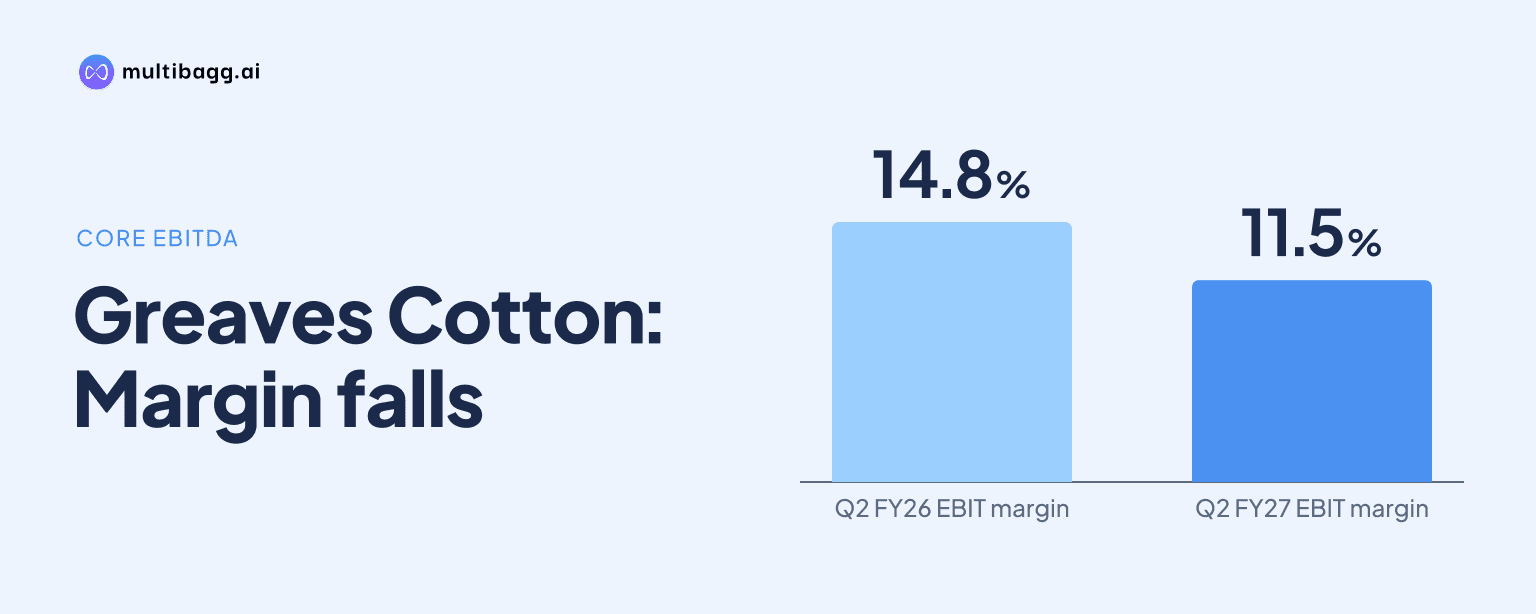
Greaves Cotton Limited reported an 11.5% Core Business EBITDA margin in Q2 FY27, down from 14.8% a year earlier, as aluminium, iron, copper and platinum group metal costs rose faster than price recovery. Greaves management expects the full company-wide benefit of price actions to be reflected by Q4 FY27 because business-to-business and original equipment manufacturer contracts operate with a lag.
Know Greaves Cotton inside out
Results, valuation, peers and who's buying, in one view.
Why did Greaves' Core Business margin decline in Q2 FY27?
Greaves' Core Business margin declined because higher commodity costs offset benefits from pricing, cost optimisation and operating-efficiency actions. Group Chief Financial Officer Manish Poddar identified aluminium, iron, copper and platinum group metals, or PGM, as the principal input-cost buckets affecting the engines and gensets businesses. Core Business earnings before interest, tax, depreciation and amortisation, or EBITDA, margin was 11.5% in Q2 FY27, compared with 14.8% in Q2 FY26.
The margin pressure occurred despite revenue growth across the operating portfolio. Core Business revenue rose 24% year on year to Rs 768 crore in Q2 FY27 from Rs 621 crore in Q2 FY26, while H1 FY27 revenue increased 20% to Rs 1,478 crore from Rs 1,233 crore. Management said continuing cost inflation offset some of the gains from its corrective measures and made the expected margin improvement slower.
When will Greaves' price increases benefit margins?
Greaves expects the full company-wide benefit of its price increases to be reflected by Q4 FY27. The company began implementing increases in parts of the business during Q2 FY27 and said it would continue the exercise through the rest of the financial year. Management attributed the timing gap to pricing arrangements in business-to-business and original equipment manufacturer, or OEM, channels.
Management said H2 FY27 margins should be better than H1 FY27, but did not provide a quarterly margin forecast. Poddar reiterated the 13% to 15% EBITDA-margin range under the GREAVES.NEXT strategy as a mid- to long-term objective. This is a management target rather than reported FY27 guidance.
Greaves is combining pricing discipline with value engineering, productivity programmes and tight cost management. Management also said it is distinguishing costs that can be optimised from investments it considers necessary for future competitiveness. The approach is intended to improve conversion of revenue into operating earnings after Core Business sales expanded 20% in H1 FY27.
Which Greaves businesses grew despite commodity inflation?
Greaves' Energy Solutions and Mobility Solutions businesses supported Core Business growth in Q2 FY27. Energy Solutions revenue grew 36% year on year, accelerating from 21% growth in Q1 FY27, with demand across infrastructure, manufacturing, commercial and industrial applications. Its medium-horsepower genset portfolio, spanning 160 to 750 kilovolt-amperes, or kVA, grew 35% in H1 FY27, ahead of the segment's 28% growth.
Mobility Solutions increased 23% year on year in Q2 FY27, compared with 18% in Q1 FY27. Automotive Engines grew 37%, supported by three-wheeler and four-wheeler demand, and Greaves launched a 470 cubic centimetre diesel engine for three-wheeler applications during the quarter. Engineered Components, operated through Excel Controlinkage, grew 30% on new product orders and customer wins.
Industrial Solutions reported broadly flat revenue in Q2 FY27, although Greaves said the business grew 9% on a like-for-like basis after adjusting for earlier portfolio rationalisation. The segment launched a 750 horsepower fire-fighting engine and unveiled prototypes for a 160 cubic centimetre gasoline engine. These products indicate the company's focus on specialised applications, but management did not link them to an immediate resolution of commodity-cost pressure.
Got a follow-up? Ask IRIS
How did Greaves' consolidated performance compare with Core Business margins?
Greaves' consolidated EBITDA margin improved sequentially to 6.2% in Q2 FY27 from 5.8% in Q1 FY27, while Core Business EBITDA margin declined year on year to 11.5%. Consolidated revenue rose 44% year on year to Rs 1,176 crore in Q2 FY27 from Rs 815 crore, and management said consolidated EBITDA increased 43% despite commodity pressure during H1 FY27.
The comparison reflects the group's business mix, including Greaves Electric Mobility. Greaves Electric Mobility reported Q2 FY27 revenue of Rs 410 crore, up 106% from Rs 199 crore a year earlier, while its loss narrowed to Rs 25 crore from Rs 42 crore. In electric two-wheelers, EBITDA loss per unit fell 70% from about Rs 20,000 to less than Rs 6,300, while the EBITDA loss margin narrowed to negative 7% from roughly negative 24%.
Reported consolidated profit before tax also included exceptional and non-recurring items outside the commodity-cost discussion. Greaves recognised Rs 27 crore of accelerated depreciation and Rs 33 crore of exceptional items in Q2 FY27 following a review of brands, goodwill and other intangible assets. It also recorded a one-off charge linked to the planned initial public offering of Greaves Electric Mobility.
What should investors monitor in Greaves' second half of FY27?
Investors should monitor whether pricing actions and cost programmes narrow the 3.3-percentage-point year-on-year Core Business margin gap by Q4 FY27. Management said it would continue price increases through the rest of FY27, while contractual lags delay the full effect. Aluminium, iron, copper and PGM prices remain the key external variables identified by management.
The scale of Energy Solutions and Mobility Solutions will also matter for operating-cost absorption. Energy Solutions grew 36% in Q2 FY27 and Mobility Solutions grew 23%, while the medium-horsepower genset portfolio grew 35% in H1 FY27. Greaves completed the first batch of enhanced gensets for a Middle East market during the quarter as part of its plan to expand its domestic and international Energy Solutions business.
Greaves Electric Mobility is another disclosed factor to watch because it contributed Rs 410 crore of Q2 FY27 revenue and management said it was approaching break-even. The business had capacity of about 40,000 units a month and utilisation of about 40% at the time of the call. Management did not give an exact break-even date, but said performance was ahead of its previous plan.
Conclusion
Greaves delivered 24% Core Business revenue growth in Q2 FY27, but commodity inflation reduced EBITDA margin to 11.5% from 14.8% a year earlier. Higher volumes in Energy Solutions and Mobility Solutions have not yet fully overcome the interval between input-cost increases and customer-price revisions, while Greaves Electric Mobility reduced its loss as revenue more than doubled.
The next disclosed milestone is Q4 FY27, when management expects the full company-wide benefit of pricing actions to appear. Investors should watch commodity movements, the pace of value-engineering savings and whether H2 FY27 margins improve over H1 FY27 in line with management's stated expectation.