










Greenpanel sees MDF supply pressure lasting two more years
Key highlights
- Greenpanel expects 800,000 to 900,000 cubic metres of annual MDF capacity to enter over the next two years.
- Greenpanel estimates current MDF industry capacity at about 3.5 million cubic metres annually and utilisation at around 70%.
- Greenpanel operated at roughly 50% to 55% utilisation, while management said certain companies were at 60% to 70%.
- Value-added products represented about 43% to 44% of Greenpanel’s H1FY27 volume and close to 55% of value.
powered by IRIS
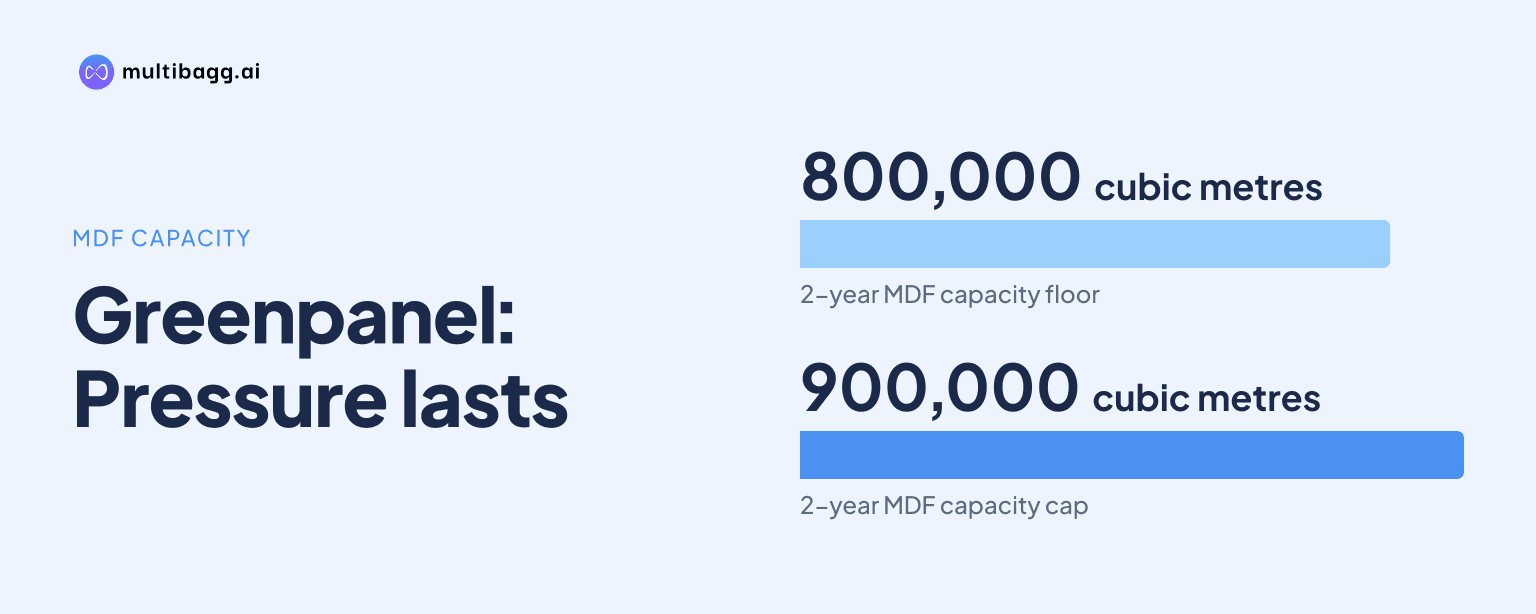
Greenpanel Industries Limited expects 800,000 to 900,000 cubic metres of annual medium-density fibreboard, or MDF, capacity to be added over the next two years, extending oversupply and pricing pressure despite a slower project pipeline. Management said the supply-demand gap should narrow over time as industry volumes grow by an estimated 15% to 20% annually.
Know Greenpanel Industries inside out
Results, valuation, peers and who's buying, in one view.
Why does Greenpanel expect MDF supply pressure to continue?
Greenpanel expects pressure to continue because management estimates that 800,000 to 900,000 cubic metres of annual MDF capacity will be added over the next two years. The estimate refers to output volume rather than capital expenditure and represents management’s quantified view of additions across organised and unorganised producers.
The projected addition follows what management called astronomical capacity expansion during the preceding two years. Greenpanel said the pace of new projects is now moderating, but capacity already being built will create oversupply for at least two years. Management expects that surplus to maintain pressure on prices, although it said the supply-demand gap should narrow progressively thereafter.
Management estimated total current industry MDF capacity at about 3.5 million cubic metres annually and average industry utilisation at around 70%. Greenpanel was operating at roughly 50% to 55% utilisation under its existing retail, original equipment manufacturer, or OEM, and export mix, while management said certain other companies were operating at 60% to 70%.
Why does Greenpanel not expect unlimited further MDF price cuts?
Greenpanel does not expect unlimited cuts because management said current realisations are already too low for further reductions to be sustainable for producers. Management also said a new entrant with debt to service would have limited practical scope to sell materially below prevailing prices, although it provided neither a price floor nor a date for market stability.
That assessment does not mean pricing pressure has ended. In Q2FY27, an analyst cited a sequential decline of about 7% in Greenpanel’s domestic realisation, against a market price decline estimated at roughly 10% to 15%. Greenpanel said its smaller blended decline reflected product mix, including lower OEM sales and a greater retail contribution.
Regional capacity can also create volume pressure before causing a measurable price move. Greenpanel said a new plant in South India would pressure suppliers in that zone and described oversupply as present across the country. Management said it could not yet determine whether the added regional volumes would lead to further price reductions.
Can multi-daylight press closures reduce excess MDF capacity?
Greenpanel said smaller multi-daylight presses are becoming increasingly difficult to sustain, and some capacity could be absorbed by larger operators or shut. Management cited one producer that operated both a multi-daylight and a continuous press, but had stopped output from the multi-daylight line while retaining continuous-press production.
Management did not expect an immediate, uniform fall in installed capacity. It said some unorganised producers continued to sell standard-grade boards with added colour as moisture-resistant or high-density products. Greenpanel expects industry initiatives and the Bureau of Indian Standards, or BIS, framework to make those practices less sustainable over time, but gave no timetable for exits.
Different producers have different break-even levels and cost structures. Greenpanel said timber costs vary sharply by zone, creating materially different raw-material costs even between its own two plants. That variation means an industry utilisation estimate of about 70% does not establish when any individual producer may stop output.
Got a follow-up? Ask IRIS
How is Greenpanel responding to MDF oversupply?
Greenpanel is seeking volume across products that provide contribution while keeping retail as its primary focus. Management estimated its domestic market share at about 23% to 25% and said the company has surplus volumes to sell. Its stated near-term objective is to sell products that contribute financially rather than limit volume efforts to a single category.
Value-added products represented about 43% to 44% of Greenpanel’s volume in H1FY27 and close to 55% of value. Management said this volume share should remain stable or improve, while noting that current oversupply means total volume growth is also a priority. Pre-laminated products were among the mix factors management cited in discussing domestic realisations.
Retail earns more than OEM business, according to management, with the margin differential ranging from 5% to 20% depending on geography, product, size, pricing and costs. OEM represented 15% of domestic volume in H1FY27, compared with about 25% or more in certain quarters of the prior year. Greenpanel said OEM demand is more exposed to imports and domestic competition because it is a commoditised segment.
Exports provide another volume outlet, although logistics constrained execution in October. About 85% of Greenpanel’s exports were going to the Middle East, and the opening export order book on 1 October stood at about 13,000 cubic metres. Management said container availability, rather than freight costs alone, prevented full execution of those pending orders.
What demand growth does Greenpanel expect against new MDF capacity?
Greenpanel expects annual industry MDF volume growth of 15% to 20% to be sustainable. Management presented this demand growth as the mechanism through which the projected 800,000 to 900,000 cubic metres of additions could be absorbed and the supply-demand gap narrowed over time.
Management said it did not expect anything substantial beyond the cited 800,000 to 900,000 cubic metres within the next two years. It added that current economics could make prospective investors reconsider new MDF projects, including companies bringing plants online. This was management’s assessment of project decisions rather than a formal forecast for industry investment.
Greenpanel said its own capacity is about 2,800 to 2,900 cubic metres per day, translating to nearly 900,000 cubic metres annually. Management said larger production lines have a lower cost per unit of output because investment does not rise proportionately with capacity. As an example, it said a 1,200-cubic-metre line did not cost twice as much as a 600-cubic-metre line built at the same time.
Conclusion
Greenpanel’s central view is that slowing new project announcements will not remove the MDF supply overhang because 800,000 to 900,000 cubic metres of annual capacity is still due within two years. With industry utilisation estimated at about 70%, management expects continuing pressure on prices and volumes, while closures or consolidation of less viable multi-daylight capacity could gradually reduce part of the surplus.
The next factors to watch are the commissioning pace of the projected capacity, whether industry volume growth reaches management’s estimated 15% to 20% range, and evidence of multi-daylight press rationalisation. For Greenpanel, management aims to rebuild OEM sales toward a possible 20% to 25% share of domestic volume while maintaining or improving the 43% to 44% value-added product volume share reported in H1FY27.