










Greenpanel Industries Limited says OEM share dropped to 15%
Key highlights
- Greenpanel said OEM share fell to 15% in H1 FY27 from 25%-30% in the prior year.
- Retail MDF volume rose 17.0% year on year in Q2 FY27, while total MDF volume fell 3.4%.
- Q2 FY27 revenue was Rs 407 crore, up 4.6% year on year and 16.4% sequentially.
- Greenpanel had about 13,000 cubic metres of pending export orders at the start of October.
powered by IRIS
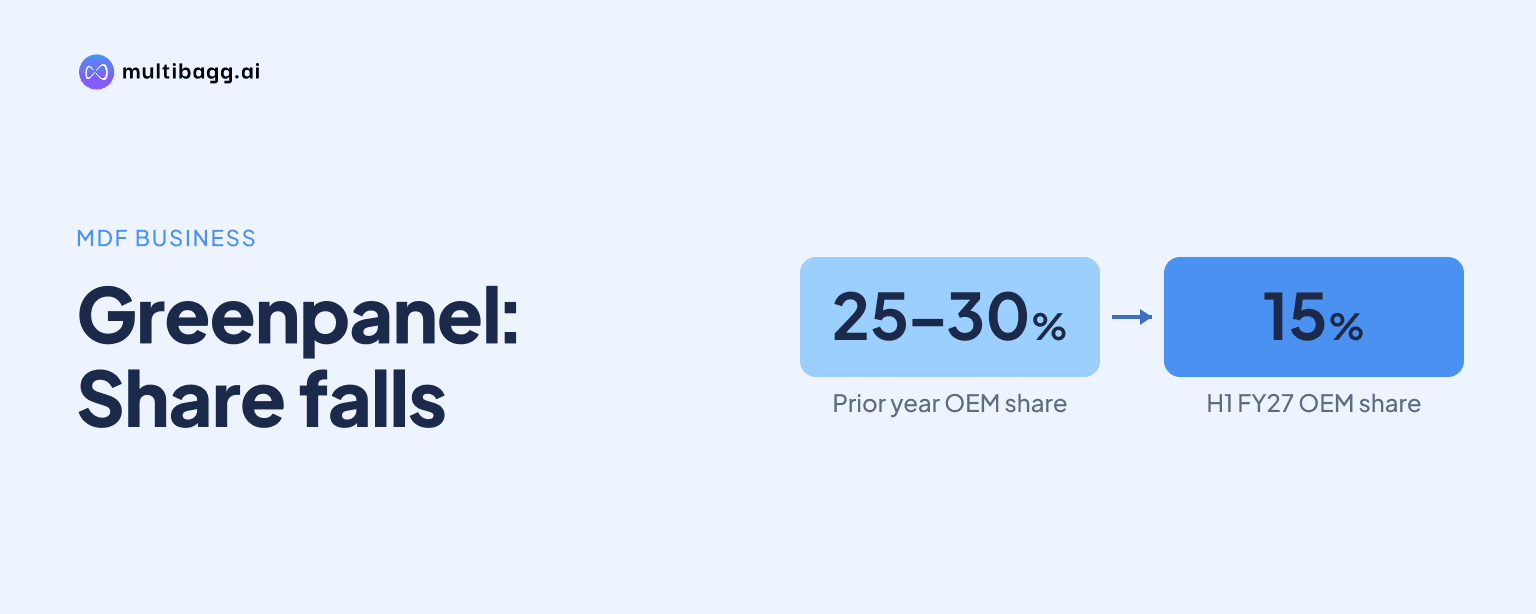
Greenpanel Industries Limited said OEM share was 15% in H1 FY27, versus 25%-30% last year, after its Q1 FY27 price increase caused customers to place import orders; total MDF volume consequently fell 3.4% year on year in Q2 despite 17% retail MDF growth.
Know Greenpanel Industries inside out
Results, valuation, peers and who's buying, in one view.
Why did Greenpanel’s OEM share fall to 15%?
Greenpanel’s original equipment manufacturer, or OEM, share fell because its Q1 FY27 price increase removed the pricing benefit available to OEM buyers and brought their prices to retail levels. Managing Director Shobhan Mittal said the increase was taken primarily because war-related developments had raised chemical costs. OEM customers then arranged alternate import supplies, whose effects extended into Q2 FY27.
The prior-year comparison was demanding. Greenpanel said it had taken corrective pricing action from Q1 FY26 to Q2 FY26 and almost doubled OEM volumes, with Q2 FY26 OEM volume at nearly 28,000 cubic metres. Management described the channel as commoditised and price-sensitive, where imports as well as Tier 2 and Tier 3 domestic suppliers can compete more readily than in retail.
The 15% figure applies to the first half of FY27 rather than Q2 alone. Chief Financial Officer Himanshu Jindal said Greenpanel could return to more normal OEM levels relatively soon through pricing-focused efforts, but management did not set a numerical OEM-share target for H2 FY27 or FY28.
Has Greenpanel’s pricing realignment restored OEM volumes?
Greenpanel said pricing realignment with major counterparties had helped OEM volumes recover month on month, although October had not reached the level management wanted. Mittal said Q3 FY27 should be materially better than Q2 FY27 for OEM volumes, while qualifying that the October trend was directionally positive rather than a full recovery.
The recovery has been delayed by the timing of import procurement. Greenpanel said OEMs place larger orders and plan imports over longer periods, so alternate purchases arranged after the Q1 FY27 price increase continued to affect Q2 FY27. Disruption in vessel and container availability also meant some imports did not arrive when buyers had expected, extending the effect of those procurement decisions.
Greenpanel’s total medium-density fibreboard, or MDF, volume declined 3.4% year on year in Q2 FY27, even though retail MDF volume rose 17% year on year. Total MDF volume increased 23% sequentially from Q1 FY27, showing that retail growth and a quarter-on-quarter recovery partly offset the OEM disruption, but not enough to exceed the prior-year quarter.
Can retail MDF growth make up for Greenpanel’s OEM setback?
Greenpanel aims to make up the first-half OEM and export MDF volume shortfall through retail growth, OEM recovery and renewed export focus in H2 FY27. Management said Q2 FY27 retail MDF sales were Greenpanel’s highest in a single quarter and set a target of mid-teen MDF volume growth for the full year.
Retail remains the company’s priority because it generates more money on a broad basis than OEM sales, according to Jindal. He said the margin difference could range from 5% to 20%, depending on geography, product, selling price and cost. OEM orders nevertheless provide large and consistent production runs, which can improve operating efficiency.
Q2 FY27 revenue was Rs 407 crore, up 4.6% year on year and 16.4% from Q1 FY27, while H1 FY27 revenue increased 6.3% to Rs 757 crore. Plywood sales rose 8.4% year on year in Q2, and retail MDF growth supported overall revenue, although Greenpanel did not disclose revenue by channel or product category.
Management expects the MDF market to sustain a 15%-17% compound annual growth rate, or CAGR. It also said the Furniture Quality Control Order 2025 had been in place for more than six months by the November 2 call, while transition relief for imports and exemptions for micro, small and medium enterprises had lapsed in Q2 FY27.
Got a follow-up? Ask IRIS
How do imports and freight affect Greenpanel’s recovery?
Imports remain a competitive variable for Greenpanel’s OEM channel, although management said higher container freight had made imported MDF less feasible in domestic markets. Mittal said import pricing matters particularly in OEM because the channel is commoditised. He added that domestic competition, rather than Bureau of Indian Standards certification alone, had also made local pricing competitive.
Export execution faced the opposite problem: customer demand existed, but shipping capacity was constrained. Greenpanel had about 13,000 cubic metres of pending export orders at the start of October, more than its total Q2 FY27 export sales. Management said it could not execute the entire quantity because container availability was a bigger issue than customers’ willingness to absorb higher freight costs.
About 85% of Greenpanel’s exports were going to the Middle East, with smaller shipments to Southeast Asia and Sri Lanka. The company said abnormal conditions in the Middle East had reduced vessel and container availability, while export sales remained neutral in Q2 FY27 because of geopolitical conditions and sea-freight challenges.
How did pricing changes affect Greenpanel’s margins and balance sheet?
Greenpanel’s consolidated operating earnings before interest, tax, depreciation and amortisation, or EBITDA, margin was 7.5% in Q2 FY27, compared with 9.6% in Q1 FY27 and 10.2% a year earlier. Management attributed the decline to price reductions while the cost of goods remained elevated by higher-cost opening inventory carried from Q1 FY27.
Cost of production fell 5% sequentially in Q2 FY27, but Greenpanel said the full benefit was not yet visible. Domestic average selling prices, or ASPs, had risen 13.5% sequentially in Q1 FY27 following a price increase of close to 15%; ASPs then contracted by 6%-7% in Q2 as pricing was realigned to counter competition.
Utilisation improved from 51% in Q1 FY27 to 55% in Q2 FY27, helping fixed-cost absorption, but management said additional volume was required for operating leverage to have a larger effect. H1 FY27 operating EBITDA margin was 8.4%, up 100 basis points year on year, while the working-capital cycle improved by five days from June 30 and net debt declined to Rs 133 crore.
Conclusion
Greenpanel’s OEM decline reflects a channel-specific consequence of its Q1 FY27 pricing decision rather than a simple fall in MDF demand. The price increase encouraged customers to secure imports, cutting OEM share to 15% in H1 FY27 from 25%-30% last year. Retail MDF growth and sequential volume improvement provided an offset, but Q2 total MDF volume remained below the prior-year period.
The next evidence point is Q3 FY27 OEM volume, which management expects to improve after price realignment, alongside its mid-teen full-year MDF volume growth target. Execution of the roughly 13,000-cubic-metre October export order book will also depend on container availability, while management said chemical costs, freight and geopolitical conditions remain unresolved variables.