










Greenpanel retail record cannot prevent 3.4% MDF volume fall
Key highlights
- Greenpanel’s total MDF volume fell 3.4% year on year in Q2 FY27 but rose 23% sequentially from Q1 FY27.
- Retail MDF sales grew 17% year on year and were Greenpanel’s highest-ever quarterly retail MDF sales.
- Q2 FY27 revenue rose 4.6% year on year to Rs 407 crore, while plywood sales increased 8.4%.
- Operating EBITDA margin was 7.5% in Q2 FY27, versus 9.6% in Q1 FY27 and 10.2% in Q2 FY26.
powered by IRIS
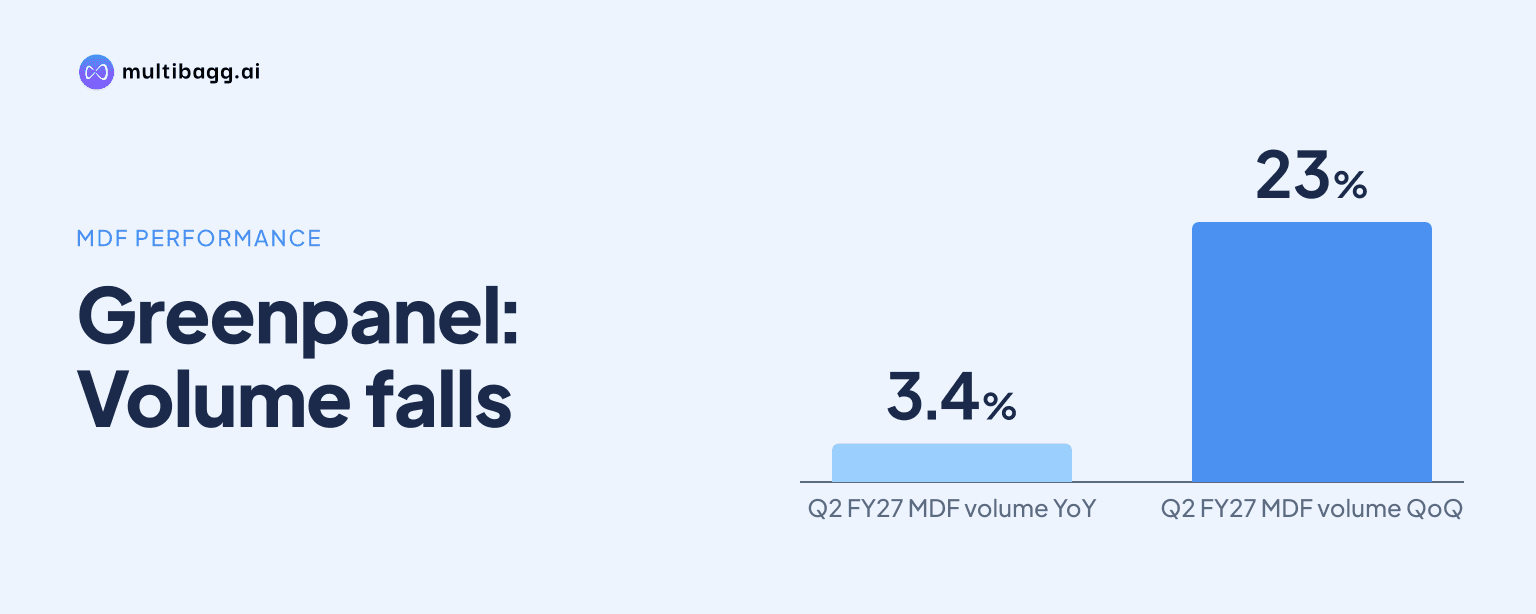
Greenpanel Industries Limited reported a 3.4% year-on-year decline in medium-density fibreboard (MDF) volume in Q2 FY27, despite 17% retail MDF growth and its highest-ever quarterly retail sales. Greenpanel said a delayed original equipment manufacturer (OEM) recovery and freight-disrupted exports outweighed retail momentum, although total MDF volume rose 23% sequentially from Q1 FY27.
Know Greenpanel Industries inside out
Results, valuation, peers and who's buying, in one view.
Why did Greenpanel’s MDF volume fall in Q2 FY27?
Greenpanel’s total MDF volume fell because record retail growth did not offset weaker OEM demand and neutral export sales in the quarter ended September 30, 2026. Retail MDF sales increased 17% year on year, but total MDF volume declined 3.4% from Q2 FY26 as the other two channels did not contribute enough volume.
The sequential trend was different, with total MDF volume increasing 23% from Q1 FY27. Management said retail momentum continued from the first quarter and that pre-festive demand suggested a better Q3 FY27 and second half. Greenpanel also held its annual foreign-trip scheme meeting with more than 150 channel partners in Hong Kong and Macau in August.
What delayed Greenpanel’s OEM MDF recovery?
Greenpanel said OEM volumes were affected after its Q1 FY27 price increase removed the pricing benefit OEM customers had received versus retail buyers. Management said OEMs made alternative import arrangements when Greenpanel’s prices rose, and the effect of those purchasing decisions continued into Q2 FY27.
The prior-year comparison was also demanding. Greenpanel said OEM volume had almost doubled from Q1 FY26 to Q2 FY26 after corrective pricing, reaching about 28,000 cubic metres in Q2 FY26. In Q2 FY27, management said chemical-cost increases had led to substantial price increases, reducing the company’s competitiveness for OEM customers.
Greenpanel said pricing realignment with major counterparties supported month-on-month OEM volume recovery, but October volumes had not reached management’s desired level. Management expects Q3 FY27 OEM volumes to exceed Q2 FY27 and intends to regain OEM market share, while aiming for mid-teen MDF volume growth for the full year.
How did Middle East freight disruption affect Greenpanel exports?
Greenpanel said abnormal conditions in the Middle East reduced the availability of containers and vessels in Q2 FY27, raising delivery costs for export customers. Export sales therefore remained neutral during the quarter, despite month-on-month growth in export sales salience and further sea-freight increases at the end of September.
The opening export order pipeline at the start of October exceeded Greenpanel’s total export sales in Q2 FY27, according to management. Management said customers were again viewing Greenpanel as a dependable supplier on price and volume, but the pipeline was not reported sales and conversion remained exposed to freight and geopolitical conditions.
Management also said higher container freight had made imports less feasible in the domestic market. Greenpanel plans renewed export focus in the second half of FY27 and aims to recover the first-half shortfall in OEM and export MDF volume, though it did not disclose a specific export-volume target.
Got a follow-up? Ask IRIS
How did Greenpanel’s revenue compare with volume performance?
Greenpanel’s total revenue rose 4.6% year on year to Rs 407 crore in Q2 FY27 despite the 3.4% decline in total MDF volume. Revenue was also 16.4% higher than Q1 FY27, reflecting retail MDF growth and contributions from the company’s plywood business alongside its MDF channels.
Plywood sales rose 8.4% year on year in Q2 FY27 and 16.5% sequentially from Q1 FY27. For H1 FY27, total revenue increased 6.3% year on year to Rs 757 crore. Management said domestic MDF demand drivers remained intact and expected the MDF market to sustain a 15% to 17% compound annual growth rate.
Management cited the Furniture Quality Control Order 2025 as a potential support for domestic wood-panel demand. It said the order had been in place for more than six months, while transitional import relief and the exemption period for micro, small and medium enterprises had lapsed in Q2 FY27. Greenpanel said Line 3 at Andhra was operational and provided organic capacity headroom.
What did pricing and inventory mean for Greenpanel’s margins?
Greenpanel reported a consolidated operating earnings before interest, tax, depreciation and amortisation (EBITDA) margin of 7.5% in Q2 FY27, down from 9.6% in Q1 FY27 and 10.2% in Q2 FY26. Management attributed the contraction to price reductions made to counter competition while higher-cost opening inventory was still being consumed.
Cost of production declined 5% sequentially as chemical costs softened, but management said the full benefit was not visible in Q2 FY27. The chief financial officer said Greenpanel carried 50,000 cubic metres of inventory from the prior quarter, which had been produced or procured at a higher cost.
Management said domestic average selling prices increased 13.5% sequentially in Q1 FY27 before contracting by 6% to 7% in Q2 FY27. Better fixed-cost absorption from higher sequential volumes partly offset that pressure. For H1 FY27, operating EBITDA margin improved by 100 basis points to 8.4%, and management said additional volume could support operating leverage.
Conclusion
Greenpanel’s Q2 FY27 performance shows that retail MDF demand alone could not compensate for the delayed OEM response and freight-constrained exports. Total MDF volume fell 3.4% year on year even as retail sales rose 17% and total volume recovered 23% from Q1 FY27. Revenue increased to Rs 407 crore, aided by 8.4% plywood sales growth, while pricing reductions and high-cost inventory reduced quarterly operating EBITDA margin to 7.5%.
The next measures to watch are whether October’s improving OEM trend develops into a larger Q3 FY27 recovery and whether the opening export order pipeline converts despite container and vessel constraints. Management is targeting mid-teen MDF volume growth for FY27 and plans to recover first-half OEM and export shortfalls in the second half, while chemical costs, pricing and the 50,000-cubic-metre higher-cost inventory remain relevant to margins.