










GRM targets ₹3,500 crore FY28 revenue as India overtakes exports
Key highlights
- GRM targets consolidated revenue of ₹3,500 crore in FY28.
- India revenue is targeted to reach ₹2,000 crore in FY28 from ₹740 crore in FY26.
- GRM’s FY28 target mix is 57% India and 43% international, versus 46% and 54% in FY26.
- International revenue is targeted to increase from ₹854 crore in FY26 to ₹1,500 crore in FY28.
powered by IRIS
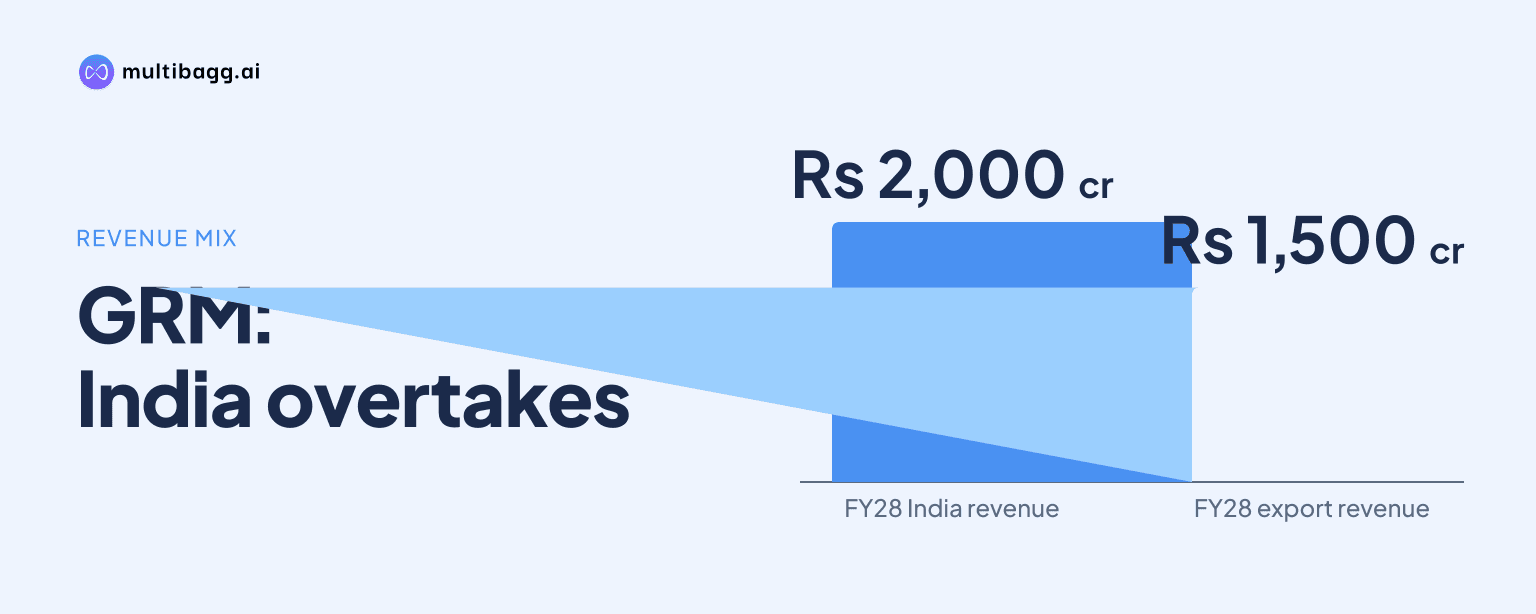
GRM Overseas Limited targets consolidated revenue of ₹3,500 crore in FY28, with the India business planned to contribute ₹2,000 crore, or 57%, overtaking international revenue of ₹1,500 crore. Management’s plan requires India revenue to rise 2.7 times from ₹740 crore in FY26, compared with a 1.8-times increase in international revenue.
Know GRM Overseas inside out
Results, valuation, peers and who's buying, in one view.
What does GRM’s FY28 revenue target require?
GRM’s FY28 target requires consolidated revenue of ₹3,500 crore, split between ₹2,000 crore from India and ₹1,500 crore from international markets. The company labels these figures as management targets rather than reported financial results, and sets the intended revenue mix at 57% India and 43% international.
The planned mix would reverse the position reported for FY26, when India represented 46% of revenue and international operations represented 54%. India would therefore become the larger engine in the target year, even though the international business remained ahead in the FY26 mix disclosed in the presentation.
The growth burden is weighted toward the domestic operation. GRM describes the India revenue objective as 2.7 times its FY26 level in two years, while the international objective is 1.8 times the FY26 level. In absolute terms, the domestic target adds ₹1,260 crore from FY26, compared with ₹646 crore targeted from international markets.
Why is GRM making India its larger revenue engine?
GRM is making India its larger revenue engine because domestic revenue grew from ₹58 crore in FY21 to ₹740 crore in FY26 under the 10X fast-moving consumer goods, or FMCG, strategy. The company launched 10X in 2020 to focus on the domestic food FMCG market and introduced packaged rice under the brand that year.
That domestic expansion exceeded the change reported in international sales over the same period. International revenue rose from ₹652 crore in FY21 to ₹854 crore in FY26, while India moved from a much smaller ₹58 crore base to ₹740 crore. International revenue was still ₹114 crore higher in FY26, but the FY28 plan calls for India to be ₹500 crore larger.
GRM’s domestic product range includes rice, atta, oil, besan and other products. Its premium 10X Zarda King Golden Sella Basmati Rice was introduced in 2022, while 10X atta and oil were launched in 2024. These launches broaden the India business beyond packaged rice, which was the starting point for 10X in 2020.
How does GRM plan to reach ₹2,000 crore in India?
GRM plans to reach ₹2,000 crore in India by expanding in packaged foods, launching fast-selling ready-to-eat and ready-to-cook products, and acquiring new-age businesses in niche segments. These are management’s stated growth strategies for the FY28 domestic target, which is ₹1,260 crore above FY26 revenue of ₹740 crore.
The company is also moving from one principal staples brand towards what it calls a house of brands. Under this structure, 10X will continue to hold staple products including rice, atta, oil, besan and maida. The 10X Farms brand includes organic honey, A2 desi cow ghee, sattu flour and khapli atta, giving the group a separate food range.
GRM has identified 10X Ventures as a digital-first platform for acquiring direct-to-consumer, or D2C, brands, lifestyle brands, smaller portfolio brands and incubator opportunities. Its first disclosed acquisition is Rage Coffee, founded in 2018 and described by the company as a plant-based vitamin coffee brand selling instant coffee, whole beans and ground coffee.
The presentation lists six levers for India growth: scaled products under 10X, available funds, a distribution and supplier network, a diverse product range, marketing featuring Salman Khan for 10X, and FMCG industry opportunities. These levers describe the operating and commercial mechanisms GRM intends to use as it seeks a 2.7-times increase over two years.
Got a follow-up? Ask IRIS
How will GRM grow international revenue to ₹1,500 crore?
GRM plans to grow international revenue to ₹1,500 crore by expanding sustainably in established private-label markets and taking its own brands into newer markets through distributor partnerships. The FY28 target is ₹646 crore above FY26 international revenue of ₹854 crore and is described as a 1.8-times increase in two years.
The international business is primarily a basmati rice operation, with exports mainly conducted through private labels. GRM also sells some products through its own brands via its United Kingdom subsidiary, GRM International. The group says it is present in more than 55 countries and is among the top five basmati exporters globally.
Himalaya River and Tanoush are the company’s premium global brands, launched in 2018. The FY28 plan specifically identifies distributor partnerships as the route for expanding these brands into newer markets, whereas private labels remain central to growth in markets where GRM says it is already established.
What operating base does GRM cite for its growth plan?
GRM cites annual production capacity of 4,40,800 metric tonnes, supported by facilities in Panipat and Naultha in Haryana for the domestic market and Gandhidham in Gujarat for the export market. Its listed processing infrastructure includes three milling plants with 550 metric tonnes per day of capacity and nine Sortex plants with 1,400 metric tonnes per day.
The company also lists 1.75 lakh square feet of warehousing in Kutch, Gujarat, and 10 third-party units across five states. Those units have installed capacity of 4,800 metric tonnes of atta and 4,000 metric tonnes of edible oil per month, aligning with the expansion of 10X staples including atta and oil launched in 2024.
Conclusion
GRM’s FY28 plan changes the group’s intended revenue balance rather than simply increasing both businesses at the same rate. International revenue is targeted to rise from ₹854 crore to ₹1,500 crore, but the larger planned increase is in India, where revenue is targeted to move from ₹740 crore to ₹2,000 crore and lift the domestic share from 46% to 57%.
The next point to watch is execution of the measures management has identified for the two-year target: ready-to-eat and ready-to-cook launches, new-age acquisitions through 10X Ventures, and broader distribution for Himalaya River and Tanoush. The presentation provides no interim revenue milestones between FY26 and FY28, leaving future disclosures on progress towards the ₹2,000 crore India and ₹1,500 crore international targets as the relevant measure of execution.