










Balu Forge does not disclose a 50% defence backlog figure
Key highlights
- Balu Forge reported a total order book of Rs 2,400 crore as of September 30, 2026.
- Defence, aerospace and railways rose from 5% of revenue in FY24 to 13% in FY26.
- Balu Forge targets a 50% revenue share from defence, aerospace and railways by FY30E.
- Forging capacity is planned to rise from 50,000 MTPA in FY26 to 220,000 MTPA in FY29E.
powered by IRIS
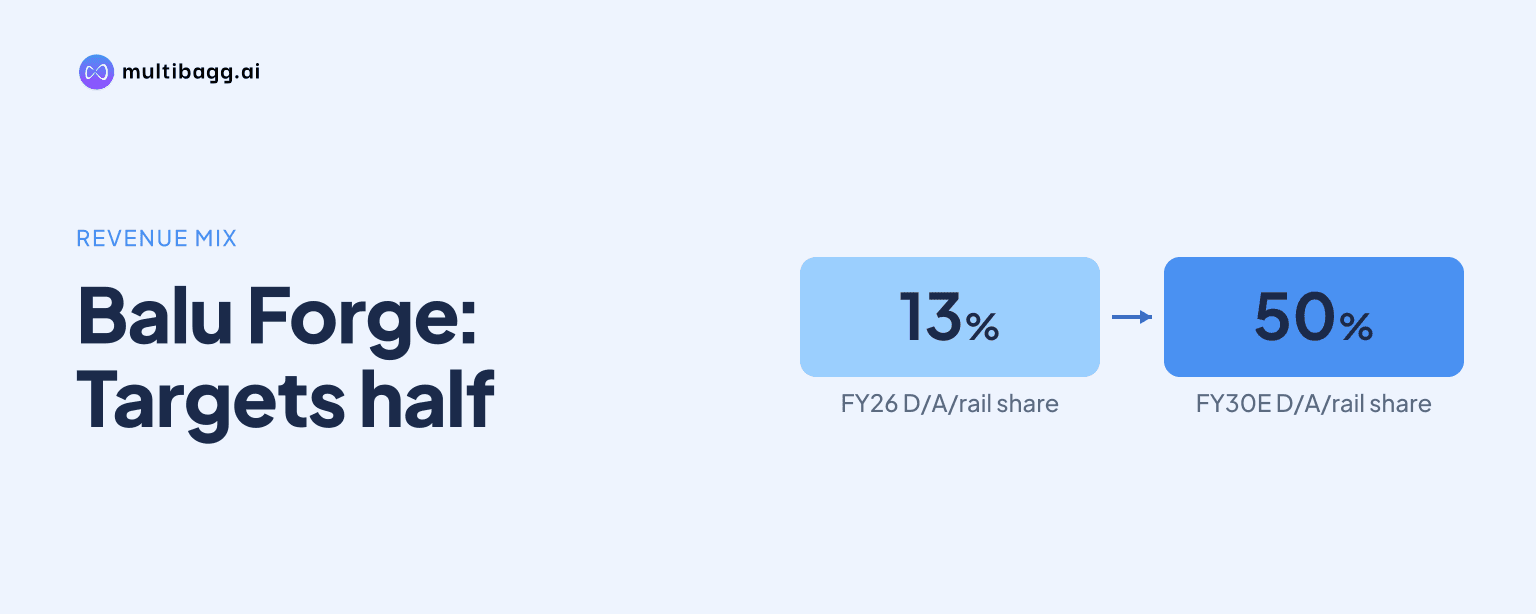
Balu Forge reported a Rs 2,400 crore total order book on September 30, 2026, but did not disclose that defence, aerospace and rail accounted for 50% of it; the 50% figure is management’s FY30E revenue-share target. The presentation instead records these sectors at 13% of FY26 revenue.
Know Balu Forge Industries inside out
Results, valuation, peers and who's buying, in one view.
What does Balu Forge disclose about its Rs 2,400 crore order book?
Balu Forge discloses a total order book of Rs 2,400 crore as of September 30, 2026, without publishing a numerical split between agriculture, defence, aerospace, railways or other sectors. Therefore, the presentation does not support a conclusion that defence, aerospace and railways already make up 50% of the backlog. The 50% number appears in a revenue-mix table as an FY30E estimate rather than as an order-book statistic.
The distinction matters because the disclosed programmes have different order stages and delivery profiles. A five-year memorandum of understanding, or MoU, for 155 mm M107 and 152 mm large-calibre ammunition has partial dispatches under way, while a 30,000-unit order for 152 mm artillery shells has been supplied since June 2026. Other programmes are a 10,000-unit 155 mm ERFB BB/BT shell pilot batch, a 15,000-unit 105 mm shell order, and an aerospace order covering 22 stock-keeping units, or SKUs.
The order-book disclosure follows a period of revenue expansion. Revenue rose from Rs 327 crore in FY23 to Rs 1,107 crore in FY26, while gross margin increased from 31% to 36%. In H1FY27, revenue was Rs 625 crore and gross margin remained 36%, giving context for the company’s effort to increase activity in applications it identifies as higher value.
How is Balu Forge shifting revenue mix toward defence?
Balu Forge’s disclosed strategy is to lift defence, aerospace and railways from 13% of FY26 revenue to 50% of revenue by FY30E. The comparable share was 5% in FY24 and 9% in FY25, showing that this group gained 8 percentage points in the two fiscal years through FY26. The presentation frames this as a move beyond agriculture rather than a disclosed sector allocation of the Rs 2,400 crore order book.
The economic rationale presented is a difference in realisation per kilogram. Agriculture components below one metre are shown at about Rs 245 to Rs 250 per kg, compared with about Rs 475 to Rs 525 per kg for heavy industrial and large commercial-vehicle components. Defence is shown at about Rs 600 to Rs 650 per kg, or roughly Rs 350 to Rs 405 per kg above the agriculture range.
Balu Forge describes the operational route as progressing from forging through precision machining and complex geometries to critical components and higher-value applications. Its Hattaraj plant support infrastructure includes chemical, mechanical and microstructure testing aligned with ASTM and ISO standards, as well as a continuous pusher-type heat-treatment facility with hardening and tempering lines. The company is pursuing National Accreditation Board for Testing and Calibration Laboratories, or NABL, accreditation for its laboratory.
Got a follow-up? Ask IRIS
Which defence and aerospace programmes are in supply?
Balu Forge says supplies for the 30,000-unit 152 mm artillery-shell programme began in June 2026, and volumes are expected to scale beyond 100,000 units. This order is from a major Indian energetics company. Separately, the company reports a 15,000-unit 105 mm shell order from a major Indian defence factory, adding another disclosed ammunition platform to the pipeline.
For the five-year ammunition MoU with a NATO-affiliated entity, the stated monthly scope is more than 30,000 units of 155 mm M107 ammunition plus 10,000 units of 152 mm ammunition. Partial dispatches have commenced, and Balu Forge says contracted volumes exceed current capacity. The statement identifies the constraint as manufacturing capacity, but does not give the contract’s value or quantify its contribution to the Rs 2,400 crore order book.
The 155 mm ERFB BB/BT programme is described as a 10,000-unit pilot batch followed by monthly deliveries. In aerospace, Balu Forge has received its maiden order for 22 SKUs, with two SKUs already in supply and prototyping. Management sees up to Rs 250 crore of aerospace opportunity over three years, but this is a management view of potential rather than a reported order value.
The presentation places these programmes against India’s FY2025-26 defence-production figure of Rs 1.78 lakh crore, stated to be 15.6% higher year on year. It also cites defence exports of Rs 38,424 crore, up 62.66%, and private-sector production share of 24%, or about Rs 42,000 crore. These figures describe the market setting, not Balu Forge’s booked revenue or backlog by segment.
Can Balu Forge expand capacity to cover contracted volumes?
Balu Forge plans to increase forging capacity from 50,000 metric tonnes per annum, or MTPA, in FY26 to 168,000 MTPA in FY27E, 200,000 MTPA in FY28E and 220,000 MTPA in FY29E. Machining capacity, including shell capacity, is planned to rise from 45,000 MTPA in FY26 to 120,000 MTPA in FY29E. These plans are relevant because the company says the contracted volumes under its five-year ammunition MoU exceed current capacity.
Empty-shell capacity is planned at 360,000 units annually across FY26 to FY27E, increasing to 480,000 units in FY28E and 600,000 units in FY29E. The presentation links the expansion to completion of the Hattargi campus and characterises the resulting change as a tripling of forging capacity and an approximately 1.7-times increase in empty-shell capacity.
The company’s reported profitability data show earnings before interest, tax, depreciation and amortisation, or EBITDA, margin rose from 15% in FY23 to 27% in FY25 and FY26, then 29% in H1FY27. Return on capital employed, or ROCE, declined from 25% in FY25 to 20% in FY26 and H1FY27, while return on equity, or ROE, moved from 30% in FY25 to 17% in H1FY27. Balu Forge attributes the changes to its equity and debt base.
Conclusion
Balu Forge has disclosed a growing set of ammunition and aerospace programmes, a Rs 2,400 crore order book, and a planned shift in defence, aerospace and railways from 13% of FY26 revenue to 50% by FY30E. Yet the presentation does not provide the sector composition of the September 2026 backlog, so it does not establish that these sectors constitute 50% of current orders.
The next disclosed milestones are supply scaling beyond 100,000 units for the 152 mm artillery-shell programme, monthly deliveries after the 10,000-unit 155 mm pilot batch, and capacity increases through FY29E. Investors will also need to watch whether the two aerospace SKUs in supply and prototyping develop toward management’s stated potential of up to Rs 250 crore over three years.