










Balu Forge targets 220,000-tonne forging capacity by FY29E
Key highlights
- Balu Forge targets 220,000 tonnes of forging capacity in FY29E, compared with 50,000 tonnes in FY26.
- Balu Forge plans to increase empty-shell capacity from 360,000 units in FY26-FY27E to 600,000 units annually in FY29E.
- A five-year ammunition memorandum covers 40,000 units per month across 155 millimetre and 152 millimetre products.
- Balu Forge’s acquired ring-rolling line has a 6.7-metre maximum outside diameter and an 18,000-kilogram maximum ring weight.
powered by IRIS
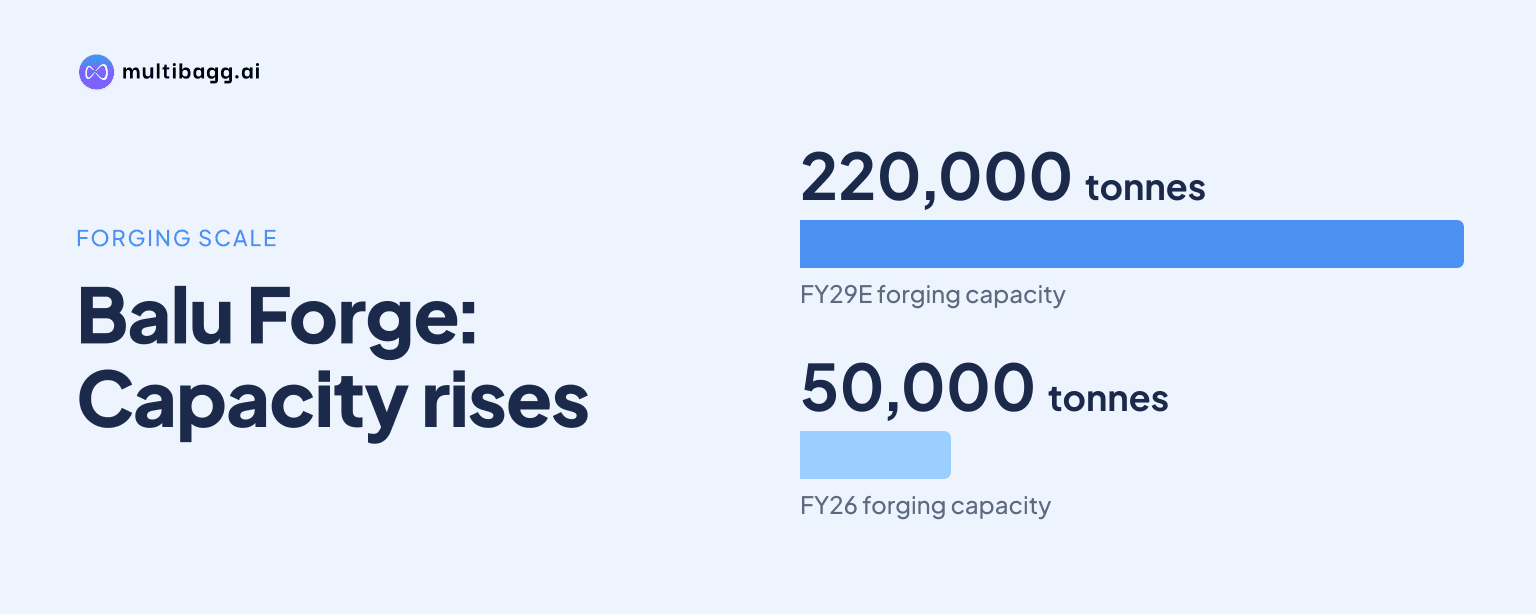
Balu Forge targets commercialised forging capacity of 220,000 tonnes by FY29E, up from 50,000 tonnes in FY26, while empty-shell capacity is planned to reach 600,000 units annually from 360,000 units in FY26-FY27E. The roadmap is tied to completion of the Hattargi campus, while trials of its acquired 6.7-metre ring-rolling line are due before end-2026.
Know Balu Forge Industries inside out
Results, valuation, peers and who's buying, in one view.
What capacity does Balu Forge target by FY29E?
Balu Forge targets 220,000 tonnes of forging capacity, 120,000 tonnes of machining capacity including shell capacity, and 600,000 empty shells annually in FY29E. Compared with FY26, the plan adds 170,000 tonnes of forging capacity and 75,000 tonnes of machining capacity. The presentation identifies these as commercialised capacity targets, not reported production volumes.
The forging roadmap rises from 50,000 tonnes in FY26 to 168,000 tonnes in FY27E, 200,000 tonnes in FY28E and 220,000 tonnes in FY29E. Machining capacity follows a different path, increasing from 45,000 tonnes in FY26 to 65,000 tonnes in FY27E, 80,000 tonnes in FY28E and 120,000 tonnes in FY29E. The largest planned forging increase is the 118,000-tonne change between FY26 and FY27E.
Empty-shell capacity is measured separately in annual units rather than tonnes. It remains at 360,000 units in FY26-FY27E, rises to 480,000 units in FY28E and reaches 600,000 units in FY29E. That is an increase of 240,000 units, or about 1.7 times the FY26-FY27E level, as the Hattargi campus is completed.
How does Balu Forge’s capacity mix change from FY26?
Balu Forge plans a faster initial increase in forging than in machining capacity. Forging capacity is scheduled to more than triple from 50,000 tonnes in FY26 to 168,000 tonnes in FY27E, while machining capacity including shells rises from 45,000 tonnes to 65,000 tonnes. By FY29E, planned forging capacity of 220,000 tonnes exceeds planned machining capacity of 120,000 tonnes by 100,000 tonnes.
The source includes shell capacity within machining but separately states empty-shell capacity in units. In FY29E, Balu Forge plans 120,000 tonnes of machining capacity including shells and capacity for 600,000 empty shells per year. It does not disclose utilisation rates, capital expenditure, product allocation within machining capacity, or commissioning dates for individual lines.
The two shell-related measures also have different timing. Empty-shell capacity stays at 360,000 units in FY26-FY27E even as machining capacity rises by 20,000 tonnes to 65,000 tonnes in FY27E. From FY28E to FY29E, machining capacity adds 40,000 tonnes and empty-shell capacity adds 120,000 units, indicating that the disclosed manufacturing plan covers products beyond shell volumes.
Got a follow-up? Ask IRIS
What disclosed demand supports Balu Forge’s shell expansion?
Balu Forge has disclosed ammunition programmes that include volumes exceeding current capacity in one programme. Its five-year memorandum of understanding with a NATO-affiliated entity covers 30,000 155 millimetre M107 units and 10,000 152 millimetre units per month, and the presentation says partial dispatches have commenced. It also states that contracted volumes exceed current capacity.
A separate 152 millimetre artillery-shell programme with a major Indian energetics company covers 30,000 units, with supplies scheduled from June 2026 and volumes expected to scale beyond 100,000 units. Other disclosed programmes include a 10,000-unit pilot batch of 155 millimetre ERFB BB/BT shells followed by monthly deliveries, and an order for 15,000 105 millimetre shells from a major Indian defence factory.
The presentation also lists a maiden aerospace order for 22 stock-keeping units, with two units in supply and prototyping. Management sees potential for up to Rs 250 crore from aerospace over three years, but this is management’s view rather than a contracted value disclosed in the programme table. The ammunition programmes relate directly to the planned rise from 360,000 to 600,000 empty shells annually.
How does the ring-rolling acquisition fit Balu Forge’s expansion?
Balu Forge has acquired a ring-rolling line with a maximum outside diameter of 6.7 metres and a maximum ring weight of 18,000 kilograms, with trials planned before the end of 2026. The presentation describes the line as one of India’s largest ring-rolling capabilities. It does not assign separate capacity in tonnes to this asset within the FY26-to-FY29E forging and machining roadmap.
The company identifies wind, aerospace and defence, space, nuclear and power, oil and gas, heavy mining, marine and rail as potential end-markets for the line. It also identifies space- and nuclear-grade components, offshore wind and defence as possible future opportunities. The source does not disclose acquisition consideration, utilisation, customer contracts, expected revenue or a date for commercial commissioning beyond the planned trials.
Balu Forge says ultra-large ring rolling is capital-intensive and technically demanding, and presents the equipment as an import-substitution opportunity for ultra-large forgings. Those are strategic statements by the company rather than quantified financial projections. The measurable specifications disclosed are the 6.7-metre maximum diameter and 18,000-kilogram maximum ring weight.
Conclusion
Balu Forge’s FY29E roadmap combines a rise in forging capacity from 50,000 tonnes to 220,000 tonnes with an increase in machining capacity including shells from 45,000 tonnes to 120,000 tonnes. Empty-shell capacity is planned to rise from 360,000 units in FY26-FY27E to 600,000 units annually, alongside disclosed artillery programmes whose volumes include one contract exceeding current capacity.
The next disclosed milestones are completion of the Hattargi campus underlying the FY29E plan and trials of the 6.7-metre ring-rolling line before end-2026. Investors can also watch whether 152 millimetre shell supplies scheduled from June 2026 scale beyond 100,000 units and whether forging capacity reaches the stated 168,000 tonnes in FY27E.