










Balu Forge H1 Revenue Gains 17.3% as Q2 Margin Hits 28.9%
Key highlights
- Balu Forge reported H1FY27 revenue of Rs 625.1 crore, up 17.3% year on year.
- Balu Forge’s Q2FY27 EBITDA margin increased 130 bps year on year to 28.9%.
- Balu Forge’s Q2FY27 PAT rose 17.8% year on year to Rs 76.6 crore.
- Defence, aerospace and railway work represented 50% of Balu Forge’s Rs 2,400 crore H1FY27 order book.
powered by IRIS
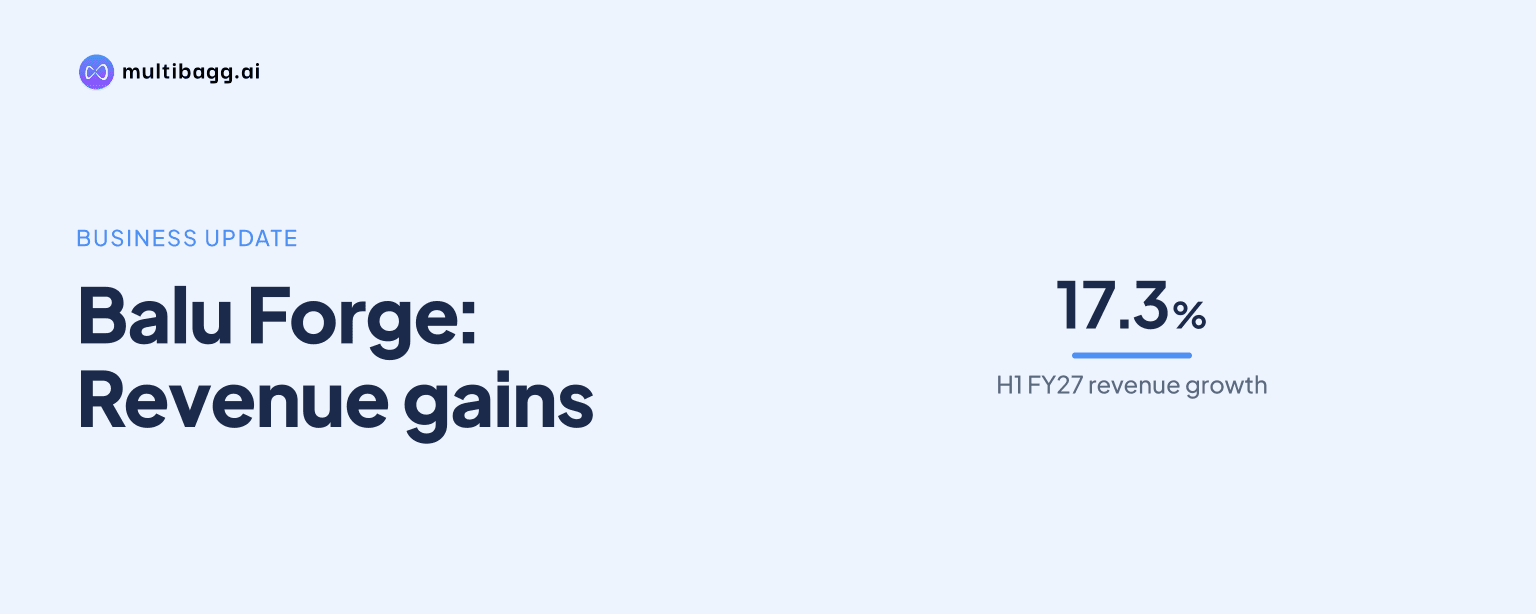
Balu Forge Industries Ltd reported H1FY27 revenue from operations of Rs 625.1 crore, up 17.3% year on year, while Q2FY27 EBITDA margin reached 28.9%, up 130 basis points. Balu Forge’s Q2FY27 profit after tax rose 17.8% to Rs 76.6 crore, exceeding the quarter’s 8.3% revenue growth.
Know Balu Forge Industries inside out
Results, valuation, peers and who's buying, in one view.
How did Balu Forge perform in Q2FY27?
Balu Forge reported Q2FY27 revenue from operations of Rs 324.3 crore, up 8.3% from Rs 299.5 crore in Q2FY26 and 7.9% from Rs 300.7 crore in Q1FY27. Earnings before interest, tax, depreciation and amortisation, or EBITDA, excluding other income rose 13.1% year on year to Rs 93.7 crore. EBITDA was also 10.5% higher than Rs 84.8 crore in Q1FY27.
Q2FY27 EBITDA margin was 28.9%, compared with 27.6% in Q2FY26 and 28.2% in Q1FY27. The year-on-year increase was 130 basis points, or bps, while the sequential increase was 70 bps. Total expenses rose 6.5% year on year to Rs 230.7 crore, below the 8.3% rise in revenue from operations during the quarter.
Profit before tax increased 13.4% year on year to Rs 90.6 crore in Q2FY27 from Rs 79.9 crore. Profit after tax, or PAT, rose to Rs 76.6 crore from Rs 65 crore, lifting PAT margin by 190 bps to 23.6% from 21.7%. Basic earnings per share were Rs 6.59, compared with Rs 6.08 in Q2FY26 and Rs 5.49 in Q1FY27.
Costs below EBITDA increased during the quarter. Finance cost rose 34.9% year on year to Rs 5.4 crore, while depreciation and amortisation increased 65.9% to Rs 3.6 crore. Other income rose to Rs 5.9 crore from Rs 3.3 crore, although Balu Forge’s reported EBITDA measure excludes other income.
What did Balu Forge report for H1FY27?
Balu Forge reported H1FY27 revenue from operations of Rs 625.1 crore, an increase of 17.3% from Rs 532.7 crore in H1FY26. EBITDA increased 15.1% to Rs 178.5 crore from Rs 155.1 crore, while PAT rose 16.9% to Rs 142.7 crore from Rs 122.1 crore. Total income, including other income, reached Rs 634.9 crore, up 18.1% from Rs 537.7 crore.
The first-half margin comparison differed from the Q2 trend. H1FY27 EBITDA margin was 28.6%, 50 bps below 29.1% in H1FY26, despite the 130 bps year-on-year expansion reported in Q2FY27. H1FY27 PAT margin was 22.8%, versus 22.9% in H1FY26, a reduction of 10 bps.
H1FY27 total expenses rose 18.3% year on year to Rs 446.6 crore, marginally faster than the 17.3% rise in revenue from operations. Finance cost rose 60.2% to Rs 10 crore and depreciation and amortisation increased 79.4% to Rs 6.9 crore. Profit before tax nevertheless increased 14.3% to Rs 171.3 crore, while basic earnings per share rose to Rs 12.08 from Rs 10.76.
The reported period comparison shows a faster revenue increase in the first half than in Q2 alone. Revenue grew 17.3% in H1FY27 but 8.3% in Q2FY27, while EBITDA grew 15.1% in the half year and 13.1% in the quarter. Q2FY27 margins, however, were above both Q1FY27 and Q2FY26 levels.
Got a follow-up? Ask IRIS
How has Balu Forge’s end-market mix changed?
Balu Forge increased the revenue share of defence, aerospace and railway customers to 15% in H1FY27 from 10% in H1FY26. Agriculture’s share declined to 30% from 38%, while commercial vehicles increased to 20% from 19%. Heavy engineering and industrial machinery rose to 19% from 18%, oil and gas increased to 6% from 5%, and power generation remained at 10%.
The order book is more concentrated in defence, aerospace and railway work than the H1FY27 revenue mix. Those three sectors represented 50% of Balu Forge’s Rs 2,400 crore H1FY27 order book, compared with 15% of first-half revenue. Commercial vehicles accounted for 19% of the order book, followed by oil and gas at 11%, agriculture at 10%, heavy engineering and industrial machinery at 7%, and power generation at 3%.
Balu Forge disclosed a first purchase order for 10,000 units of 155mm ERFB BB/BT ammunition, with monthly supplies planned after the pilot supply. The company also said that its 155mm ERFB products had quality approval at forging total indicated runout of 3 mm and machined wall tolerance of 0.3 mm. Multiple dispatches of 152mm empty shells were made against an order disclosed earlier.
The presentation also reported approvals and new orders for 105mm empty shells from two Indian Ordnance factories, with dispatches planned shortly. In aerospace, Balu Forge said jet-engine components had been approved against the tightest tolerance, while a wider aerospace portfolio was under development. It also reported a long-term supply contract with Brazil’s largest engine manufacturer.
What capacity and funding plans does Balu Forge disclose?
Balu Forge plans to begin production trials on its ring rolling line before the end of December 2026. The line is designed for rings up to 6.7 metres in outer diameter and single products weighing up to 18 metric tonnes. The presentation identifies wind, aerospace and defence, nuclear, oil and gas, marine and railway as potential end markets.
Balu Forge states that its forging capacity exceeds 100,000 metric tonnes per annum and will increase to 168,000 metric tonnes per annum. Its manufacturing footprint comprises four units, including three in Karnataka and one in the United Arab Emirates, across 54 acres. The company also identifies 7-axis and 11-axis computer numerical control machining and automated forging lines as part of its manufacturing platform.
Balu Forge says Rs 300 crore of foreign currency convertible bond proceeds is intended for capital expenditure, including heavy forging lines, ring rolling, a hydraulic press and additional defence-ammunition capacity. A further Rs 150 crore is identified for retirement of Indian working-capital limits. The company says this could save about 200 to 250 bps of interest cost after hedging.
The proposed preferential warrant issue covers 30 lakh warrants at a floor price of Rs 540 each, with an indicative value of Rs 162 crore. The proposed utilisation of the warrant proceeds is 40% for capital expenditure, 30% for working capital and 30% for general corporate purposes. The proposed allottees are promoter-group members Trimaan Chandock and Jaikaran Chandock, with 15 lakh warrants each.
Conclusion
Balu Forge reported 17.3% H1FY27 revenue growth to Rs 625.1 crore and 16.9% PAT growth to Rs 142.7 crore. The more pronounced quarterly profitability movement was in Q2FY27, when EBITDA rose 13.1% to Rs 93.7 crore, PAT increased 17.8% to Rs 76.6 crore, and EBITDA margin reached 28.9%. Revenue mix also shifted, with defence, aerospace and railway revenue share rising by 5 percentage points to 15%.
The next disclosed operational milestone is the ring rolling line’s production trial before the end of December 2026. Readers can watch whether defence, aerospace and railway work, which represents 50% of the Rs 2,400 crore order book, converts into revenue, and whether the planned Rs 300 crore capital expenditure and Rs 150 crore working-capital-limit retirement affect capacity, finance cost and margins.