










Balu Forge Industries Ltd Reports 29% Q1 FY27 Revenue Growth
Key highlights
- Balu Forge reported Q1 FY27 revenue from operations of Rs 3,007 million, up 29.0% year-on-year.
- Q1 FY27 EBITDA was Rs 848 million, up 17.3% year-on-year, with a 28.2% margin.
- Q1 FY27 profit after tax rose 15.9% year-on-year to Rs 661 million.
- Balu Forge reported FY26 revenue from operations of Rs 11,074 million.
powered by IRIS
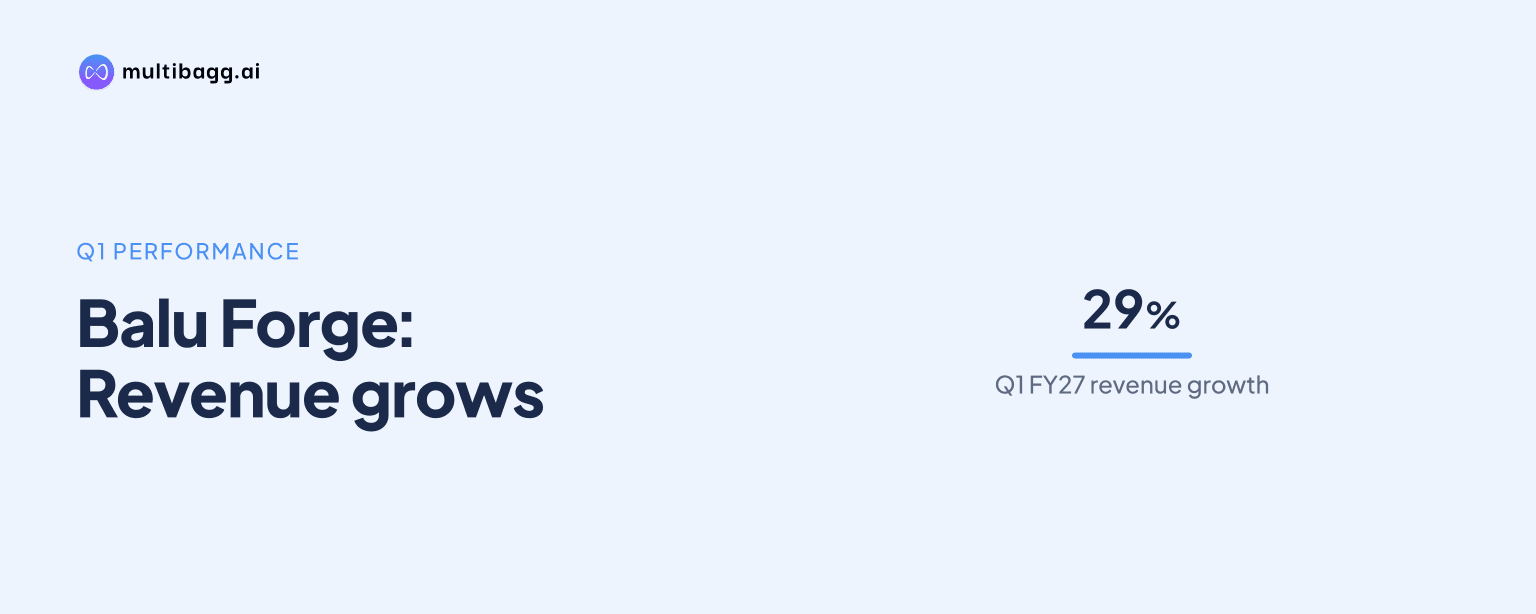
Balu Forge Industries Ltd reported 29.0% year-on-year revenue growth in Q1 FY27, with revenue from operations of Rs 3,007 million, according to its August 12, 2026 earnings presentation. EBITDA rose 17.3% to Rs 848 million and profit after tax increased 15.9% to Rs 661 million during the quarter ended June 30, 2026.
Know Balu Forge Industries inside out
Results, valuation, peers and who's buying, in one view.
What did Balu Forge report for Q1 FY27?
Balu Forge reported revenue from operations of Rs 3,007 million for Q1 FY27, representing 29.0% growth from the corresponding quarter of the previous year. The company disclosed the quarterly results through an earnings presentation submitted on August 12, 2026 for the quarter ended June 30, 2026.
The company said the quarter reflected continued scaling across high-value and technology-intensive engineering segments. Its operations span precision-machined and forged components supplied to automotive, industrial machinery, power generation, defence and railway end-markets. The presentation also referred to developments in aerospace, defence and precision heavy engineering during the period.
Balu Forge was incorporated in 1989 and makes fully finished and semi-finished crankshafts and forged components. It has stated that its products can conform to new emission regulations and new-energy vehicle requirements. The company supplies precision-engineered components to 25 global original equipment manufacturers across 80 countries, according to its investor materials.
How profitable was Balu Forge in the June 2026 quarter?
Balu Forge recorded EBITDA of Rs 848 million in Q1 FY27, up 17.3% year-on-year, with an EBITDA margin of 28.2%. Profit after tax stood at Rs 661 million, an increase of 15.9% from a year earlier.
The difference between revenue growth and profit growth resulted in the reported EBITDA margin of 28.2%, while the presentation did not provide a separate Q1 FY27 PAT margin. Management described the performance as being accompanied by progress in higher-value engineering applications, rather than disclosing a quantified contribution from each business segment.
The company had reported EBITDA and PAT margins of 27.0% and 22.7%, respectively, for FY26. This places the Q1 FY27 EBITDA margin above the full-year FY26 EBITDA margin, although one quarter alone does not establish a full-year trend.
How does the quarter compare with Balu Forge's recent performance?
Balu Forge's Q1 FY27 revenue of Rs 3,007 million followed FY26 revenue from operations of Rs 11,074 million. The company had reported FY26 EBITDA and PAT margins of 27.0% and 22.7%, respectively.
In Q2 FY26, Balu Forge had posted revenue from operations of Rs 2,995 million, up 34.4% year-on-year, EBITDA of Rs 828 million and PAT of Rs 650 million. For H1 FY26, revenue was Rs 5,327 million, up 33.8% year-on-year, while EBITDA was Rs 1,551 million and PAT was Rs 1,261 million.
For FY25, the company reported revenue from operations of Rs 9,236 million, EBITDA margin of 27.2% and PAT margin of 21.7%. The available figures show that the business has continued to report growth while maintaining margins in the high-20% range at the EBITDA level.
Got a follow-up? Ask IRIS
Why do aerospace and defence developments matter for Balu Forge?
Aerospace, defence and precision heavy engineering matter because Balu Forge has identified them as areas where it is extending its value chain into higher-value engineering applications. The company already serves a broad mix of industries, including automobiles, agriculture, power generation, oil and gas, railways and marine-related applications.
Its investor presentations have also highlighted integrated manufacturing and capacity expansion as part of its strategy to support global OEMs. The company operates from Karnataka, with facilities listed in Kakti Industrial Area, Belgaum, and Hattargi village in Hukkeri taluk. Its historical manufacturing capability included annual capacity to produce 360,000 crankshafts, according to a May 2023 presentation.
For investors, the reported June-quarter figures indicate that Balu Forge's revenue expansion continued alongside positive EBITDA and PAT growth. However, the presentation does not quantify revenue from aerospace, defence or other individual end-markets, so the financial contribution of these developments cannot be calculated from the disclosed information.
How could the update affect investors and industry participants?
The Q1 FY27 update provides investors with current revenue, profitability and margin data for Balu Forge's engineering operations. Revenue growth of 29.0% and an EBITDA margin of 28.2% are the central reported indicators, while the company’s FY26 revenue base was Rs 11,074 million.
Customers and OEMs are relevant to the update because Balu Forge supplies components across several industrial applications and reports a presence in 80 countries. The company’s focus on emission-compliant and new-energy vehicle components also links its manufacturing platform to changing vehicle and industrial equipment requirements.
No share-price movement, order-book figure, capital-expenditure amount or revised financial guidance was disclosed in the material provided. As a result, the presentation supports an assessment of reported operating performance but does not provide enough detail to determine the near-term financial impact of each expansion initiative.
Conclusion
Balu Forge delivered Q1 FY27 revenue of Rs 3,007 million, up 29.0% year-on-year, while EBITDA reached Rs 848 million and PAT was Rs 661 million. The quarter continued the company’s recent pattern of revenue growth with EBITDA margins around its FY26 level, supported by its precision-machining and forging operations across multiple end-markets.
The next disclosures to watch are the company’s subsequent quarterly results and any quantified updates on aerospace, defence and precision heavy-engineering activity. Investors may also monitor whether Balu Forge provides segment-level revenue details, order inflows, capacity-expansion costs or updated guidance in future investor presentations.